.webp)

Cities in Australia store more heat for longer periods due to surfaces absorbing and reflecting heat. This increases health risks and costs, especially during heatwaves and for vulnerable groups. The most effective fixes combine smart urban design and green infrastructure. This includes green roofs, which help lower roof surface temperatures in dense areas with limited ground-level space.
If you've ever noticed that cities can feel noticeably hotter than the countryside just a few kilometres away, you're not imagining it.
Many Australian cities run 1-3 degrees warmer on average than surrounding rural areas. This issue is known as the urban heat island (UHI) effect.
On scorching days, the difference becomes even more dramatic. Roads, car parks, and rooftops can sit 10–20°C hotter than the air around them, radiating heat well into the evening.
Urban heat influences health, power bills, productivity, and the long-term liveability of our suburbs.
The good news: Australian cities are already deploying solutions that have the power to help.
What creates urban heat islands in Australia?
Urban heat islands form when natural landscapes are replaced with built surfaces. These surfaces absorb, store, and re-release heat.
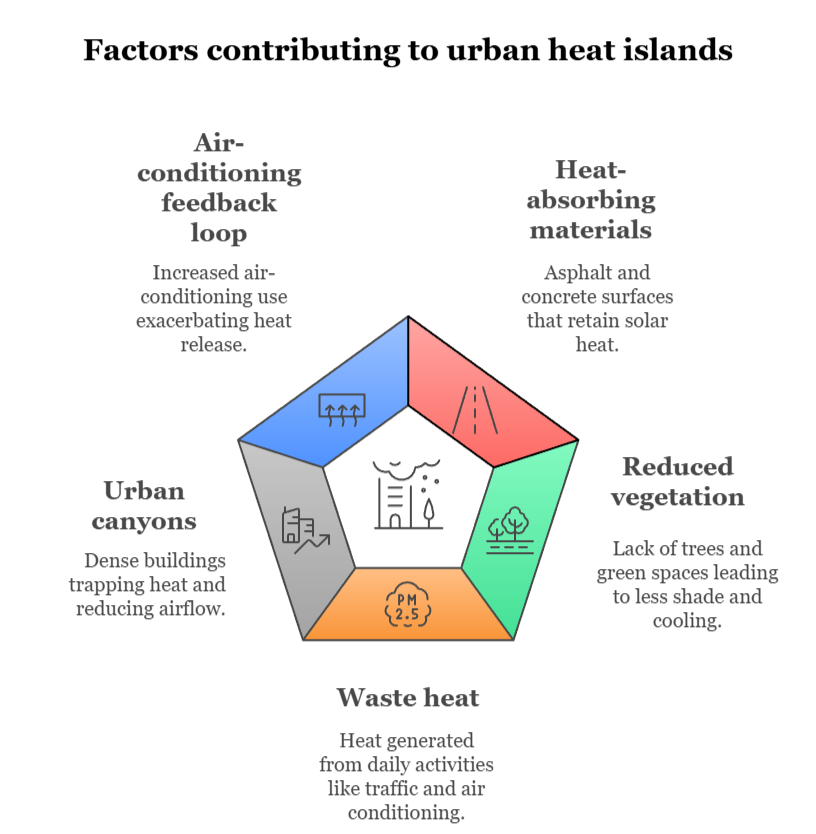
In Australian conditions, several factors tend to stack together:
- Heat-absorbing materials: Asphalt, concrete, and darker roofs soak up solar radiation and hold it for hours.
- Reduced vegetation and tree canopy: Fewer trees means less shade and less cooling from evapotranspiration.
- Waste heat from daily activity: Air conditioning, traffic, and industry all dump heat into the outdoor environment.
- Urban "canyons:" Dense streets lined with taller buildings can trap heat and reduce airflow.
- The air-conditioning feedback loop: Hotter streets drive more air-conditioning use, which pushes more hot air outside.
Where the heat hits hardest in Australia
While urban heat islands show up nationwide, some areas face much more severe exposure. Factors that contribute include development patterns, canopy loss, and geography.
Here are some urban heat island examples:
Western Sydney
Western Sydney is often cited as one of Australia's most heat-vulnerable regions. Extreme heat is frequent and intense in dense suburban areas. This is especially the case in growth corridors, where you'll find a lot of dark roofs and wide asphalt surfaces.
Melbourne's outer west
Melbourne's outer west is another urban heat island example. This is the case because of low tree cover and growing urban development. If nothing changes, heat impacts during heatwaves are only going to intensify.
Not just "hot" cities
It is easy to assume that urban heat is mainly a problem in Western Sydney or northern Australia. However, Adelaide, Hobart, Launceston, and Albury also contain notable heat hot spots. This reminds us that UHI isn't limited to traditionally hot climates.
Inner-city pockets can be high risk too
Heat vulnerability is not limited to outer suburbs or low-income areas. Some inner-city neighbourhoods also face a high risk. This is because dense buildings and hard surfaces trap heat and limit airflow.
Where these conditions overlap with a higher share of older residents, the health impacts of extreme heat can be more severe. This even applies to areas with higher average incomes.
Why it matters: health and economic impacts
Urban heat islands are not just about discomfort. They change how safe a city is during summer, how much energy we use, and how well communities cope during heatwaves.
Urban heat islands are a public health issue.
Health impacts of the UHI effect
Health risks increase when days are hot and nights stay warm. Problems escalate when the heat lasts for several days in a row.
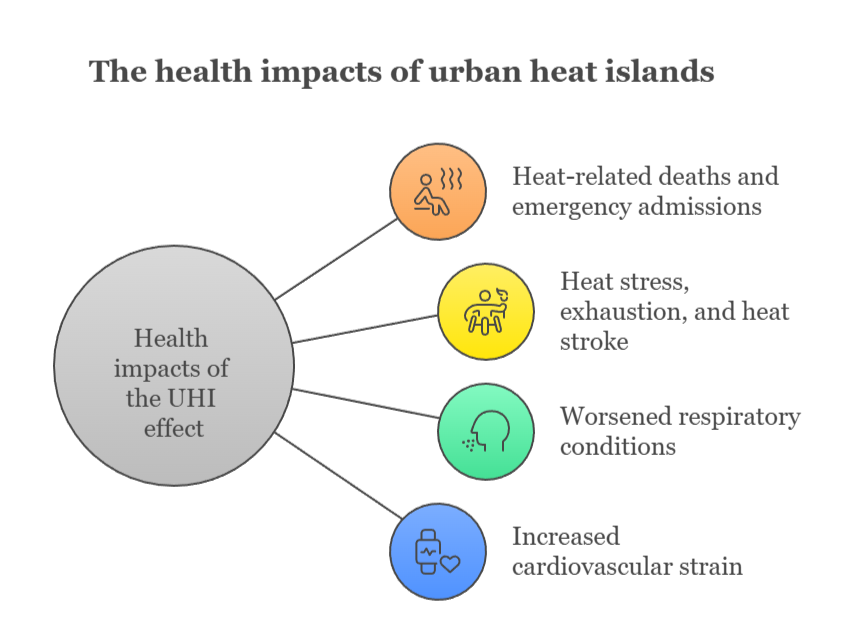
Common health impacts include:
- Higher heat-related deaths and emergency admissions
- Heat stress, exhaustion, and heat stroke
- Worsened respiratory conditions
- Increased cardiovascular strain, particularly for people with heart disease
These impacts are not evenly distributed. The same temperature can produce very different outcomes.
It depends on housing quality, access to shade, and the ability to cool down safely.
Who is most at risk?
Urban heat hits hardest where heat exposure and social vulnerability overlap. Groups at higher risk include:
- Older adults, especially those with chronic conditions
- Children
- Outdoor workers
- Low-income households, particularly where cooling is unaffordable
- People with pre-existing health conditions
Risk spikes when vulnerable groups live in areas that trap heat. These places often have low tree canopy, dark roofs, few cool public spaces, and poorly performing buildings.
The economic consequences of the UHI effect
Urban heat also carries major economic consequences for households, businesses, and governments. They include:
- Higher energy demand and peak load stress
- Rising household cooling costs
- More water use
- Productivity loss (reduced work capacity and altered operating hours)
- Increased pressure on hospitals and emergency services
What works: practical solutions Australia is already using
The strongest UHI responses combine green infrastructure, water-smart design, and cool materials.
Green infrastructure and green roofs
Green infrastructure cools cities by adding shade and natural cooling from plants. It works best when placed where people spend time.
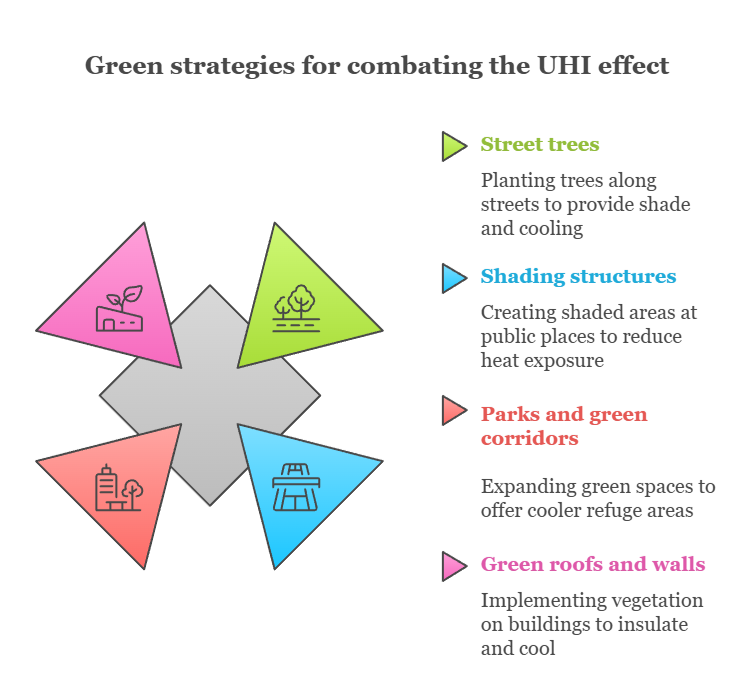
Adding more green spaces can include:
- Increasing street tree canopy along footpaths, cycling routes, and key pedestrian corridors
- Shading high-use places such as public transport stops, schools, shopping strips, and aged-care facilities
- Expanding parks and green corridors to create cooler "refuge" areas during heatwaves
- Using green roofs and green walls in dense areas with limited ground space
Green roofs can help lower roof surface temperatures and reduce the amount of heat entering buildings.
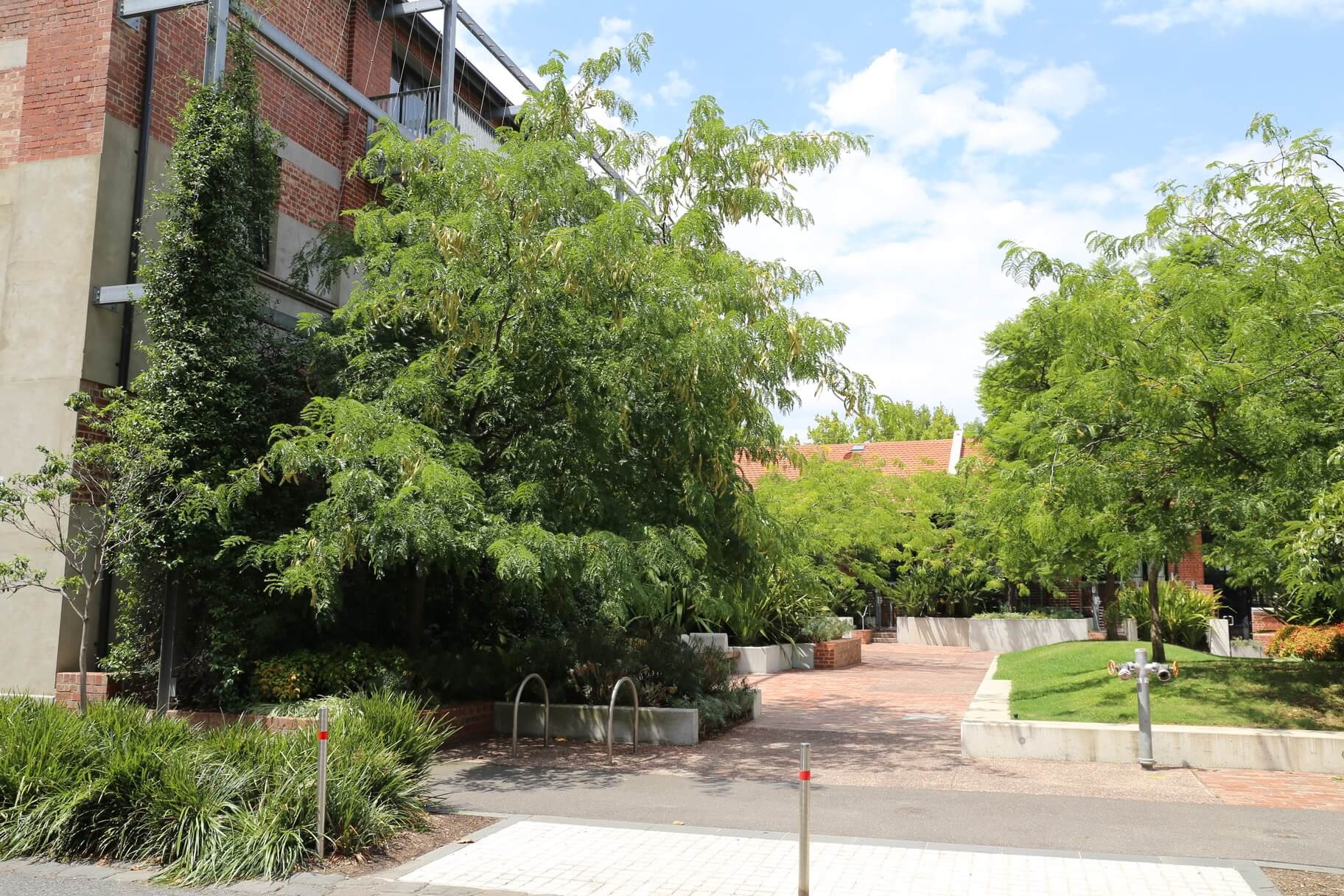
Additional plant and canopy cover help cool this roof garden, ensuring the space is an inviting location for social use.
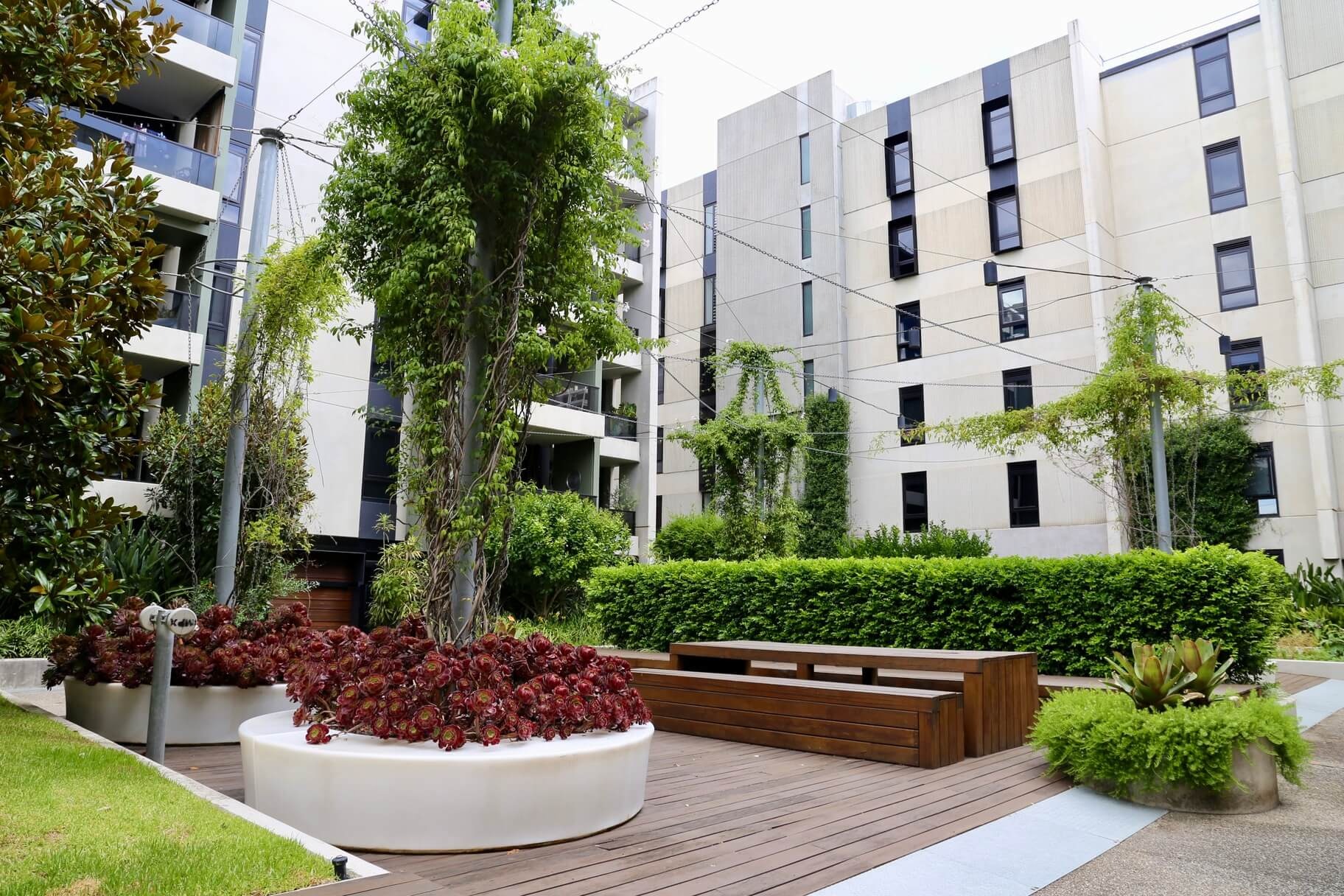
Tree coverage and this green facade make sitting or walking through this space a cooling and very inviting landscape.
Water-sensitive urban design (WSUD)
WSUD supports cooling by keeping trees and green spaces healthy during hot and dry periods.
It captures and reuses water that would otherwise run off streets and hard surfaces.
Common water-sensitive urban design elements include:
- Rain gardens and bio-filters
- Swales and infiltration zones
- Wetlands and retention basins
- Stormwater harvesting and passive irrigation
These methods deliver healthier trees, larger canopies, and stronger cooling through transpiration.
Peak temperatures at the neighbourhood scale can thus be lower, especially during heatwaves.
Cool materials: roofs, roads, and pavements
High-albedo ("cool") roofs and pavements reflect more sunlight and absorb less heat. By doing so, they lower surface temperatures and reduce heat build-up.
They are especially useful:
- In low-canopy industrial zones and logistics precincts
- Along wide arterial roads and large car parks
- In new-growth suburbs with limited mature trees
- Where planting is constrained by underground services or land availability
Urban form, ventilation, and shade
Urban heat is not only a materials problem. It is also a layout and design problem.
The way streets, buildings, and public spaces are arranged can either trap heat or help it escape.
It's important to use design moves that reduce heat and improve comfort. Examples include:
- Orienting streets to capture prevailing breezes
- Avoiding deep, narrow, poorly ventilated street canyons
- Using gradual height transitions to support airflow
- Reducing excessive solar gain with smarter massing and materials
Because trees take years to mature, built shade is an important "now" solution. It can deliver immediate cooling and protect people during extreme heat days.
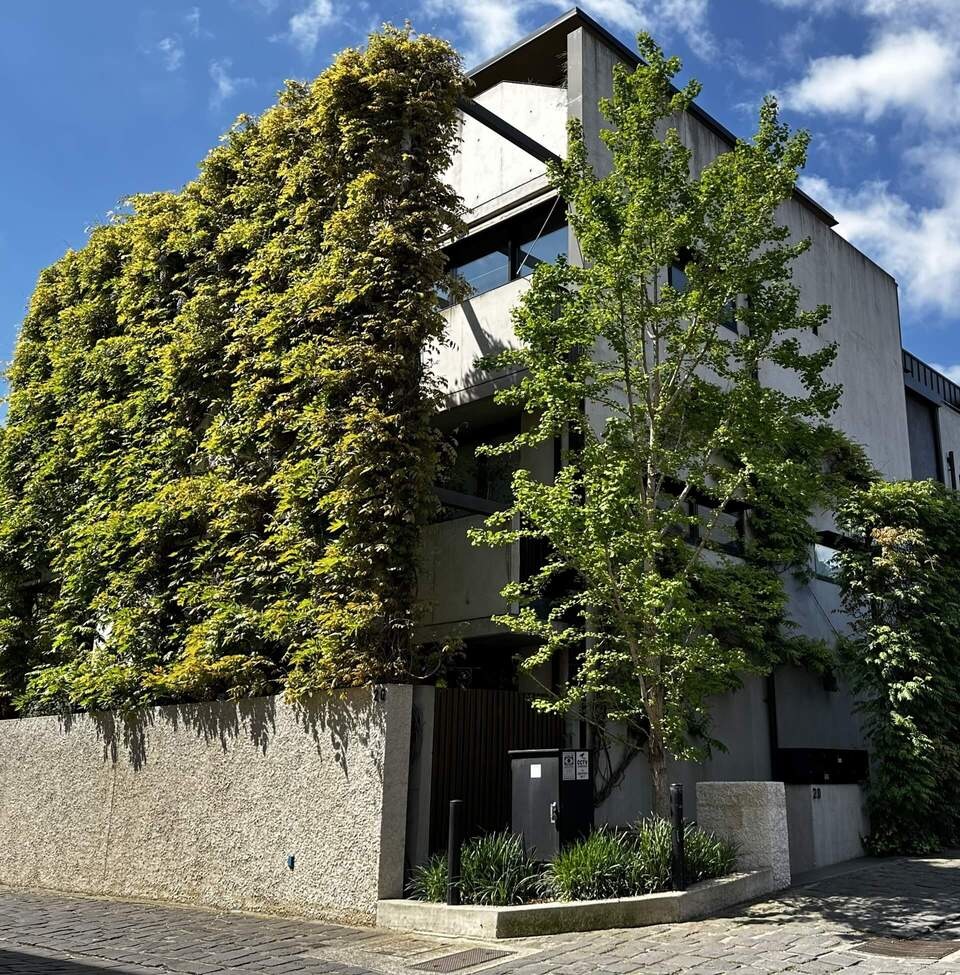
Shade structures such as this green facade and feature tree help cool down the building along with the adjacent hard surfaces.
Leading Australian initiatives tackling urban heat
Across Australia, councils, governments, and researchers are moving from planning to delivery.
They are testing practical ways to cool streets, buildings, and whole precincts. These initiatives show what works at scale.
Darwin Heat Mitigation Program
Darwin is using detailed heat mapping and modelling to understand where the city overheats. The program tests a wide range of cooling options across different neighbourhoods.
These include cool roofs and cool pavements, street shading, more urban greenery, and evaporative cooling.
The goal is to find the best mix of actions for city-wide cooling.
Victorian green–blue infrastructure strategies
Many Victorian councils are focusing on long-term greening and cooling.
They are building urban forest strategies and setting ambitious canopy targets, often around 40% tree cover over the coming decades.
These plans are linked to water-sensitive urban design (WSUD) so trees can survive and keep cooling during hot, dry summers.
Councils are combining policy targets with on-the-ground delivery. This includes planting programs and upgrades to streets and parks.
Industrial precinct heat mitigation
Industrial areas often run hotter than the surrounding suburbs.
They have large roof areas, wide paved surfaces, and extra operational heat. Precinct plans are now targeting measurable temperature reductions, sometimes around 4°C.
The approach usually combines WSUD and landscaping with cool roofs and high-albedo pavements. This includes steps to reduce waste heat from operations.
The path forward for Australian cities
Urban heat islands are already shaping how Australian cities feel, function, and cope during summer. With more heatwaves and warmer nights, health, energy, and our daily lives are at greater risk.
Evergreen Infrastructure can help you put these ideas into action, especially with green roof solutions. Green roofs can help cool buildings, improve comfort, and add usable green space in dense areas.
If you are planning a new development or upgrading an existing building, Evergreen Infrastructure can help. We can help you choose and deliver the right green roof and greening approach to support your urban heat goals.
Reach out to us to get started.
We create green oases in urban settings
We'd love to discuss how we can partner to bring innovative, sustainable solutions to your urban environment.