.webp)

Australia is already facing hotter temperatures, extreme weather, and rising sea levels. Climate change adaptation means improving how we plan, build, and manage towns and cities to stay safe. Strategies include stronger infrastructure, coastal protection, urban greening, and better health and emergency planning. Funding is spread across several programs, so councils and businesses often rely on partnerships to deliver projects successfully.
Climate change is no longer a distant threat in Australia. It's a direct cause of reshaping coastlines, intensifying heat, and increasing flood, fire, and storm risks.
A range of mitigation strategies is already underway, with cutting emissions being most essential. However, adaptation to climate change is now just as practical and urgent.
This means changing how we plan, build, and manage our surroundings so communities and economies stay safe and sustainable.
For green infrastructure providers like Evergreen Infrastructure, this is the operating environment.
Climate change adaptation is no longer a niche issue. It's now a core requirement for projects, funding, and approvals.

What is climate change adaptation?
Adaptation to climate change means adjusting to current and expected climate impacts. The aim is to reduce harm and, where possible, take advantage of opportunities.
In Australia, adaptation to climate change includes:
- Building and upgrading coastal protections where appropriate.
- Restoring dunes, wetlands, mangroves, and salt marshes to buffer waves and erosion.
- Upgrading roads, bridges, utilities, hospitals, and schools for heat, floods, and storms.
- Redesigning cities with trees, shade, and cooler materials to reduce heat stress.
- Updating land-use plans, building standards, and setbacks using climate projections.
- Strengthening health systems for heat, smoke, floods, and emerging diseases.
This concept differs from mitigation. Mitigation cuts emissions, and adaptation helps us live with the impacts that are already "locked in."
Why are climate change adaptation measures urgent in Australia
Australia is already warming. The Bureau of Meteorology and CSIRO report:
- Rising temperatures
- Increasing extreme heat
- Heavier rainfall events
- Longer and more dangerous fire weather
- Rising sea levels
These changes increase the risk to people, infrastructure, food systems, and ecosystems.
Some risks also combine. For example, coastal flooding can coincide with heavy rainfall, storm surge, and infrastructure failures. This can overwhelm emergency services and disrupt supply chains.
Australia's National Climate Risk Assessment was designed to identify nationally significant physical climate risks across major systems. This includes infrastructure, health, the economy, and the natural environment.
Australia's national adaptation framework
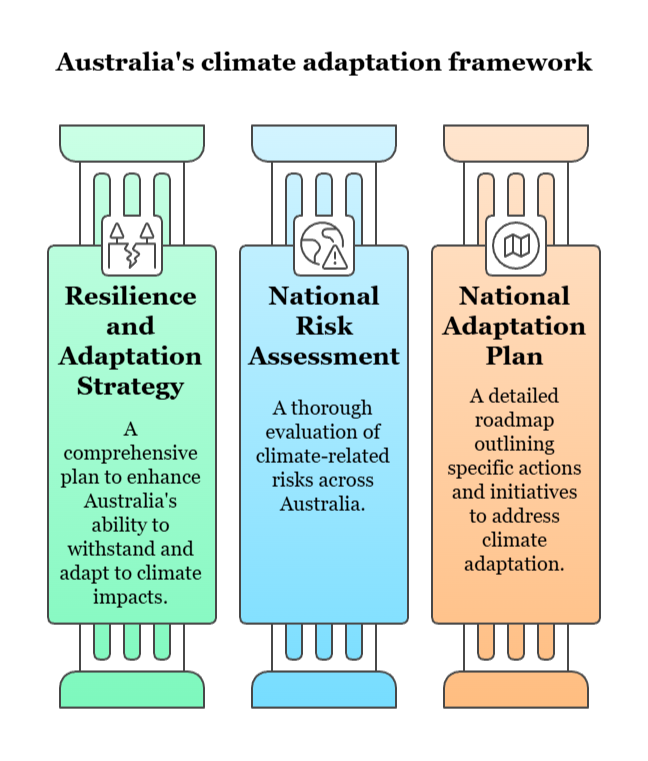
Australia's national approach has three main pillars:
- A resilience and adaptation strategy
- A national risk assessment
- A national adaptation plan
National Climate Resilience and Adaptation Strategy 2021–2025
Australia's National Climate Resilience and Adaptation Strategy (2021–2025) sets out how the country will better anticipate, manage, and adapt to climate change.
It frames adaptation as essential to future prosperity. It also notes that the impact will continue to increase for decades, even with strong global emissions cuts.
The strategy is built around a clear premise: adaptation is a shared responsibility. It's intended to support action by governments, communities, and businesses, not replace it.
It organises adaptation across four domains:
- Natural (biodiversity, natural capital, and ecosystem services)
- Built (assets, infrastructure, and the places we construct)
- Social (community wellbeing, services, and resilience)
- Economic (industry, jobs, and productivity under changing conditions)
National Climate Risk Assessment
Australia's first National Climate Risk Assessment (NCRA) is designed to build a nationally consistent picture of the most significant climate risks this century.
It looks at how people, infrastructure, the economy, and the environment are exposed and vulnerable.
A key message is that hazards are not isolated. The NCRA highlights compounding and cascading hazards, which are expected to increase.
This matters because it can create simultaneous pressure on:
- Emergency response
- Critical infrastructure
- Health systems
- Supply chains
The assessment is delivered through the Australian Climate Service, drawing on expertise from:
- The Bureau of Meteorology
- CSIRO
- The Australian Bureau of Statistics
- Geoscience Australia
It's intended to be usable at multiple scales. The goal is to support decisions by governments, communities, and businesses, including at national, regional, and local levels.
National Adaptation Plan
Australia's National Adaptation Plan (NAP) is a national framework for adapting to nationally significant physical climate risks.
It defines nationally significant risks as those with severe, widespread, and long-lasting impacts. These risks also need a coordinated national response.
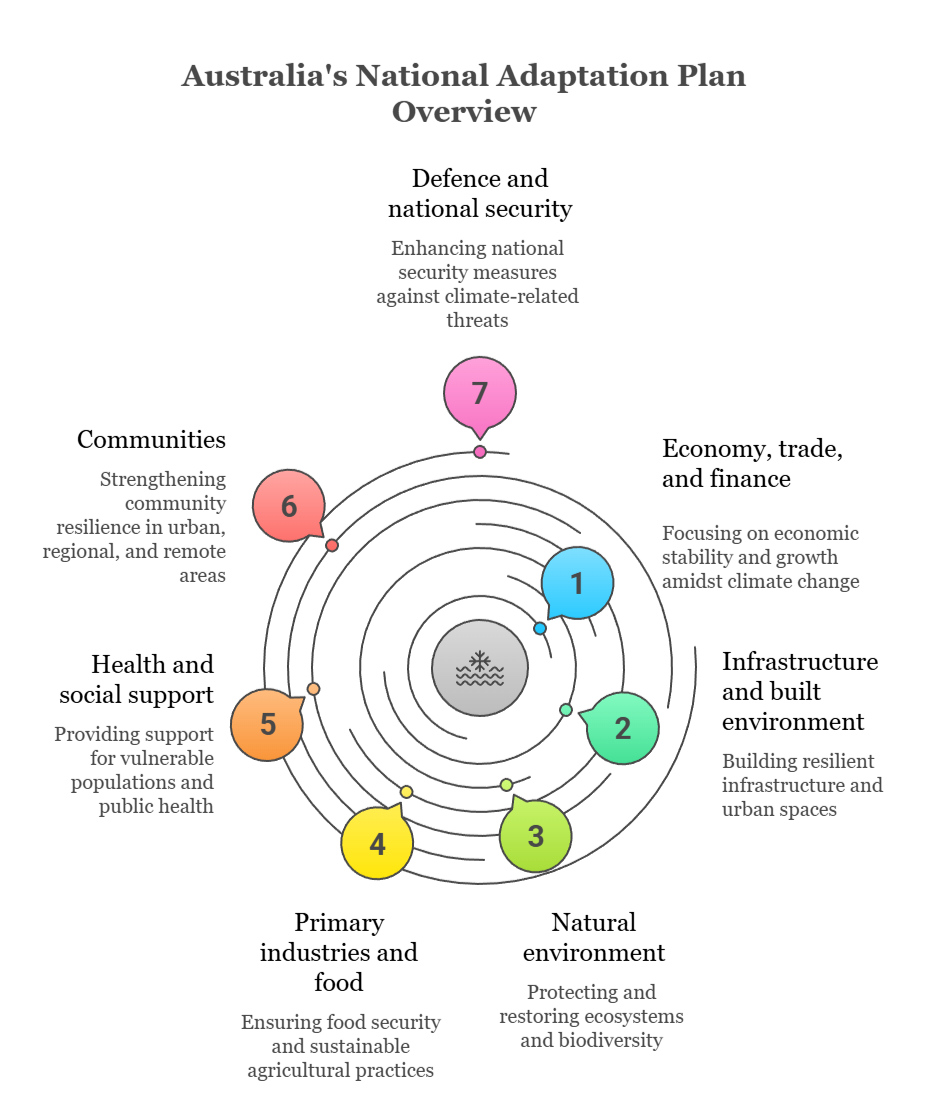
The plan sets priorities and actions across seven systems:
- Economy, trade, and finance
- Infrastructure and built environment
- Natural environment
- Primary industries and food
- Health and social support
- Communities (urban, regional, and remote)
- Defence and national security
The plan also includes a dedicated focus on Aboriginal and Torres Strait Islander peoples.
Key climate risks facing Australia
Australia's climate risks are broad, and they affect many systems at once.
The most urgent risks are captured in national climate science and the National Climate Risk Assessment.
Key risks include:
- Extreme heat: More frequent and intense heat events over land and sea.
- Heavy rainfall and flooding: Increasing intensity of heavy rainfall events, raising flood risk.
- Fire weather: A longer, more dangerous fire weather season across large parts of Australia.
- Sea-level rise and coastal impacts: Rising sea levels, with more frequent extremes that increase damage to coastal infrastructure and communities.
- Concurrency and cascading impacts: Multiple events can occur together, stressing governments and services.
How Australia is adapting in practice
Australia's adaptation to climate change strategies tend to fall into a few practical categories. Most projects blend several at once.
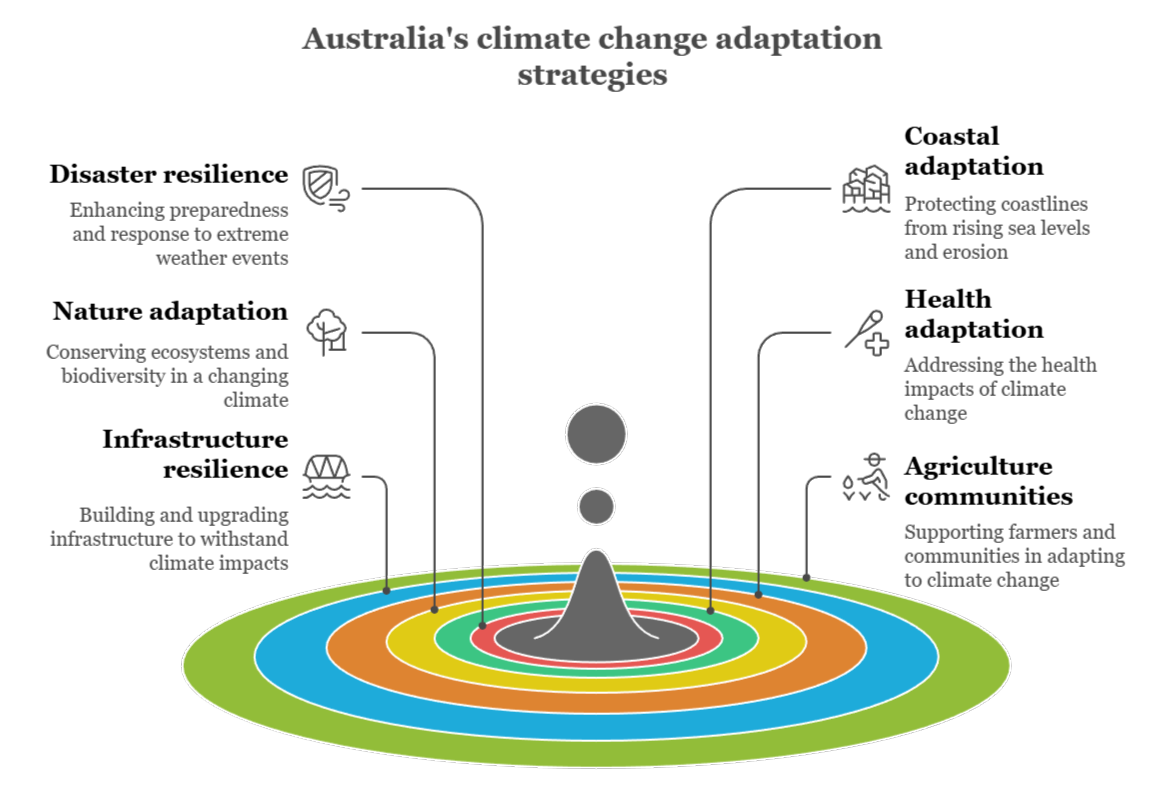
These are the most important strategies for climate change adaptation:
- Disaster resilience and risk reduction
- Coastal and marine adaptation
- Nature, water, and urban adaptation
- Health and climate adaptation
- Climate-resilient infrastructure
- Agriculture and regional communities
Disaster resilience and risk reduction
More effort is going into prevention and preparedness, not just recovery.
In the National Adaptation Plan, the Australian Government highlights the Disaster Ready Fund. It provides up to $1 billion over five years from July 2023 to 2028.
Common project types include:
- Flood levees and stormwater upgrades
- Fire breaks, fuel management, and landscape-scale risk reduction
- Resilient design upgrades for essential infrastructure
- Early warning systems and community preparedness programs
Coastal and marine adaptation
Coasts are a frontline issue. Sea-level rise and erosion can threaten homes, roads, ports, and water and wastewater assets.
Practical climate adaptation measures used in Australia include:
- Hard protection: Seawalls, levees, revetments, and raised assets where protection is viable.
- Nature-based solutions: Beach nourishment, dune restoration, and protection of mangroves and salt marshes.
- Planning reforms: Coastal hazard overlays, setbacks, minimum floor levels, and development controls in high-risk areas.
- Planned retreat: Targeted relocation where protection is not feasible.
These approaches are usually led by state frameworks and implemented by local councils.
Nature, water, and urban adaptation
Nature-based approaches can deliver numerous benefits: flood mitigation, urban cooling, biodiversity, and public amenity.
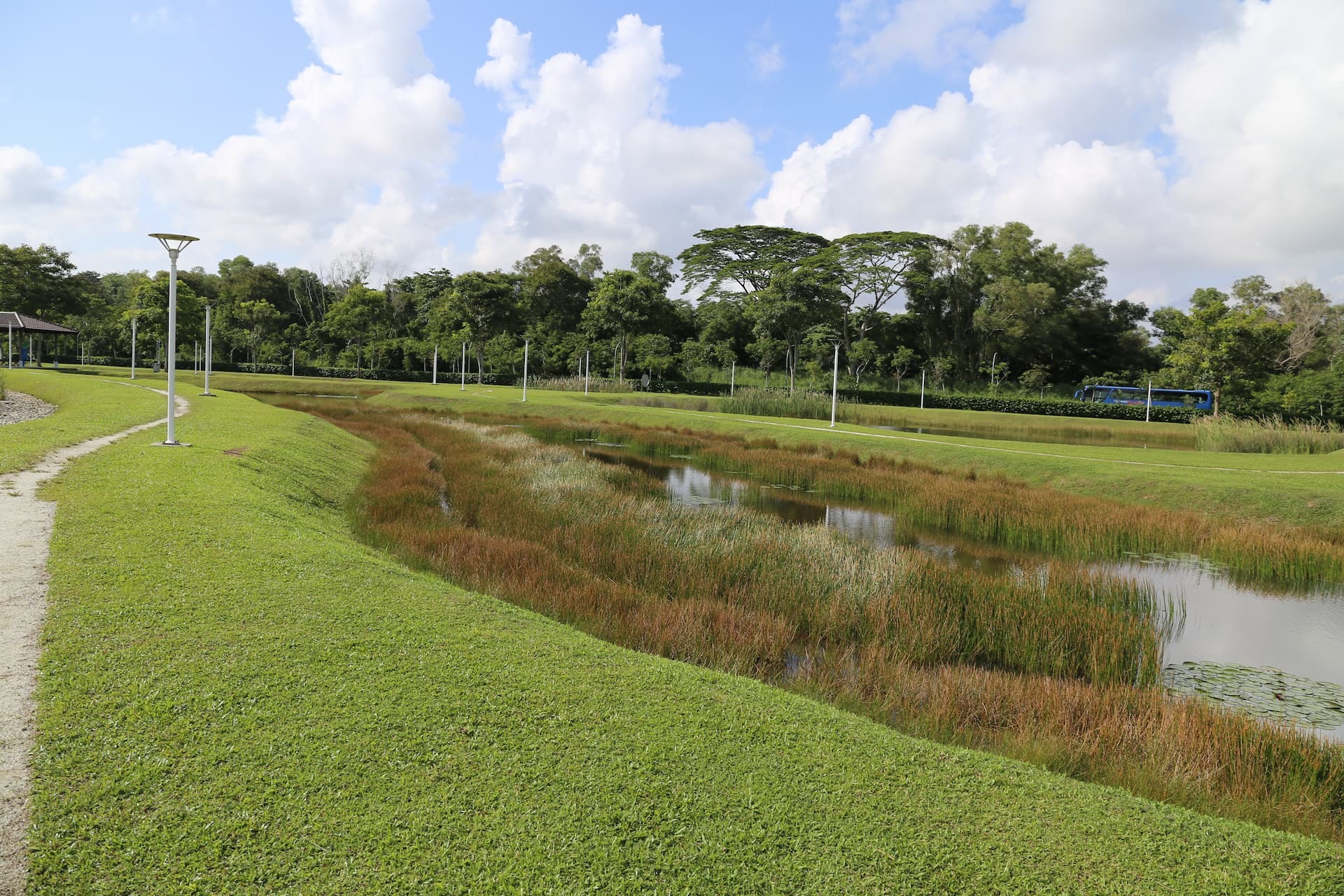
A federal example is the $200 million Urban Rivers and Catchments Program. It's aimed at restoring urban waterways for native plants, animals, and communities.
Projects in this category often include:
- Wetland, floodplain, and riparian restoration
- Integrated catchment works to reduce flood peaks
- Urban greening to cut heat exposure and improve liveability
Health and climate adaptation
Climate impacts are health impacts, especially during heatwaves, smoke events, and floods.
Australia's National Adaptation Plan references the implementation of the National Health and Climate Strategy. It also includes a health-focused adaptation approach.
The National Health and Climate Strategy implementation plan sets out a whole-of-government approach. It aims to build healthy, climate-resilient communities and a more resilient health system.
Climate-resilient infrastructure
A large share of adaptation is "quiet" engineering work. It is also one of the most cost-effective.
Typical adaptation techniques for climate change in infrastructure include:
- Raising roads and bridges in flood-prone corridors
- Hardening utilities and protecting substations
- Designing hospitals, schools, and community facilities for heat, smoke, and flood
- Using updated hazard allowances in drainage, coastal, and structural design
The National Adaptation Plan also stresses mainstreaming adaptation into existing policies, standards, and decision-making.
Agriculture and regional communities
Regional economies depend on rainfall, soil, and water systems.
A federal example is the Climate-Smart Agriculture Program. The program provides $85.6 million in Regional Delivery Partner project funding across 52 regions.
These projects focus on practical resilience outcomes. For example, soil and water management, drought resilience, and climate-risk planning.
Funding and support for adaptation
Australia's adaptation funding is spread across multiple programs. Many investments support resilience even if they are not labelled "adaptation."
The National Adaptation Plan states that $3.6 billion has been committed to adaptation and resilience measures since 2022. It also states that around $9 billion out to 2030 is committed to policies and programs that support broader efforts.
Key program examples include:
- Disaster Ready Fund: up to $1 billion over five years.
- Urban Rivers and Catchments Program: $200 million for urban waterways restoration.
- Preparing Australia Program: described as $600 million over six years (2021–22 to 2026–27) in published grant guidelines.
There is also significant investment in Reef management and resilience through Reef 2050-related actions.
Government documents describe large, multi-year funding baselines and commitments.
Local government advocacy
Local governments implement much of the on-the-ground work, but they often face a patchwork of funding sources.
ALGA has called for a $400 million per year climate adaptation fund for local governments. The goal is to support local projects, such as coastal protection, urban greening, and drainage upgrades.
As of the latest ALGA statements, this remains an advocacy position rather than a confirmed Commonwealth program.
Coordination and capability building
A consistent theme in national planning is that capability and coordination matter as much as capital spending.
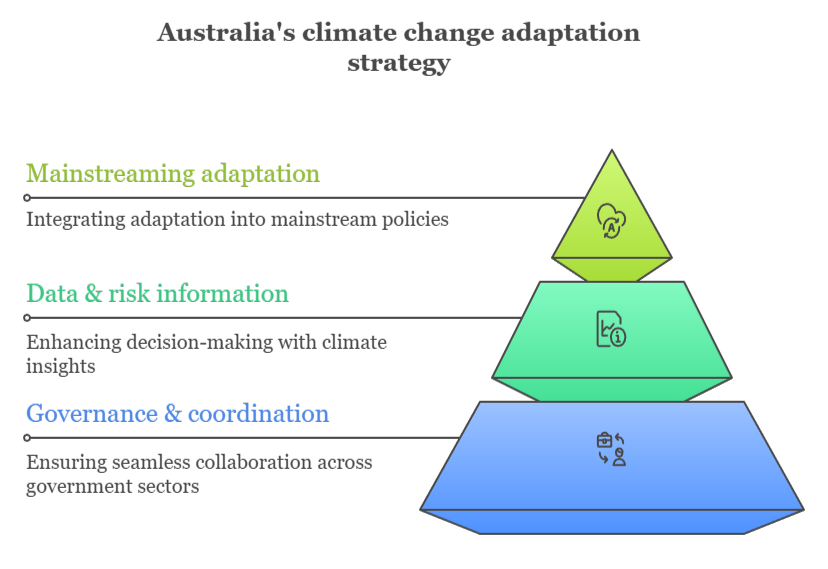
Australia's National Adaptation Plan focuses on enabling action through:
- Governance and coordination across sectors and levels of government
- Better use of climate data and risk information in decisions
- Mainstreaming adaptation so it is not treated as a niche issue
For delivery partners, this shift is already visible. Funders are asking more often for climate risk assessments. They also want evidence-based design standards and measurable resilience outcomes.
Limits, gaps, and policy debates
Adaptation in Australia is moving quickly, but several gaps persist.
Common issues include:
- Uneven coverage: Capacity and funding vary by region and council.
- Managed retreat complexity: Decisions about buy-backs, relocations, and long-term land use are difficult and often incremental.
- Science-to-decision uptake: Many sectors still struggle to turn projections into design standards and long-term investment pipelines.
The National Adaptation Plan calls for adaptation to be built into everyday decisions. It also emphasises aligning adaptation with other major policy agendas, including disaster risk reduction.
What businesses, councils, and communities can do now
Climate change adaptation is practical, and it's also highly local. Here are steps that align with current Australian policy settings and funding realities.
For local governments
- Use climate projections: Apply nationally consistent climate science and risk information in planning and design.
- Prioritise high-risk assets: Focus early work on health facilities, transport corridors, water systems, and coastal assets.
- Mix nature-based and engineered options: Hybrid approaches can reduce risk and improve amenity.
- Partner to access funding: Work with NRM groups, utilities, and regional bodies to scale applications.
For businesses
- Assess climate risk to assets and supply chains: Include heat, flood, fire, and coastal hazards.
- Align projects with public funding priorities: Many programs fund resilience outcomes, even when they are packaged as biodiversity, disaster readiness, or waterway restoration.
- Invest in resilient design standards: This reduces future retrofit costs and downtime.
- Work with councils and regions: Partnerships can strengthen the business case and unlock co-investment.
- Work with green infrastructure partners: Collaborate with providers such as Evergreen Infrastructure to deliver nature-based projects that are easier to align with funding priorities.
For communities
- Participate in local planning: Community input shapes priority projects and acceptable trade-offs.
- Support nature-based solutions: Trees, wetlands, and restored waterways deliver multiple benefits.
- Prepare household plans: Heatwaves, floods, bushfires, and storms require different responses.
Building a well-adapted Australia starts now
Australia's climate risks are growing, and many impacts are already tangible. That makes climate change adaptation a practical requirement, not a future ambition.
The national strategy, risk assessment, and National Adaptation Plan provide a clear direction for risk-based planning and coordinated delivery.
The work now is to turn that direction into projects that protect people, critical assets, and ecosystems.
Evergreen Infrastructure can support this shift with climate-smart, nature-based, and hybrid solutions. Together, these solutions can support cooling, water management, and biodiversity.
If you are planning upgrades, designing new assets, or seeking co-funded resilience projects, reach out to us. Let's talk about climate adaptation measures that align with national priorities and deliver measurable outcomes.
We create green oases in urban settings
We'd love to discuss how we can partner to bring innovative, sustainable solutions to your urban environment.