.webp)

Sustainable Development Goal 11 (SDG 11) aims to make cities inclusive, safe, resilient, and sustainable by 2030. For Australia, where almost 90% of the population lives in urban areas, this goal is critical. The nation is moving forward at a moderate pace, but there are still major hurdles to overcome.
Australia is a highly urbanised country, with the vast majority of people living in cities and large towns. Urban planning shapes daily life and affects the cost of living and community well-being.
It also determines how well we cope with the growing pressures of climate change, including extreme heat, bushfires, and floods.
This is where Sustainable Development Goal 11 (SDG 11) comes in. Its focus is clear: by 2030, cities should be inclusive, safe, resilient, and sustainable.
For Australia, that ambition requires practical action. Housing must be more accessible and affordable. Transport needs to be safe and fair. Public and green spaces should be easier to access for everyone.
This article explains what SDG 11 includes and looks at where Australia is progressing. It also outlines the steps that can help close the gap before 2030, and the challenges that remain.
What are the SDG 11 goals and targets?
SDG 11 stands for Sustainable Development Goal 11. It includes 10 targets that span the full urban sustainability agenda.
SDG 11 is one of the 17 Sustainable Development Goals adopted by the United Nations General Assembly in 2015.
It focuses on the fundamentals that determine whether people can thrive in the places they live.
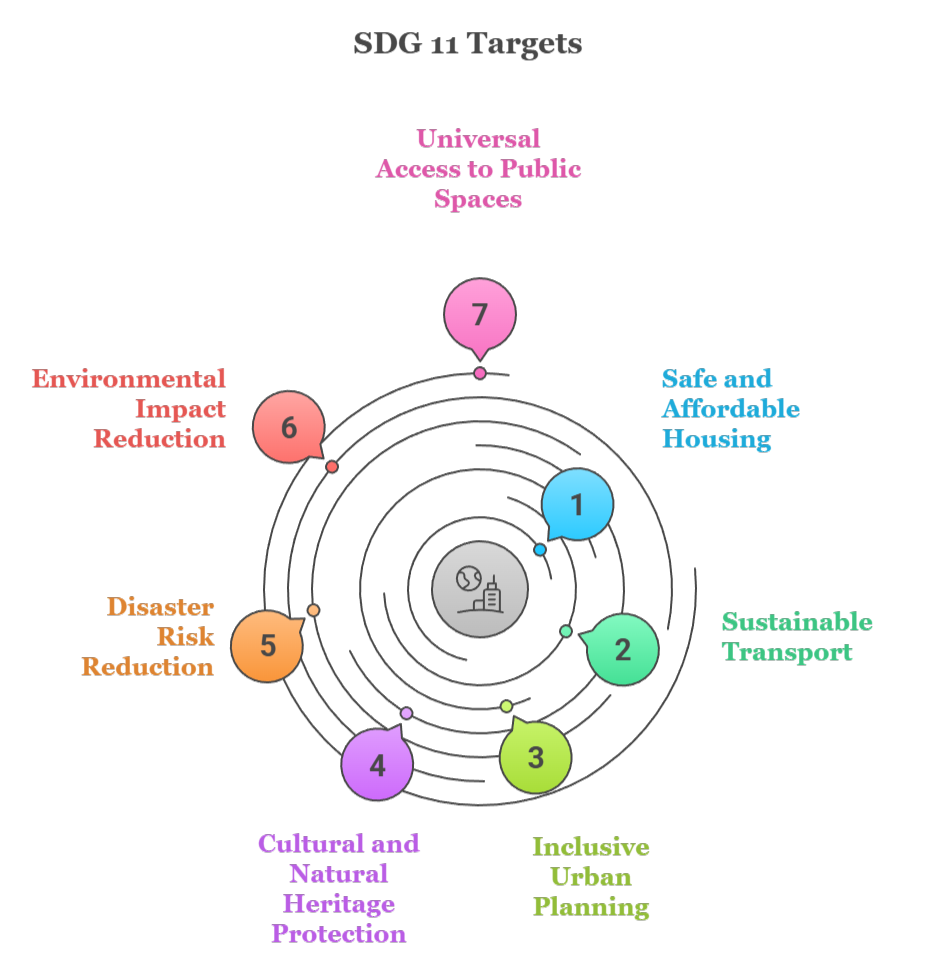
The 10 defined SDG 11 targets include:
- 11.1 Safe and affordable housing
- 11.2 Sustainable transport
- 11.3 Inclusive and sustainable urban planning
- 11.4 Protect cultural and natural heritage
- 11.5 Disaster risk reduction
- 11.6 Reduce cities' environmental impact
- 11.7 Universal access to safe, inclusive public, and green spaces
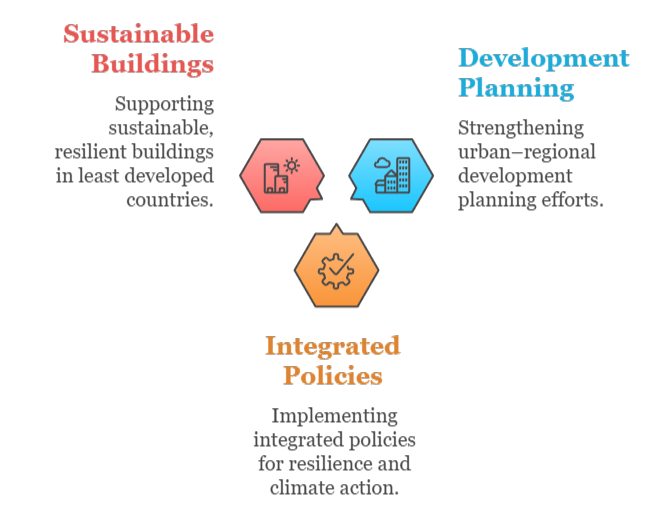
- 11.a Strengthen urban–regional development planning
- 11.b Integrated policies for resilience and climate action
- 11.c Support sustainable, resilient buildings in least developed countries
The first seven targets (11.1–11.7) describe the end results cities should achieve by 2030. These are the outcomes we want cities to deliver and what success should look like in practice.
The last three targets (11.a–11.c) describe the support systems that make those results possible. They focus on the "how."
Safe and affordable housing (Target 11.1)
This target focuses on access to safe, secure, and affordable housing. It includes essential services that make housing liveable.
It also covers upgrading informal and inadequate settlements. This issue is less prominent in Australia than in many other countries. However, it's still relevant through the lens of housing quality, overcrowding, and homelessness.
Safe, affordable transport for everyone (Target 11.2)
SDG 11 calls for transport systems that are accessible, safe, and affordable. It puts special focus on people who are often left out, including:
- Older Australians
- People with disabilities
- Women
- Children
- Low-income households
Inclusive and sustainable urban planning (Target 11.3)
This target focuses on participatory planning and better urban management. It ensures growth is guided by long-term thinking, not just short-term development pressure.
This includes giving residents and stakeholders genuine opportunities to make decisions. That way, new development will reflect local needs and deliver better outcomes.
Protecting cultural and natural heritage (Target 11.4)
SDG 11 includes the protection of heritage places and landscapes. It recognises that sustainability isn't only about carbon and infrastructure, but community, memory, and country.
Disaster risk reduction (Target 11.5)
This target aims to significantly reduce deaths, disruption, and economic losses from national disasters. Progress is measured in concrete ways, such as deaths per 100,000 people and losses relative to GDP.
Reducing environmental impact in cities (Target 11.6)
SDG 11 aims to reduce the environmental impact of cities per person. It places particular emphasis on better air quality and stronger municipal waste management. This includes tracking how much waste is collected and processed in controlled facilities.
Daylighting waterways is an example.
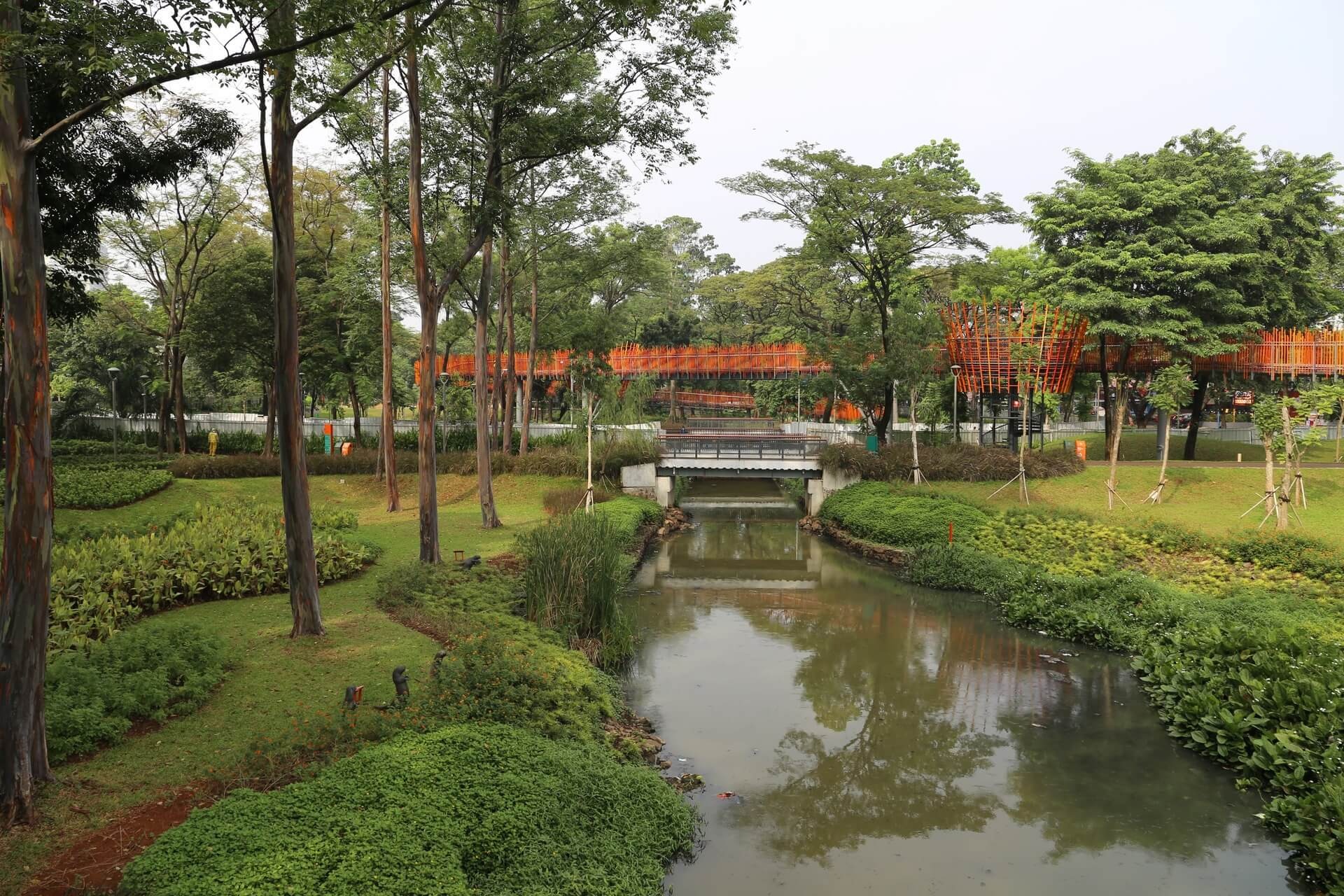
Daylighting water canals and streams means uncovering buried waterways and restoring them to a more natural state. This approach can deliver environmental, economic, and social benefits. It can also help manage stormwater, reduce flood risk, and cool surrounding urban areas.
Universal access to safe public and green spaces (Target 11.7)
Healthy cities provide safe, inclusive public environments. This target prioritises parks, streets, and public areas that are accessible to everyone. Special emphasis is placed on women, children, older people, and people with disabilities.
Stronger urban–regional planning links (Target 11.a)
This target focuses on strengthening connections between cities, peri-urban areas, and regional communities.
The intent is balanced development. The idea is for growth in major cities not to come at the expense of regional areas. That way, regions would be better integrated into economic and service networks.
How it's typically measured: whether countries have national or regional development plans that support coordinated population and infrastructure planning.
Integrated policies for resilience and climate action (Target 11.b)
This target is about adopting and implementing integrated plans and policies that:
- Improve resource efficiency
- Reduce disaster risk
- Strengthen climate adaptation
It explicitly aligns with frameworks like the Sendai Framework for Disaster Risk Reduction.
How it's typically measured: the number of local governments with disaster risk reduction strategies, and whether national strategies are in place and implemented.
Support for sustainable buildings in least developed countries (Target 11.c)
This target calls for supporting least developed countries to build sustainable and resilient buildings using local materials.
How it's typically measured: financial and technical support directed toward sustainable construction in least developed countries.
Where Australia stands today
International assessments suggest Australia still has major work to do on SDG 11. Progress is often described as slow, with limited improvement toward the 2030 targets.
Australia performs well on some other SDGs, but SDG 11 is harder to shift because it involves big, long-term issues like housing and climate risks.
There is still positive momentum. Some cities, states, and institutions are making practical progress. These examples show what can work when policy, funding, and community input line up.
Universities translating research into urban outcomes
Australian universities are helping cities move from ambition to implementation through research partnerships, pilots, and measurement tools.
Examples include:
- Urban growth and sustainability research centres
- Collaborations with local governments on transport and infrastructure upgrades
- The development of baseline liveability measures to guide planning decisions and track change over time
The practical value here is significant: better data, better modelling, and clearer pathways from evidence to policy.
State-level reforms to grow housing supply
Several states will be focusing on building more homes near public transport.
The aim is to increase housing supply where demand is highest. It also helps more people live closer to trains and metro lines, which can reduce car dependence.
- New South Wales: Planning settings and faster approvals are intended to support more mid-rise, mixed-use housing near train and metro stations.
- Victoria: The state is encouraging infill development and growth in transport-focused activity centres, including areas linked to major rail projects.
The idea is simple. As cities grow, new housing should be built in places where people can reach jobs, services, and everyday essentials.
Better integration of active and smart transport
Transport planning is no longer just about getting people from A to B. It is also a way to shape how cities grow and how neighbourhoods function.
Victoria's long-term planning strategy (Plan Melbourne) promotes '20-minute neighbourhoods' as a guiding principle for metropolitan planning.
The city is also expanding cycling networks. In some areas, it is improving how kerbside space is used for parking, deliveries, and pickups.
Sydney and Melbourne are also investing in smarter transport systems. These include connected sensors and data tools that help manage traffic in real time.
The goal is to cut congestion, improve reliability, and get more value from existing roads.
The SDG 11 challenges Australia must confront
Australia has powerful examples of what sustainable urban development can look like. However, progress is uneven and often too slow to meet the 2030 goals.
The biggest barriers tend to be structural. They cut across housing, infrastructure, and climate resilience.
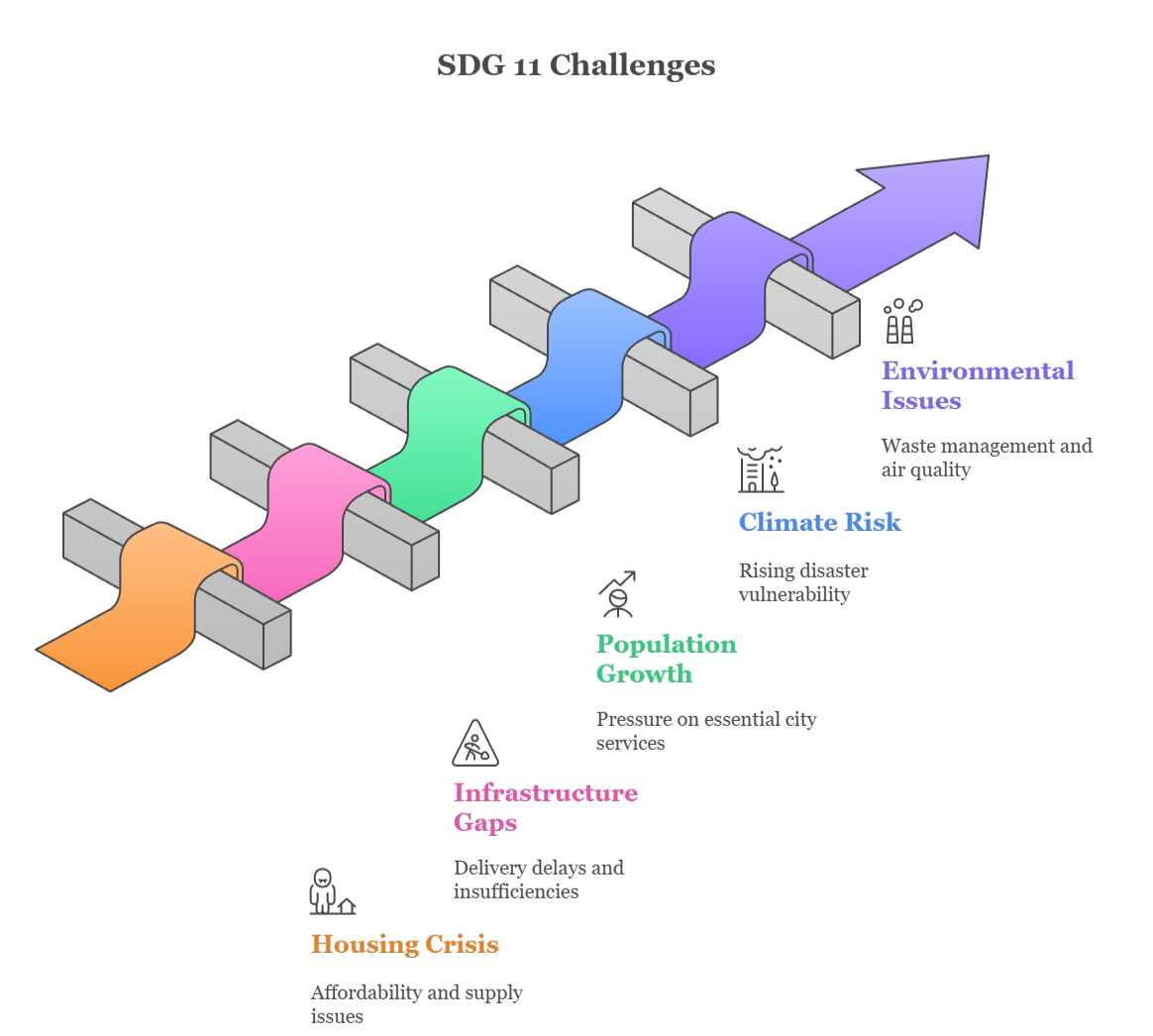
Key SDG 11 challenges include:
- Housing affordability and housing supply constraints
- Infrastructure gaps and delivery delays
- Rapid population growth and pressure on services
- Rising climate and disaster risk
- Uneven performance in waste management and air quality
Housing affordability and housing supply constraints
Housing costs remain a major pressure in many cities. Even when a new supply is planned, it can take years to deliver at scale. This makes it difficult for many households to live near jobs, schools, and essential services.
Infrastructure gaps and delivery delays
Many communities are growing faster than the infrastructure that supports them. Transport, utilities, and social infrastructure often lag behind new development. Funding constraints and slow approvals can add further delays.
Rapid population growth and pressure on services
As urban populations increase, demand rises across the board. Hospitals, schools, public transport, and local amenities all feel the strain. When services do not keep pace, liveability can decline quickly.
Rising climate and disaster risk
Cities are facing more frequent and severe climate impacts. Extreme heat affects health and energy demand. Floods and bushfires can damage homes and disrupt transport, power, and water systems.
Uneven performance in waste management and air quality
Waste collection and processing practices vary by jurisdiction. Some areas have strong diversion and recycling systems, while others rely more heavily on landfills. Air quality can also fluctuate, especially during heatwaves, hazard reduction burns, and bushfire seasons.
Building urban resilience: what response and recovery is starting to look like
Recent bushfires and floods have pushed disaster risk reduction into the centre of urban planning.
The most effective approaches tend to share three features:
- Clear governance
- Community leadership
- Investment in prevention
Community-led resilience in practice
Some communities are rebuilding with resilience as the priority. They are using recovery as a chance to reduce future risk, not just restore what was there before.
In Cobargo (NSW), the post–Black Summer rebuild has focused on practical changes. These include:
- Dedicated resilience facilities
- Clearer local coordination
- Land-use choices that reduce exposure to bushfire risk
There are also larger programs supporting local action. The Minderoo Foundation works with multiple communities to build preparedness through structured planning and local leadership.
National funding programs add another layer of support by backing mitigation projects. These often focus on risk education, targeted infrastructure upgrades, and faster recovery pathways.
Planning and construction reforms
Resilience is increasingly being embedded into standards and approvals through:
- More climate-responsive building expectations (including heat resilience)
- Stronger emissions requirements for major developments in some jurisdictions
- Coastal buffers that account for sea-level rise
- Growing reluctance to approve development in high-risk flood or bushfire zones
Alongside this, green infrastructure and recognised sustainability certification schemes are increasingly treated as both environmental and public-health assets.
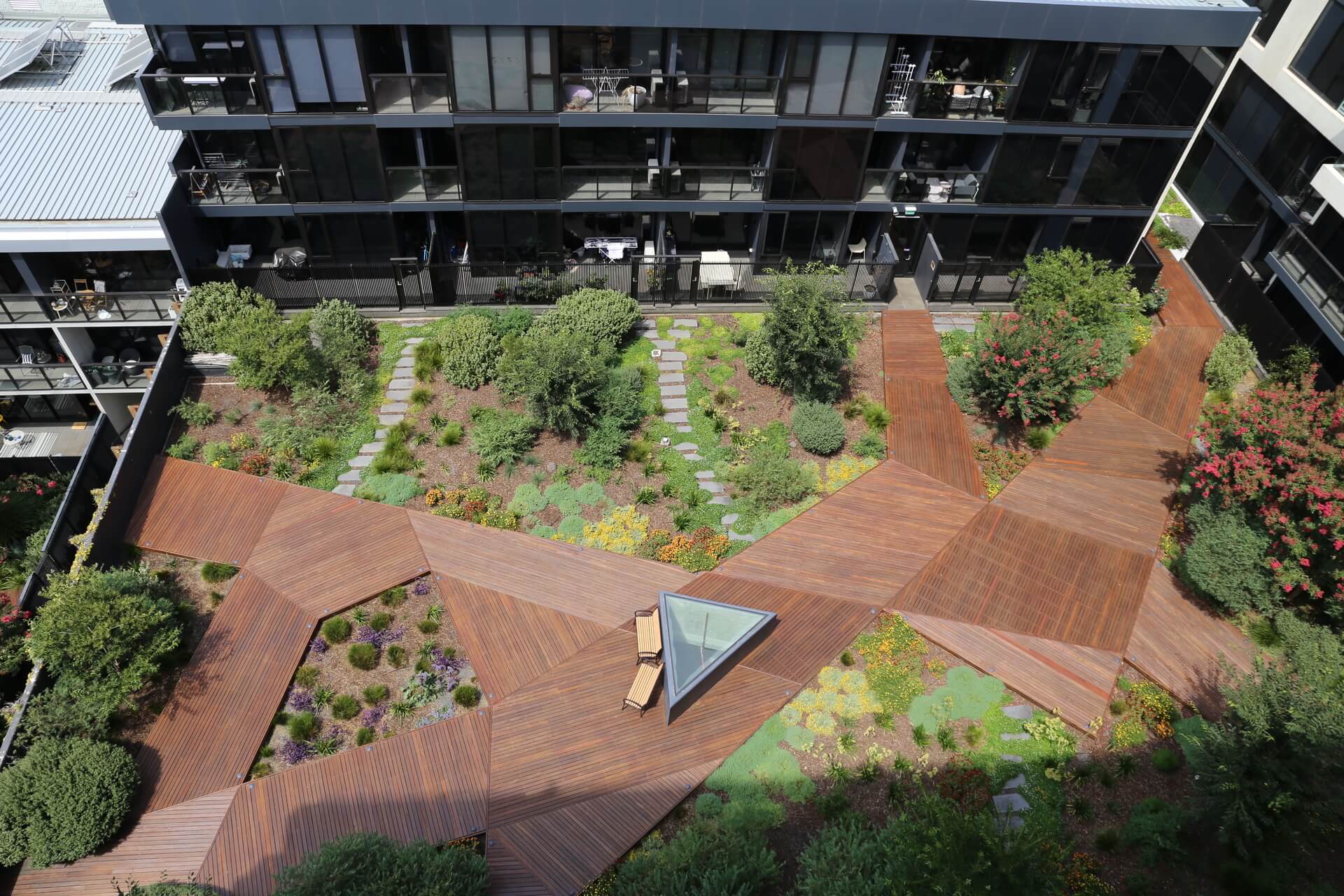
Greening our built environment goes beyond parks. It also means introducing green spaces into housing and everyday living areas, so more people benefit where they spend most of their time.
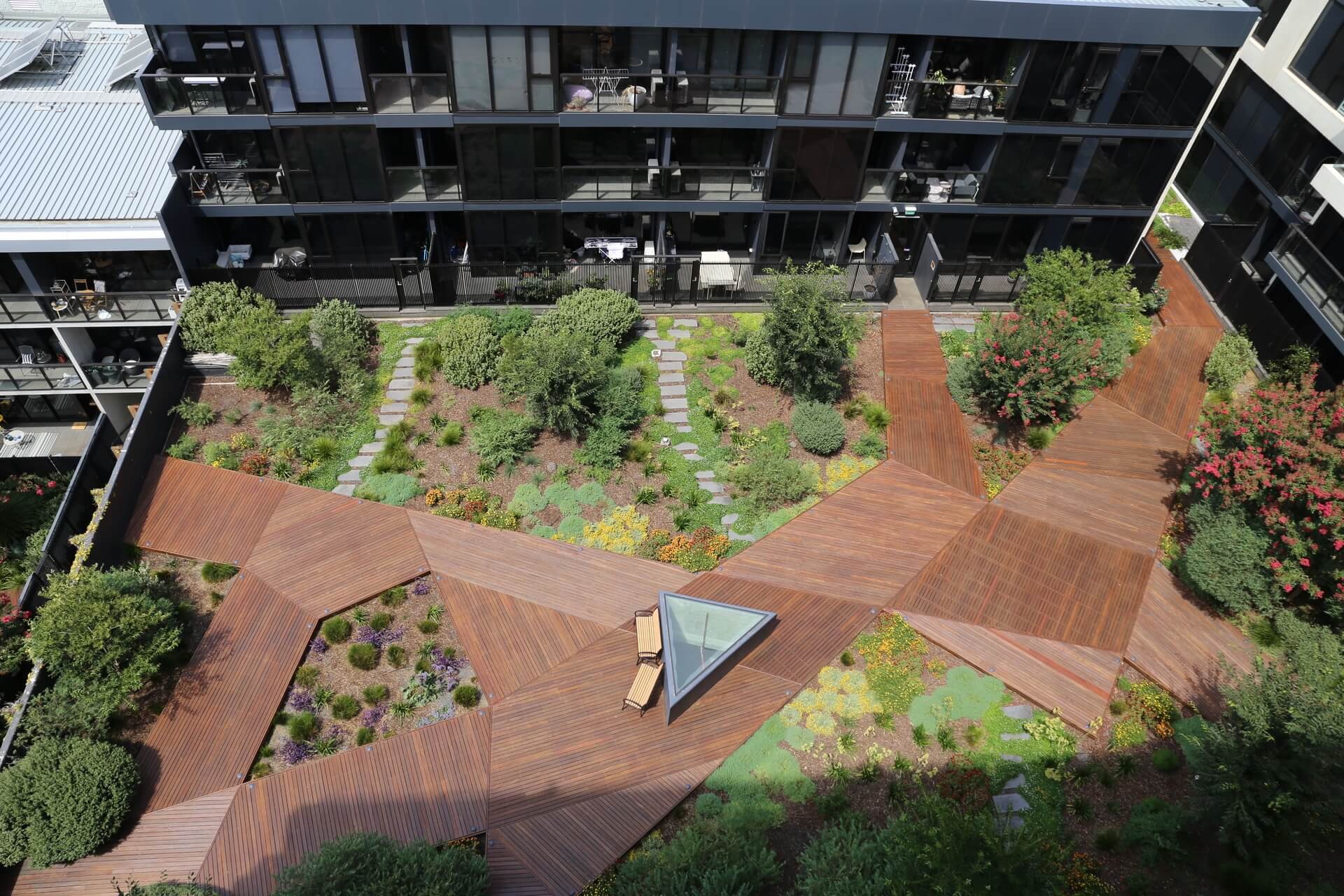
Green infrastructure can include:
- Parks and trees
- Green roofs and green walls
- Water-sensitive design
- Biophilic buildings
Sustainability trends shaping Australian cities in 2025
Several patterns are now clearly influencing planning, development, and investment decisions:
- Mixed-use, walkable communities
- Regional centralisation
- Smart city deployment
- Nature-positive development
- Renewable energy integration
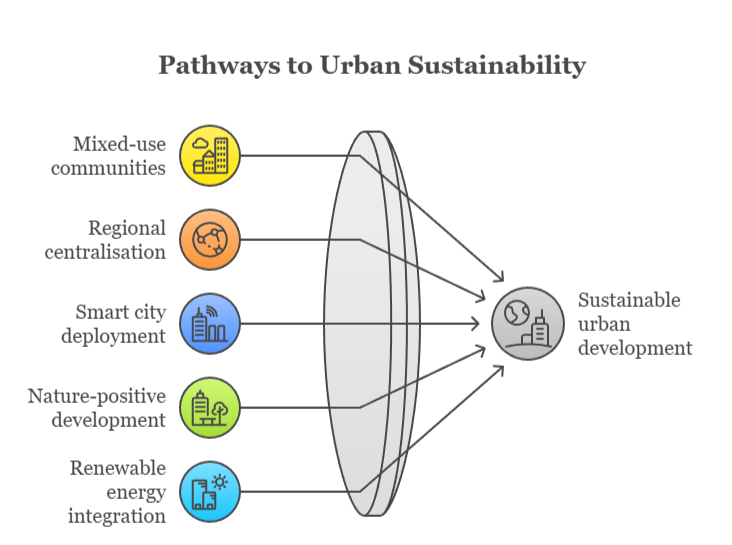
Regeneration projects increasingly combine housing, employment, and recreation close to amenities. This helps reduce long commutes and improves local economic resilience.
Pressure is mounting in capital cities. Policy is thus now more focused on boosting regional hubs and aiding migration with employment and support.
Sensors, AI, and analytics are being used to improve traffic and waste routing. They are also used for energy efficiency and emergency response, particularly in major metropolitan areas.
National settings are still evolving. Even so, some states are tightening expectations around biodiversity, habitat connectivity, and native vegetation retention.
Grid upgrades and transmission projects are increasingly linked to urban outcomes. They can support a cleaner energy supply, improve air quality, and lower emissions profiles.
What needs to change to meet SDG 11
Australia will not meet SDG 11 through isolated projects alone. Progress needs to be coordinated and sustained. It also needs to happen at a faster pace.
Key priorities include:
- Stronger national coordination across federal, state, and local governments
- More resources for local councils, including funding that matches their responsibilities
- Better data and monitoring, especially for waste, air quality, and disaster impacts
- Earlier and more meaningful community participation, with a focus on vulnerable groups
- Climate adaptation built into planning and investment, so risk is reduced rather than locked in
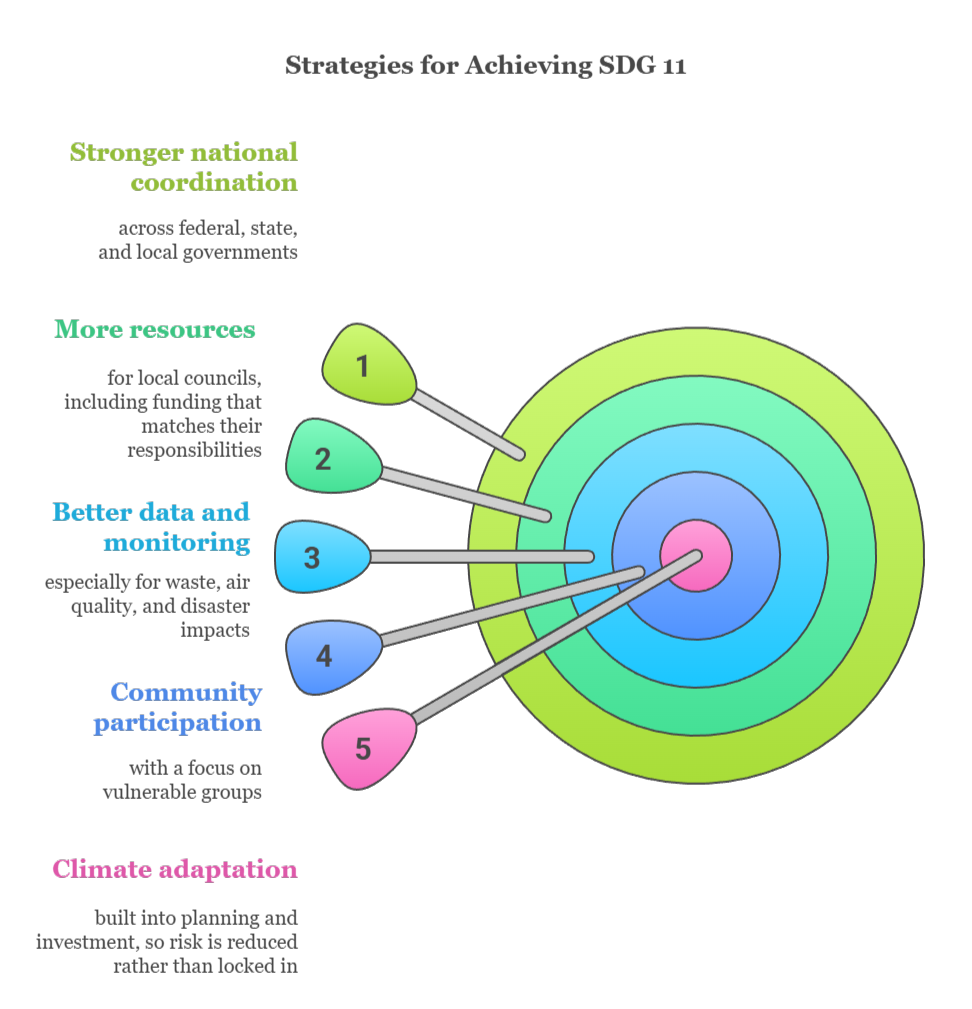
If these changes are delivered, Australia can close the gap before 2030. The payoff is practical and immediate. Cities become safer, healthier, and more liveable for everyone.
Turning SDG 11 into practical action
SDG 11 is not an abstract framework. It maps directly onto the issues Australians feel every day. Housing access, transport choices, public space, waste, and safety all sit at the centre of liveability. So does resilience to heat, floods, and bushfires.
Australia has momentum in the right places. State reforms, university-led innovation, and community-led recovery models show what is possible. However, progress still needs to be faster.
If your organisation is working to deliver more resilient, sustainable communities, Evergreen Infrastructure can help.
We support projects that improve liveability and long-term performance across the built environment.
Speak with our team to explore how your next project can align with SDG 11 and deliver measurable outcomes.
We create green oases in urban settings
We'd love to discuss how we can partner to bring innovative, sustainable solutions to your urban environment.