.webp)

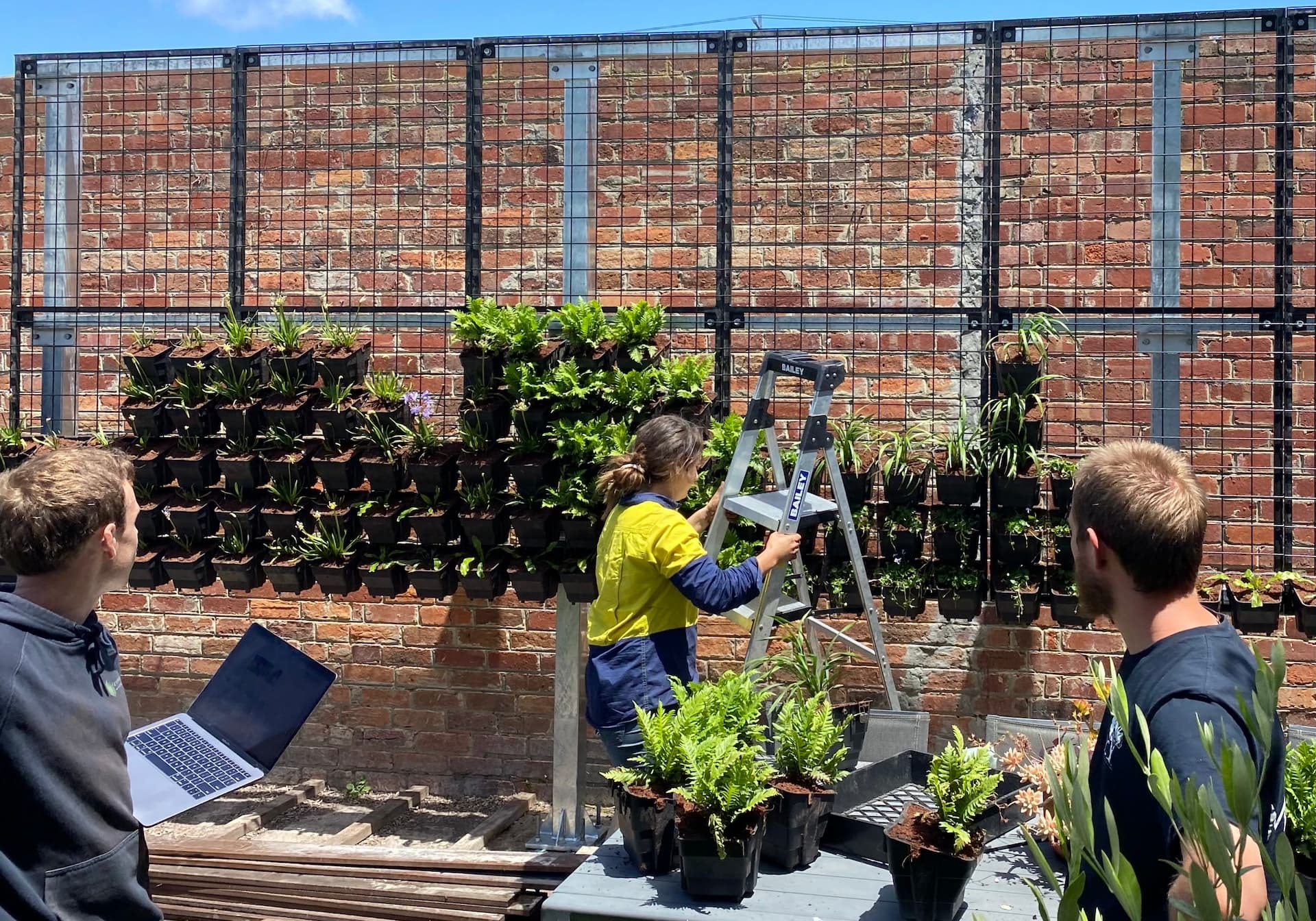
Building an outdoor green wall involves a step-by-step process, from choosing a system to ongoing maintenance. The three system types are direct climbers, climbers on cables or trellis, and modular living walls. Irrigation is non-negotiable, as rainfall alone won't do. Expect roughly $800–$1,500 per square metre installed, plus $200–$2,000 a month to maintain. A well-kept wall lasts 10 years or more. Most failures come from two shortcuts: insufficient irrigation and poor plant choice.
The first step of building an outdoor green wall is choosing a system type. Before the building even starts, you need to check if your wall can handle the load. Installing the system and choosing the right plants come after that.
Each step depends on the one before it. Most green walls fail because of cutting corners rather than bad luck. Design shortcuts and poor maintenance, especially irrigation and plants, are the main culprits.
If you want to know how to build a green wall outside, this article is for you.
What types of outdoor green walls can you build?
Three main system types are used for outdoor green walls. Each differs in structural load, cost, maintenance, and performance. These systems include:
- Green façades with direct climbers
- Green façades with indirect climbers on a support structure
- Modular living walls with planter modules
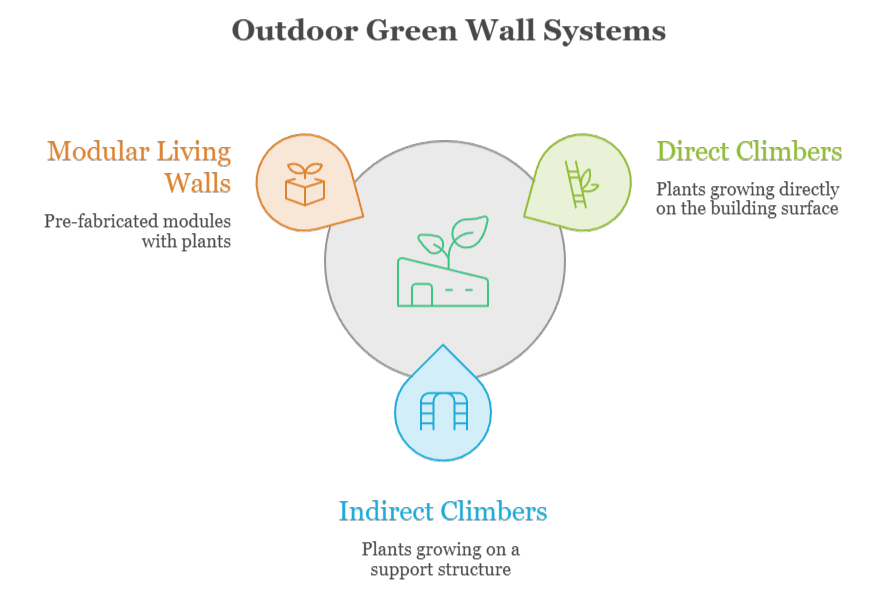
Green façades use climbing plants grown in the substrate at the base of the wall or in containers at different levels. These plants are trained over a support structure.
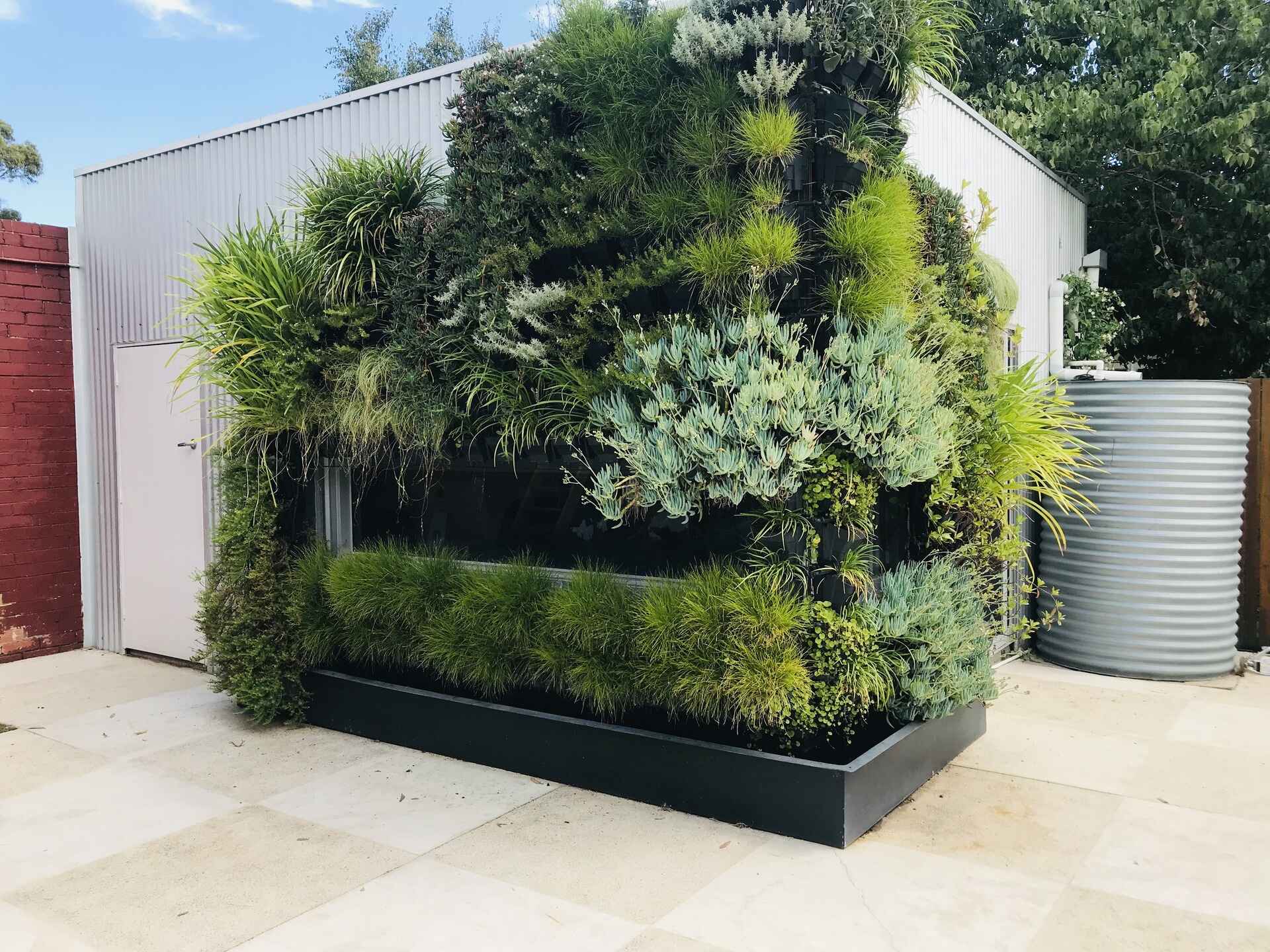
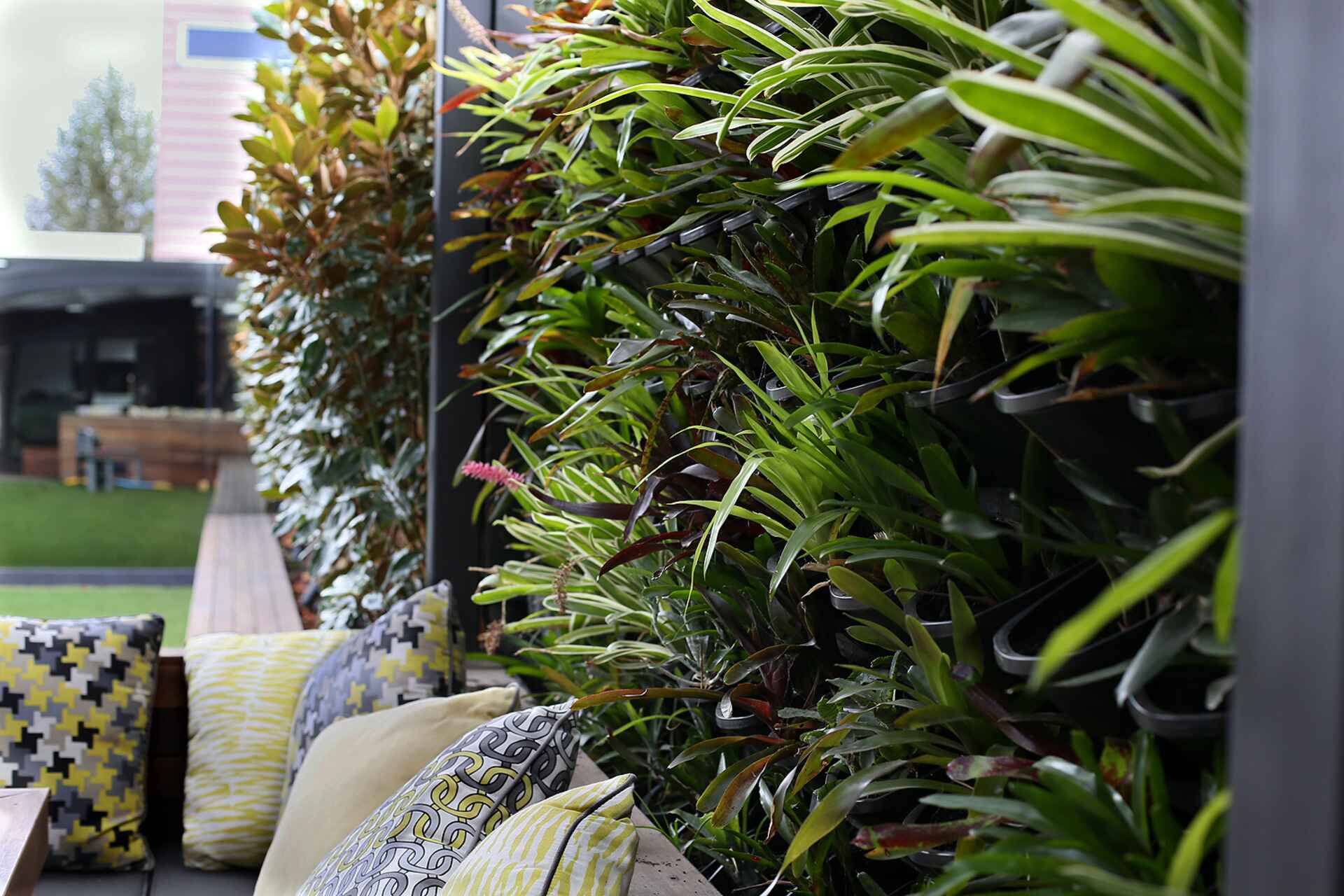
Living walls (green walls) use modular units, trays, or panel systems with integrated growing media fixed to the wall. They support many small plants across the vertical surface.
This distinction matters. Living walls typically need more complex engineering, dedicated irrigation, and more intensive maintenance.
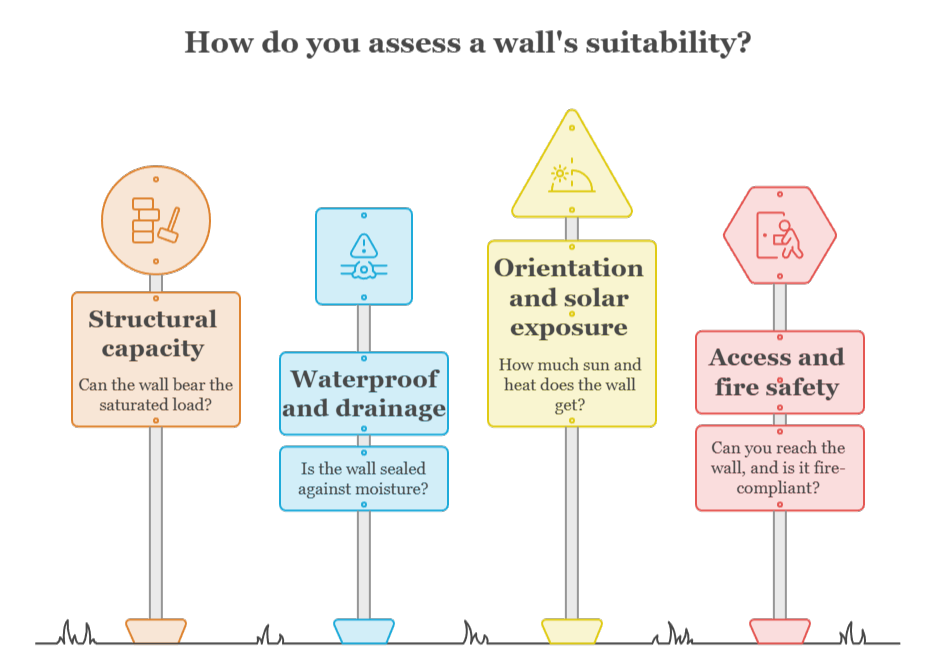
How do you assess a wall's suitability before you start?
Assess structural capacity, waterproofing condition, orientation, and access before committing to a system. A wall that can't support the saturated load of planted modules is at high risk of failure, regardless of system quality. The same applies to a wall that lacks a sound waterproof membrane.
Structural load
Living wall modules holding saturated growing media are heavy. The Growing Green Guide recommends a structural engineer's assessment for any retrofit installation. This is especially important for older buildings, where original design loads may be undocumented.
A green façade using cables or a lightweight trellis puts far less load on a wall than a modular system. This factor makes it a safer starting point on older building fabric.
Waterproofing and drainage
The wall surface and any adjacent building fabric must be protected from moisture. Installing a waterproofing membrane and a drainage layer or drainage mat behind the system is a crucial step. It will direct water away from the wall face.
The Growing Green Guide says that waterproofing is a critical design consideration for green walls. It notes that leaks can occur at junctions and penetrations, so these need careful detailing.
Orientation and solar exposure
North- and west-facing walls in Australian cities receive the highest solar loads. These orientations deliver the greatest thermal benefit from a green wall but also the greatest plant stress. Avoid placing shade-tolerant species on these aspects.
South-facing walls are cooler and suit a different plant palette.
Fire safety
Green walls on medium- and high-rise buildings must be assessed for fire performance. This is required under the National Construction Code. Many elements can contribute to vertical fire spread, including:
- Dried plant material
- Plastic irrigation components
- Combustible substrates
Work with a fire safety engineer for any installation on a building above two storeys.
How do you build a green wall outside, step by step?
Building an outdoor green wall involves working through six sequential stages. These include:
- Preparing the site and subframe
- Installing waterproofing and drainage
- Installing irrigation
- Fitting the growing media and modules
- Planting
- Commissioning
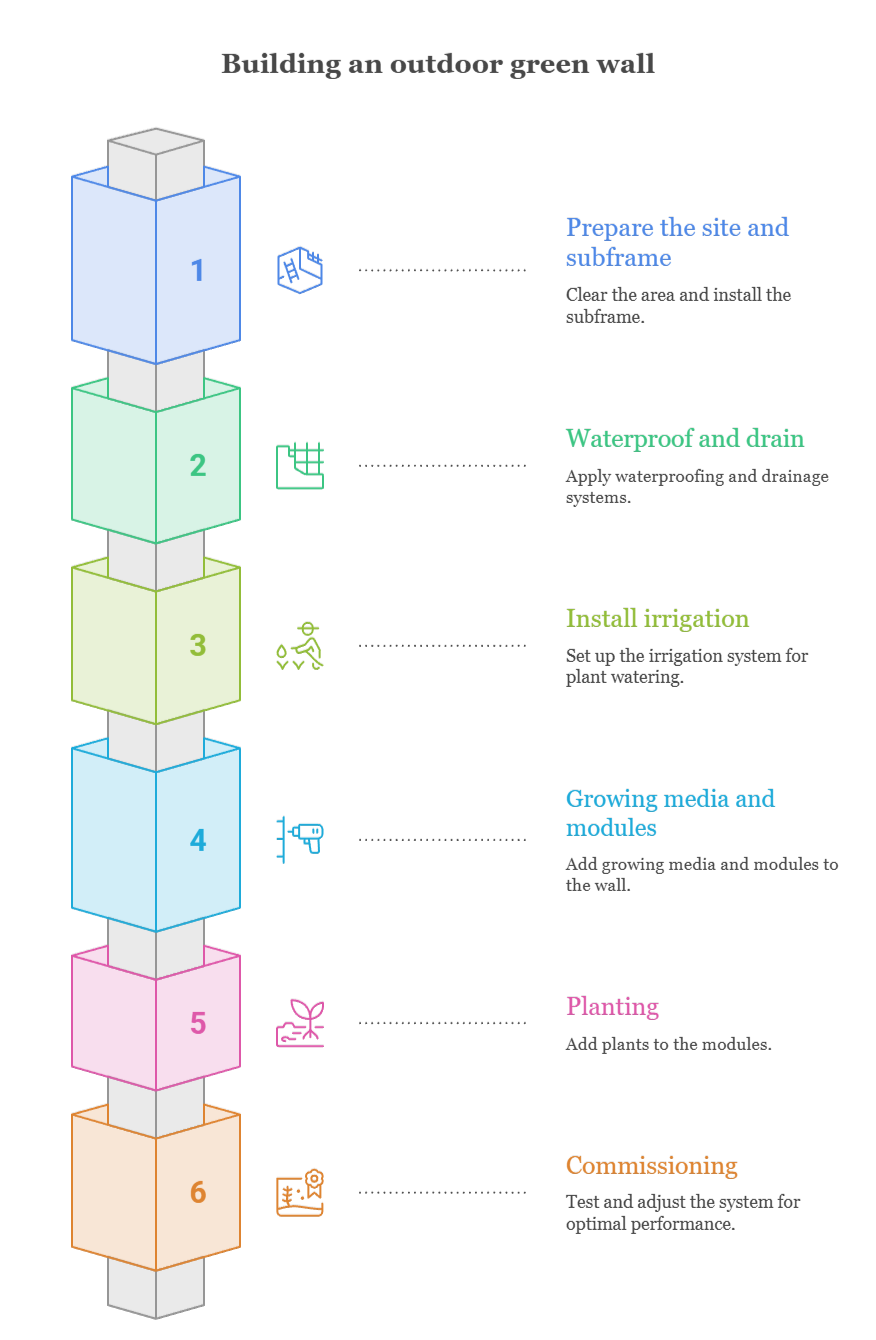
Step 1: Prepare the site and fix the subframe
The first step is to clear the wall surface. Fix galvanised or powder-coated steel subframes at the manufacturer's specified centres. The frame must be anchored into structural elements, not just face-fixed into render or cladding.
For a green façade, install stainless-steel cables or a trellis system at centres. It should be recommended by the manufacturer and suited to the chosen climber species. This gives plants adequate attachment points.
Step 2: Install waterproofing and drainage
Apply a waterproof membrane to the wall surface behind the subframe. Install a drainage layer or drainage mat over the membrane to channel excess irrigation water to the base drain.
Then, you can route drainage water to a collection point. Connecting to a rainwater tank closes the water loop and reduces potable water demand.
Step 3: Install the irrigation system
Artificial irrigation is mandatory for living wall systems. Research by Medl et al. in 2018 contributed to this notion. It found that without irrigation, vertical greening systems lose vegetation cover during dry spells.
A proprietary living wall system typically requires two litres of water per square metre per day.
Connect drip emitters to each planter module or zone. Fit a timer, pressure regulator, and filter on the supply line. Where possible, connect to a non-potable source such as a rainwater tank or a recycled water supply.
Step 4: Install the growing media and modules
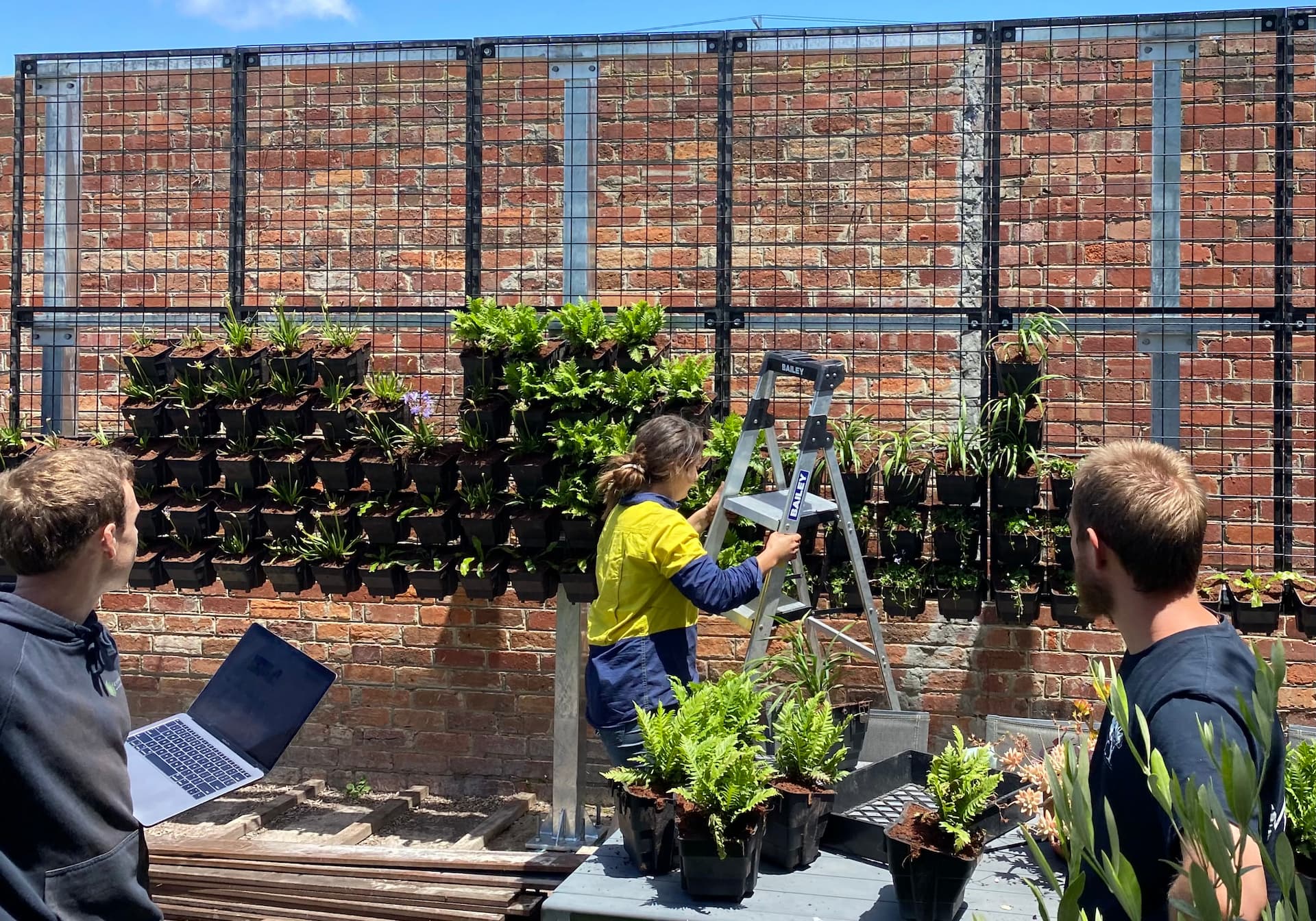
Fix planter modules or felt panels to the subframe following the manufacturer's sequence. This is typically done bottom to top to avoid damaging lower panels during installation.
Fill the modules with the specified growing media. Do not substitute standard garden substrate. It will compact under vertical drainage and cut off root oxygen.
Step 5: Plant the system
Plant according to the layout specified for your chosen species mix. Make sure to space plants to achieve full coverage without overcrowding.
Perkins and Joyce (2012) state that choosing the right plants for Australia's climate is critical to green wall success. Match species to the heat, wind, and water conditions of the specific site.
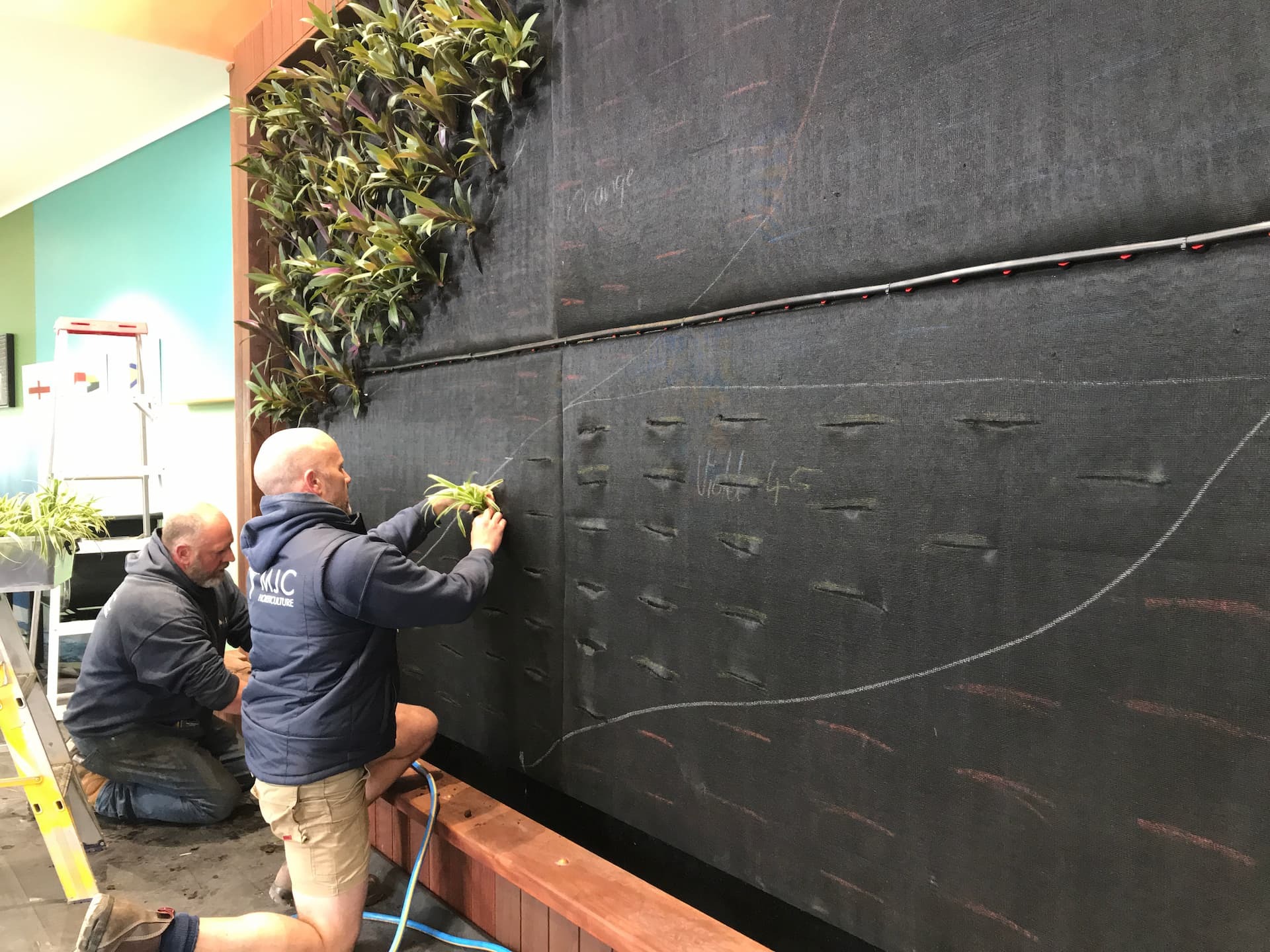
Step 6: Commission and monitor
Run the irrigation system through a full cycle before handover. Check for uniform distribution, leaks, and adequate drainage.
Early detection of irrigation faults and plant stress is critical. Issues are far easier to resolve during the establishment period than once the system matures.
What plants work best on an outdoor green wall in Australia?
Plant selection must match the wall's aspect and substrate depth. Irrigation capacity and local climate are two other important factors. No single species palette suits all Australian sites.
For north- and west-facing walls in Melbourne and Sydney, favour drought-tolerant, sun-hardy species. For example, succulents, sedums, and robust native grasses adapted to high heat and low water.
For south- and east-facing walls, shade-tolerant ferns, perennials, and shrubs generally perform better. A recent Royal Horticultural Society study on green façades found that walls with deeper, denser planting support more invertebrates.
Avoid invasive climbers such as English ivy on green façades near bushland areas. They can smother native vegetation and reduce biodiversity.
Green walls provide habitats and food for foraging birds and pollinating insects such as bees. A PhD thesis by Chiquet (2014) found that modular herb-shrub systems with full plant coverage attract the most wildlife.
What are the benefits of building a green wall outside?
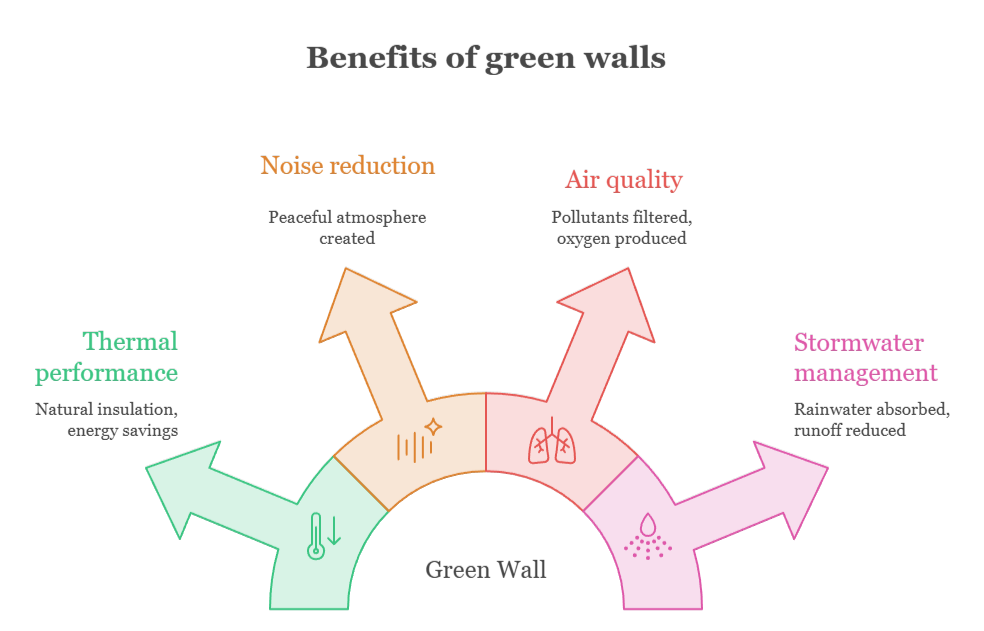
Well-designed outdoor green walls deliver measurable thermal, acoustic, air quality, and stormwater benefits. The scale of those benefits depends on system design, plant density, and orientation.
Thermal performance and energy savings
A 2022 study by Goel et al. has shown that living walls can reduce heat flux through building envelopes. In some cases, they can lower indoor temperatures by up to 10°C.
The same study summarised a Vancouver modelling case comparing a 'living skin' building with a conventional one. The green building used about 70.22 MWh less energy per year, roughly 9.3% lower consumption.
Through shading, green walls can lower summer energy costs by up to 23%. This figure is based on modelling summarised by the American Society of Landscape Architects. Temperatures behind green walls can be reduced by as much as 10°C compared with bare walls.
Well‑designed living walls can deliver measurable energy savings. Yungstein and Helman (2023) ran a laboratory workplace study on an indoor green wall. They found it could cut the energy used for air circulation and ventilation in a closed space by up to 20%.
Noise reduction
Goel et al. (2022) cite a living wall of just 10 square metres. It can reduce noise pollution in the 100–5,000 Hz range by around 40%.
Paull et al. (2020) took ambient noise measurements from 12 sites in central Sydney. The result was significantly lower noise at green wall locations than at paired reference walls over a six-month period.
Air quality
A 2019 study by Paull et al. looked at active green walls, which draw air through the growing media. It found that they can remove airborne particulates and VOCs. The study also tested Australian native species and found that some removed benzene, as well as ornamental species did.
A separate 2020 study by Paull et al. measured passive outdoor walls. It found no real difference in ambient PM between green walls and bare walls.
Stormwater management
A 2025 study published in Water Research found that vertical green systems combined with on-site storage can achieve 60–100% annual stormwater reduction. The exact percentage depends on climate and system sizing.
These systems can help meet WSUD stormwater objectives in Australian developments. This includes targets for both stormwater volume and retention. Such targets are set by local or state planning controls.
How much does it cost to build an outdoor green wall?
Outdoor green wall costs vary by system type, size, and whether installation is DIY or professional. All prices below exclude GST.
Source: Evergreen Infrastructure
A DIY green wall kit costs $300–$800 per square metre, but plants are not included. Professional design, supply, and installation typically costs $800–$1,500 per square metre. High-end custom systems exceed $1,500 per square metre.
Modular systems are quicker to install but cost more upfront. Custom non-modular walls are built on-site and may be cheaper, but involve more labour and components.
Maintenance packages run $200–$2,000 per month, depending on size, access, and complexity. Routine care includes:
- Watering system checks
- Trimming
- Pest inspection
- Fertilising
- Plant replacement
- Structural checks
A well-maintained wall can last 10 years or more. A neglected one may need a full replanting within one to two years.
Artificial green walls carry lower upfront costs. But they deliver no:
- Evapotranspirative cooling
- Stormwater retention
- Air pollutant uptake
- Habitat value
Do you need planning approval to build a green wall in Australia?
Requirements vary by state, council, and scale. The Growing Green Guide was developed in the absence of national guidelines for green wall design, construction, and maintenance. This leaves practitioners to apply international best practices locally.
For small residential façades, many councils may treat the work as minor or exempt development if it meets set criteria. Even so, confirm requirements with your council or a planning professional.
The rules for larger projects, public space systems, and stormwater infrastructure are different. They are more likely to trigger planning or building code considerations. For larger commercial and multi-residential buildings, these are non-negotiable:
- NCC fire compliance
- Structural load certification
- Waterproofing documentation
How do you maintain an outdoor green wall?
You can maintain an outdoor green wall through regular irrigation system checks. Fertilising, pruning, pest management, and plant replacement are also important.
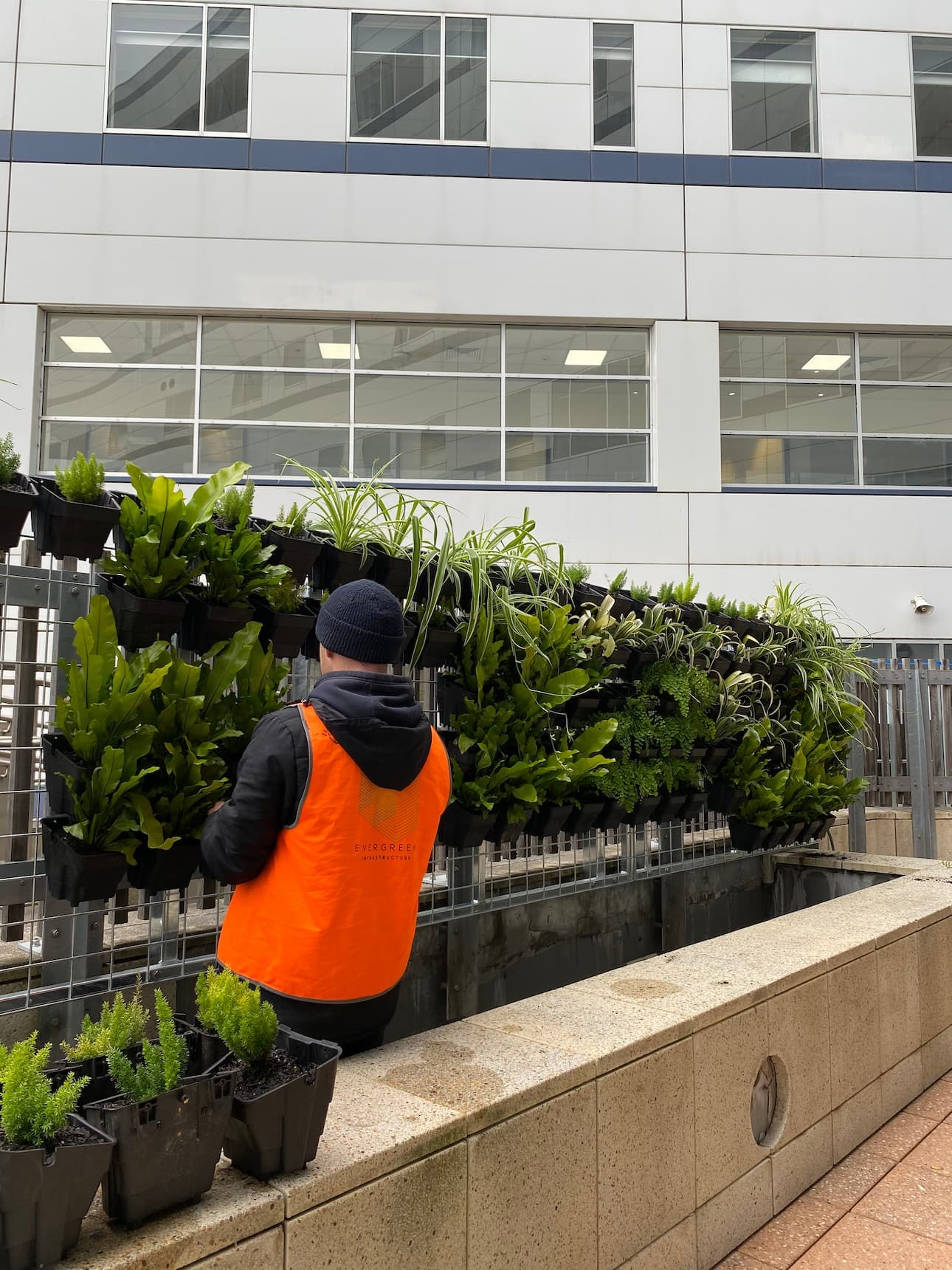
Some plant loss is normal each season. Keep replacement stock available for fast-growing species and budget for periodic replanting.
Fertiliser frequency depends on the system type. Soil-based modular systems may need only occasional slow-release applications. Hydroponic and felt systems typically require regular fertigation.
Check irrigation emitters for blockages regularly. In Australian summer conditions, a single blocked zone can cause rapid plant stress or death within a module.
Prune climbers on green façades regularly to maintain coverage without overloading the support system. Remove dead plant material promptly to reduce fire risk on combustible façades.
FAQ
Can a green wall survive on rainfall alone in Australia?
Vertical systems hold only a small amount of growing media, so plants run out of moisture quickly during dry periods. A 2018 study by Medl et al. found that green walls without irrigation suffered drought stress, while irrigated walls stayed healthier. For most climates, a dedicated irrigation system is strongly recommended over relying on rainfall.
What is the difference between a green wall and a green façade?
Living walls typically achieve higher foliage density and can provide strong shading and cooling. But they are more technically complex, and they need integrated irrigation and fertilisation. Green walls also demand more intensive maintenance than most green façades.
How much does ongoing maintenance cost for an outdoor green wall in Australia?
Maintenance packages for outdoor living walls typically run $200–$2,000 per month. The price depends on system size, access, and complexity. A formal maintenance contract with a specialist provider is a reliable way to protect a living wall investment over time.
Does an outdoor green wall add to fire risk?
An outdoor green wall can add to fire risk if it's poorly designed or maintained. Dried plant material and plastic irrigation components are combustible.
A 2021 article by This Is Construction notes that most multi-storey buildings need a fire engineer to check that a green wall is safe. This is to show compliance with NCC requirements for external wall fire spread.
Living vegetation holds moisture and lowers surface temperatures. That being said, keeping plants healthy is essential to manage fire performance.
Can an outdoor green wall improve mental wellbeing?
A 2025 systematic review by Zandi and Wung found that being near living plants is consistently linked to lower stress and better wellbeing. This held across settings like hospitals and care facilities, and extends to green walls in everyday spaces.
Building a green wall that lasts
A successful outdoor green wall comes from good sequencing, not luck. The best walls are the ones where the load, waterproofing, irrigation, and plants were all sorted before the build started. Treat the build as a long-term commitment rather than a one-off install, and it will reward you for a decade or more.
If you're planning a green wall and want it done properly, Evergreen Infrastructure can help. We've delivered green wall and green roof projects across Melbourne and Victoria. The Melbourne International Flower and Garden Show green wall is an example of our work.
We offer end-to-end service. This includes consulting, design, project management, and long-term asset management. Contact our team to discuss your project.
We create green oases in urban settings
We'd love to discuss how we can partner to bring innovative, sustainable solutions to your urban environment.