.webp)

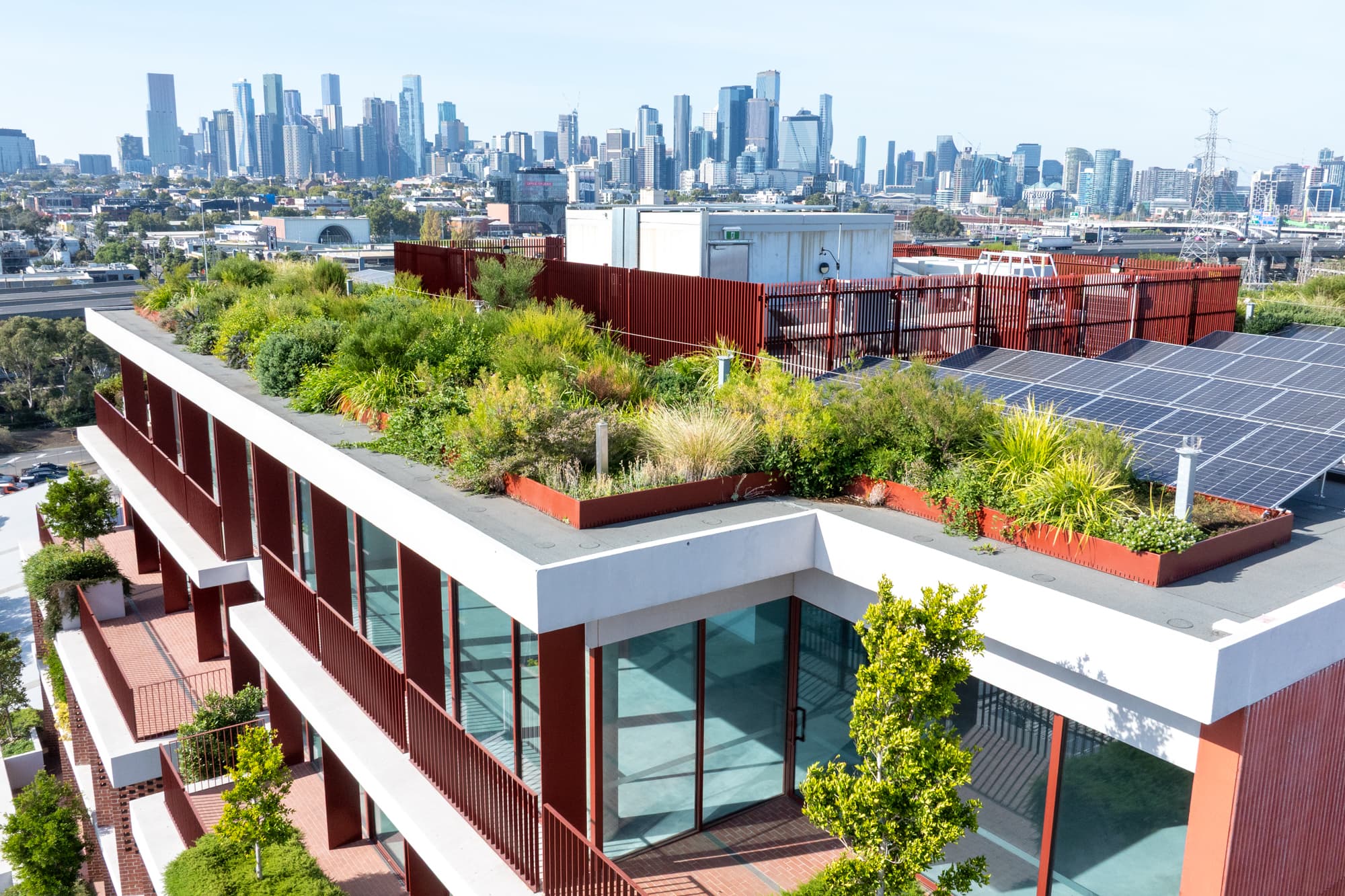
A biosolar roof combines solar panels with a vegetated green roof instead of a bare membrane. The two systems perform better together than either does alone. Vegetation cools the rooftop through evapotranspiration and shading. This keeps the panels measurably cooler and increases their electricity output. The green layer also retains a substantial share of rainfall and cuts heat flowing into the building below. It creates a habitat that supports insects, birds, and plant species. The trade-offs are cost and load. Green roofs can substantially raise the cost of a roof. Saturated substrate plus mounting frames need a structural engineer's sign-off. Solar rebates are unaffected. STC eligibility depends on the system's technical specs, not what's growing underneath it.
A biosolar roof is a green roof combined with solar panels. Its main benefit is that it produces more electricity than solar panels on a bare roof. Studies comparing vegetated and non-vegetated roofs confirm this.
Australia has the highest uptake of household solar power in the world. Hundreds of thousands of new rooftop systems are installed each year, and millions are now in operation nationwide.
Rooftop solar has become a significant contributor to national grid generation. Its share has risen sharply over the past few years. That makes any efficiency gain, including from biosolar roofs, increasingly important.
What is a biosolar roof?
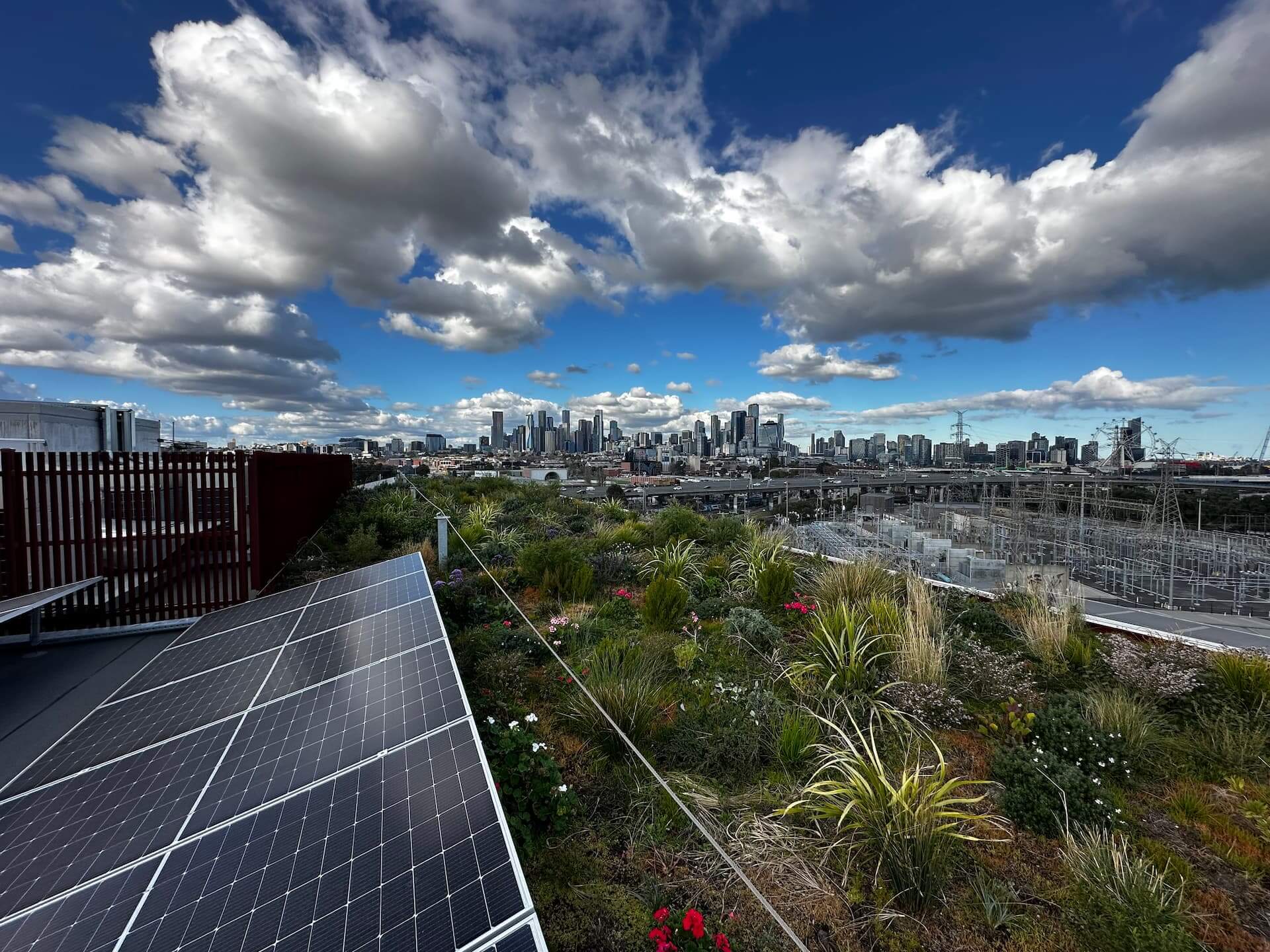
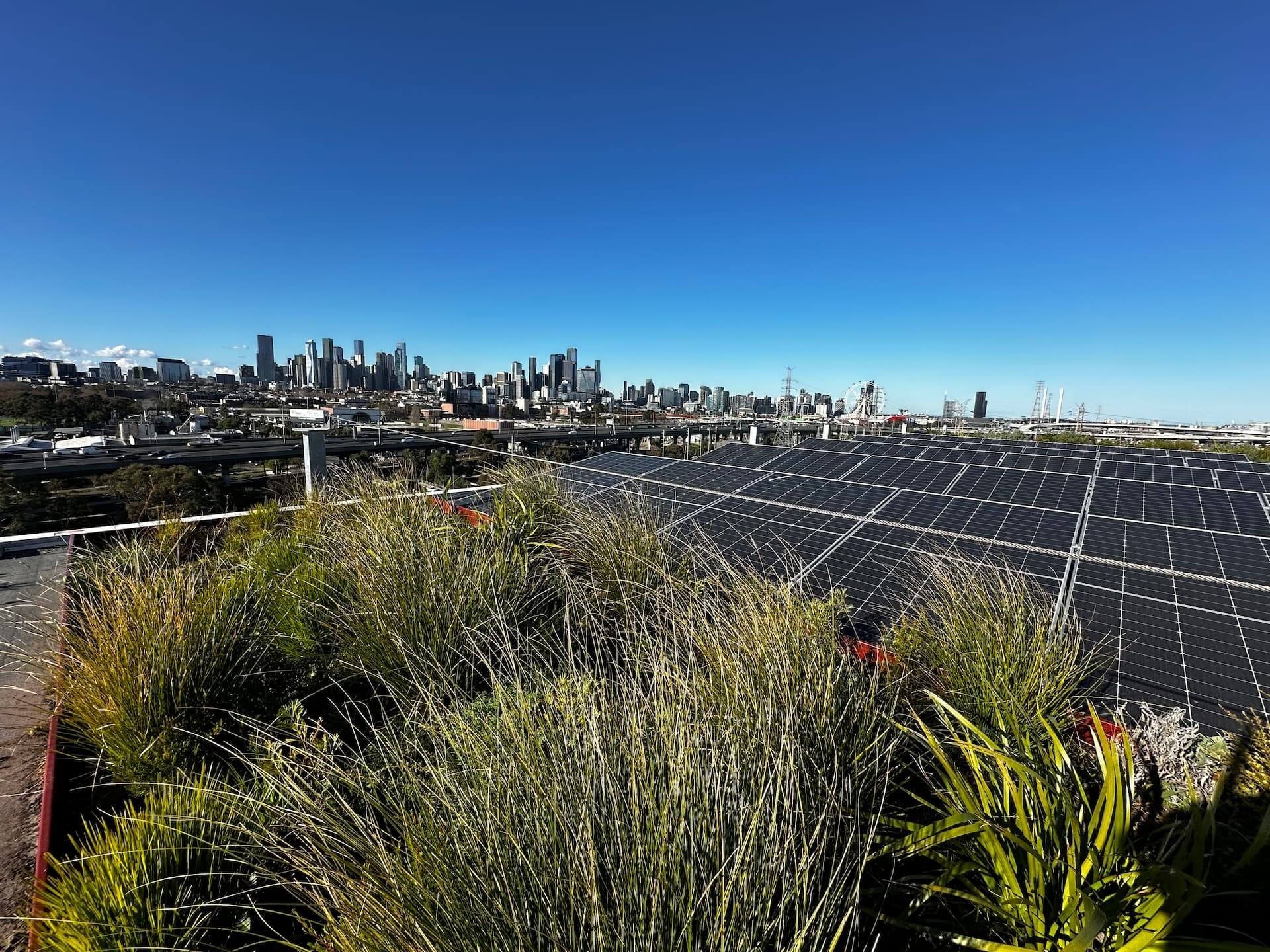
A biosolar roof combines a vegetated green roof with rooftop solar PV on the same structure. The panels sit on frames above the planted layer.
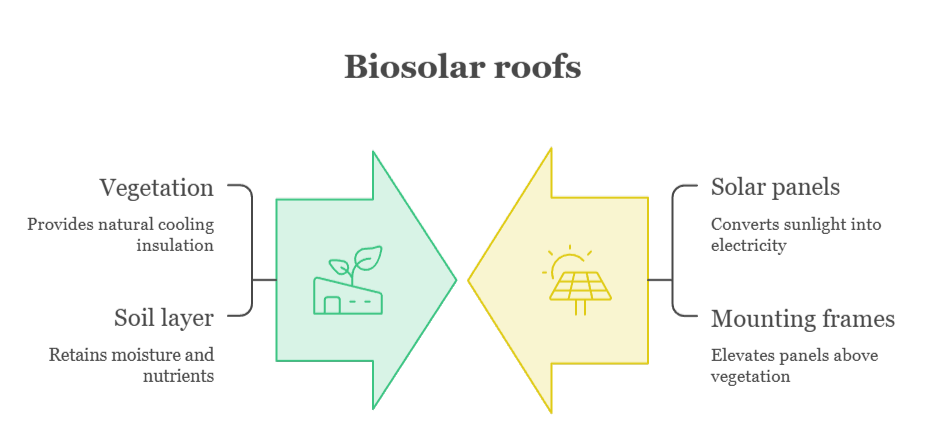
Roof space is limited, so the two systems are often treated as competing options. In fact, they work better together than either does alone.
Solar panels lose efficiency as they heat up, and a conventional roof makes that worse. Dark membranes and exposed concrete can push surface temperatures well above the surrounding air. This, in turn, warms the panels above them.
A green roof counteracts this by cooling the rooftop microclimate. A 2023 UTS study found that biosolar roof panels can run up to 8–9.6°C cooler than panels on a bare roof during Australian summers.
Why do green roofs make solar panels more efficient?
Green roofs improve solar panel output because vegetation keeps the rooftop cooler. In turn, cooler panels convert sunlight into electricity more efficiently.
Solar.com puts the temperature coefficient of most solar panels at around −0.3% to −0.5% per degree Celsius. This means efficiency drops by 0.3–0.5% for every degree above the standard test temperature of 25°C.
On a bare roof in an Australian summer, panels can exceed this threshold significantly. Greentech Renewables estimates losses of 10–25% against standard test conditions.
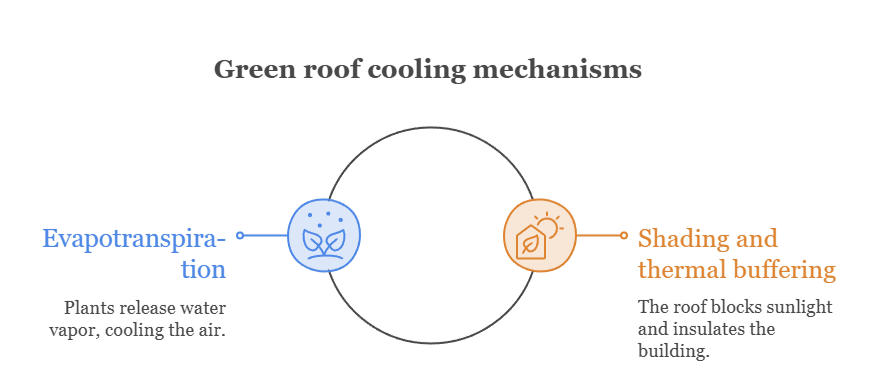
A lower ambient temperature increases PV panel performance by −0.2% to −0.5% for every degree of cooling, according to Solar Calculator. A green roof achieves this cooling through two mechanisms:
- Evapotranspiration
- Shading and thermal buffering
Evapotranspiration
Evapotranspiration is the process by which plants release water vapour through their leaves. This draws heat out of the surrounding air and reduces the temperature around and beneath the panels.
On a green roof, this helps maintain more favourable operating temperatures and improve output, according to van der Roest et al. (2023).
Shading and thermal buffering
Shading and thermal buffering describe how the substrate and plant canopy absorb solar radiation. On a bare roof, that radiation would heat the membrane directly.
Experiments on green roof–PV systems consistently show lower rooftop air and module temperatures than on bare roofs. Energy yield rises as a result.
A rooftop study in Malaysia found module temperatures around 17% lower than on an equivalent bare roof system. That lifted average power generation by roughly 1.6%.
A Sydney biosolar case study recorded panel surface temperatures up to 9.63°C lower than a bare roof. Modelling suggests this translates to around 4.5% more electricity at a given light level.
What does Australian research show about biosolar roof performance?
Australian-specific biosolar research confirms the performance gains seen in international studies.
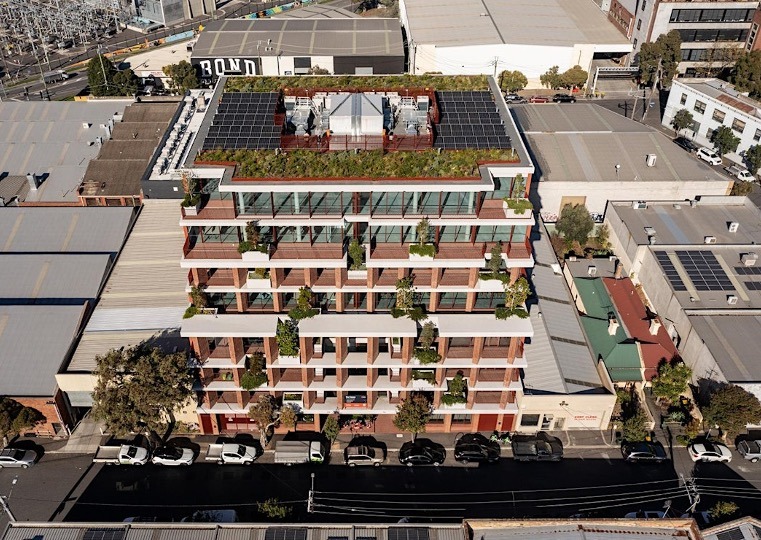
Let's take a look at the Barangaroo biosolar study. It was led by the University of Technology Sydney, in partnership with Lendlease and Junglefy. The study compared two adjacent, near-identical commercial timber office buildings:
- The International House with a conventional rooftop PV system
- The Daramu House with an integrated biosolar roof combining a green roof and PV panels
The biosolar roof produced about 3.63% more electricity than a conventional rooftop PV system over eight months (around 9.5 MWh extra).
Modelled analysis of the same study indicated roughly a 4.5% average increase in hourly output and seasonal gains of 4–5%.
This translated into an additional 14.26 MWh of generation and 11.55 tonnes of CO₂‑equivalent emissions avoided.
Melbourne modelling by Jamei et al. (2023) found that complex green roofs can lower roof‑level air temperature by about 1.5 °C. They can also improve rooftop thermal comfort by 2.38 °C on hot days.
How do green roofs and solar panels manage stormwater?
A green roof retains rainfall in its substrate and plant layers, releasing it slowly or not at all. This reduces the volume and speed of stormwater entering urban drainage systems.
A global 2022 review by Alim et al. reported an average water retention capacity of around 66.2% for green roofs.
In a study of 84 rain events, green roofs retained more than 50% of 409 mm of cumulative precipitation. This study was conducted by J. Lönnqvist et al., and it was published in the 2025 Journal of Hydrology.
Zhang et al. (2021 found that green roofs with 15 cm substrate depth retain more stormwater than those with 10 cm substrates. They also attenuate peak runoff more effectively.
This matters for biosolar design. Deeper substrates provide more retention but add structural load. That's why substrate depth must be balanced against the building's structural capacity.
Solar panels do not negate these stormwater benefits when the system is designed correctly. Mounting frames and cable conduits must be detailed carefully. Poor detailing can break up substrate continuity or concentrate runoff in ways that harm plants.
What are the building energy savings from a green roof with solar panels?
A green roof with solar panels reduces a building's cooling load through two routes:
- The vegetated roof insulates and cools the roof assembly
- The solar panels convert solar energy into electricity rather than heat
In a Sydney case study, green roofs reduced rooftop heat flow by up to 55.54%. They also lowered surface temperatures by up to 20°C on hot days.
Modelling for an Australian city found that adding 30% green roof area reduces electricity consumption by 2.56 W/m²/day.
Kazemian et al. (2025) report electrical efficiencies of 8–16% for PVT systems, which produce both electricity and usable heat. Thermal efficiencies range from 18 to 84%, and overall energy efficiencies reach up to 97%. The same paper reports emissions savings of 25–183 kg CO₂ per square metre per year.
What does a biosolar roof cost in Australia?
A biosolar roof combines green roof construction costs with rooftop solar system costs. Each component has distinct cost drivers.
Green roof costs
Extensive green roofs in Australia cost between $155 and $465 per square metre. Intensive green roofs cost between $420 and $835 per square metre.
For a 100 m² roof, the base green roof cost ranges from $20,000 to $50,000. A green roof project can cost anywhere from $30,000 to $90,000. That figure takes in structural reinforcement, irrigation, design fees, and maintenance.
The table below shows typical cost components for a green roof in Australia.
Source: Evergreen Infrastructure
{{cta}}
Solar system costs
A 6.6 kW residential solar system in Australia costs between $5,000 and $6,000 after rebates in 2026. A 10 kW system costs around $8,000–$10,500.
The national average installed price is $0.88–$0.95 per watt, including GST and the Small-scale Technology Certificate (STC) rebate.
STCs under the Small-scale Renewable Energy Scheme act as a point-of-sale discount that typically covers around 20–30% of a solar system's cost. Although, the amount declines each year as the scheme tapers toward its 2030 close.
Australian homes with rooftop solar typically save about $1,400–$1,500 a year on electricity. Many typical systems achieve payback in about 3–5 years, depending on system size, tariffs, and location.
What are the structural requirements for a green roof with solar panels?
A biosolar roof imposes combined dead loads on the structure. These come from:
- Saturated substrate
- Mature vegetation
- Solar modules
- Mounting frames
- Maintenance access structures
A licensed structural engineer should assess the existing building before installation.
Intensive green roofs can have soil depths of 150–610 mm and weigh 391–976 kg/m². The cost of structural strengthening can vary from $215 to $538 per m². It depends on the complexity and the required level of strength increase.
Extensive green roofs with lighter substrates impose lower loads and work on a wider range of existing buildings. When solar is added, mounting systems should spread loads across the roof surface.
The waterproofing membrane and the plant substrate must also be protected. This means coordinating the root barriers, drainage layers, and cable routing.
Does adding solar panels reduce a green roof's biodiversity value?
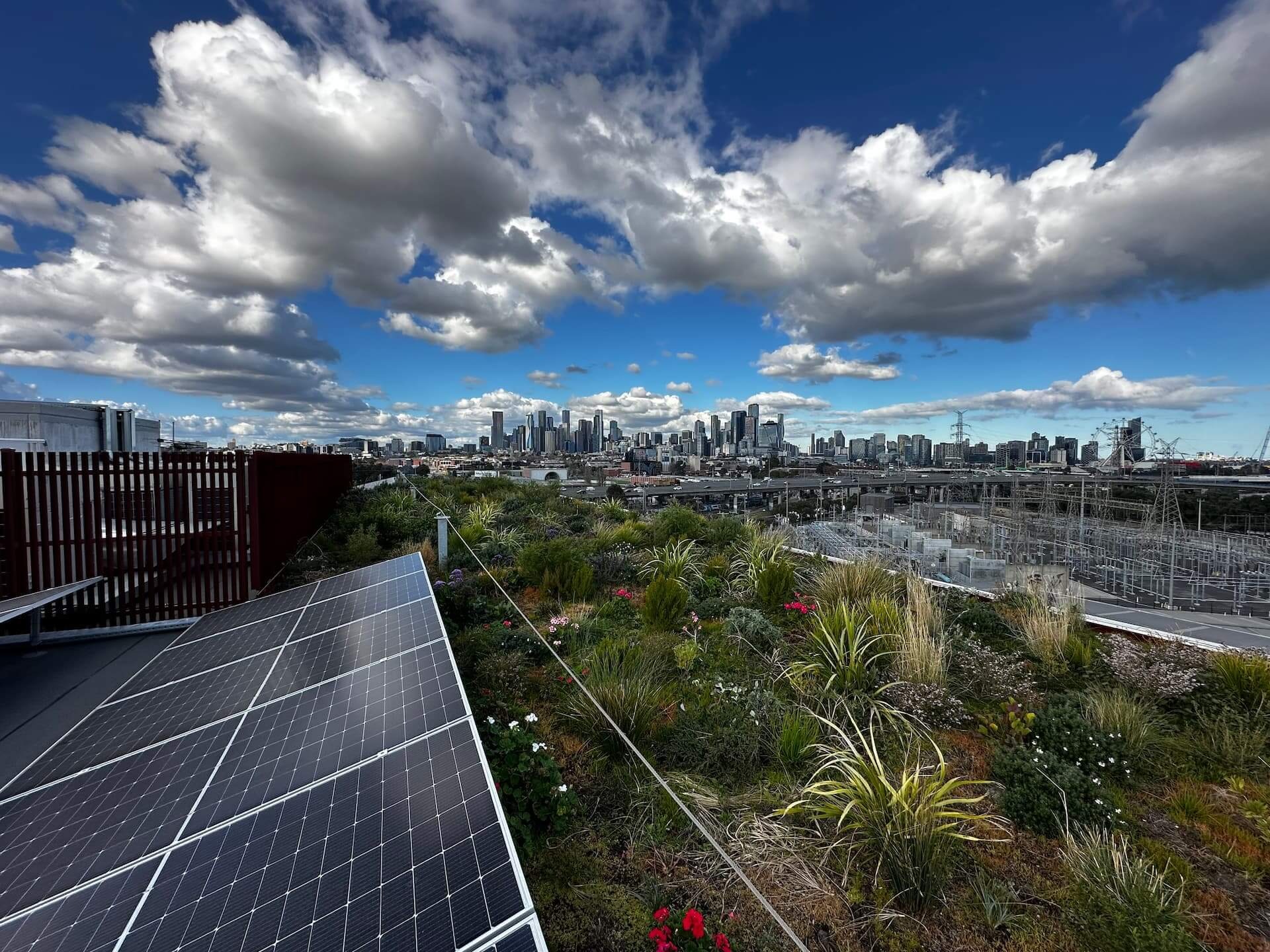
Solar panels do not reduce biodiversity value when the biosolar system is designed well. Panel structures can create extra microhabitats. They do this by introducing varied light, moisture, and shelter conditions across the roof.
The Barangaroo biosolar study found substantially more insect and bird life on the vegetated roof than on a comparable bare roof. Native species, including blue-banded bees and lychee metallic shield bugs, were recorded on the roof.
Shaded areas beneath panels support moisture-tolerant plant species. Drier areas on the sunny side of panels support drought-tolerant species.
This variation, sometimes called a habitat mosaic, increases plant diversity. This, in turn, supports a wider range of invertebrates, pollinators, and birds.
Species selection is critical. Low-growing, drought-tolerant plants suited to the rooftop microclimate perform best. Panel height and spacing must be sufficient to maintain plant health and allow safe access.
Is a biosolar roof eligible for solar rebates in Australia?
A biosolar roof is eligible for STCs under the Small-scale Renewable Energy Scheme, provided the solar system meets standard eligibility criteria. The system must have a capacity less than 100 kW and a total annual electricity output less than 250 MWh.
Panels and inverters must appear on the Clean Energy Council's approved products register. STCs are traded on the market, and their value fluctuates.
CER's December 2024 carbon market report shows a spot price of about $39.90 per certificate. Many installers assume a retail value close to $38, noting that prices can vary over time.
The presence of a green roof beneath the solar array does not affect STC eligibility. Eligibility is based on the solar system's technical characteristics, not the roofing surface below it.
Australia has some of the highest household rooftop solar uptake in the world. Both per capita PV capacity and household penetration rank among the global leaders.
More than 300,000 rooftop solar systems were installed in 2024, bringing the national total to more than 4 million. Rooftop solar provided 12.4% of national grid generation in 2024, up from 6.5% in 2020.
FAQ
What is the difference between a green roof solar system and a conventional solar installation?
A green roof solar system places solar panels above a vegetated roof substrate rather than directly on a bare roof membrane. The vegetation cools the rooftop through evapotranspiration and shading, reducing panel operating temperatures.
The Barangaroo comparative study found the biosolar array produced about 3.6% more electricity over eight months. That came to an extra 9.5 MWh, worth roughly A$2,595.
How much more electricity does a biosolar green roof produce than a conventional solar roof?
Fleck et al. (2022) found the biosolar roof produced 4.5% more hourly electricity on average than the conventional rooftop PV system. Seasonal gains ranged from 4.14% in spring to 5.21% in autumn. Gains at peak generation times can reach 20%.
Can a green roof with solar panels meet Water Sensitive Urban Design (WSUD) requirements?
Green roofs contribute to WSUD objectives by retaining and detaining stormwater at the source.
A global study found that green roofs have an average water retention capacity of around 66.2% worldwide.
Whether a biosolar roof meets WSUD requirements under Australian planning frameworks depends on:
- Substrate depth
- Vegetation coverage
- The stormwater targets set by the relevant council or water authority
Do solar panels on a green roof affect plant health?
Solar panels alter the microclimate beneath and around them. They create shaded, drier, and wetter zones depending on panel orientation and rainfall run-off patterns. When species are chosen to match these varied conditions, plant health is maintained, and diversity can increase.
The Barangaroo study recorded a seven-fold increase in insect life on the biosolar roof. Poor species selection or insufficient panel spacing can cause plant stress. This is why integrated design is essential.
What planning requirements apply to green roofs in Australian cities?
The City of Sydney requires vegetation on at least 30% of available roof space for a roof to count as a green roof. Solar panels and mounting hardware don't affect that classification, as long as the coverage threshold is met.
Melbourne's biodiversity green roof guidelines cover plant selection, substrate depth, and microhabitat design. The same framework adapts readily to roofs with solar arrays.
Green roofs and solar panels: better together than apart
Roof space is finite, which is why green roofs and solar arrays are so often framed as an either/or decision. The evidence points the other way. Pairing them produces more electricity, better stormwater performance, and lower cooling loads.
The catch is that these gains depend entirely on integrated design. Substrate depth has to be balanced against structural capacity. Species chosen to suit the shaded and exposed zones the panels create.
Done properly, a biosolar roof isn't a compromise between two competing uses. It's a single system that outperforms both.
That integration is exactly where Evergreen Infrastructure comes in. We design and build green roofs across Australia.
We work with structural, solar, and waterproofing teams from the earliest stages of a project. The growing medium, drainage, and panel layout are planned as one system rather than stitched together on site.
Get in touch with Evergreen Infrastructure to find out what your roof can support and what it could deliver.
{{cta}}
We create green oases in urban settings
We'd love to discuss how we can partner to bring innovative, sustainable solutions to your urban environment.