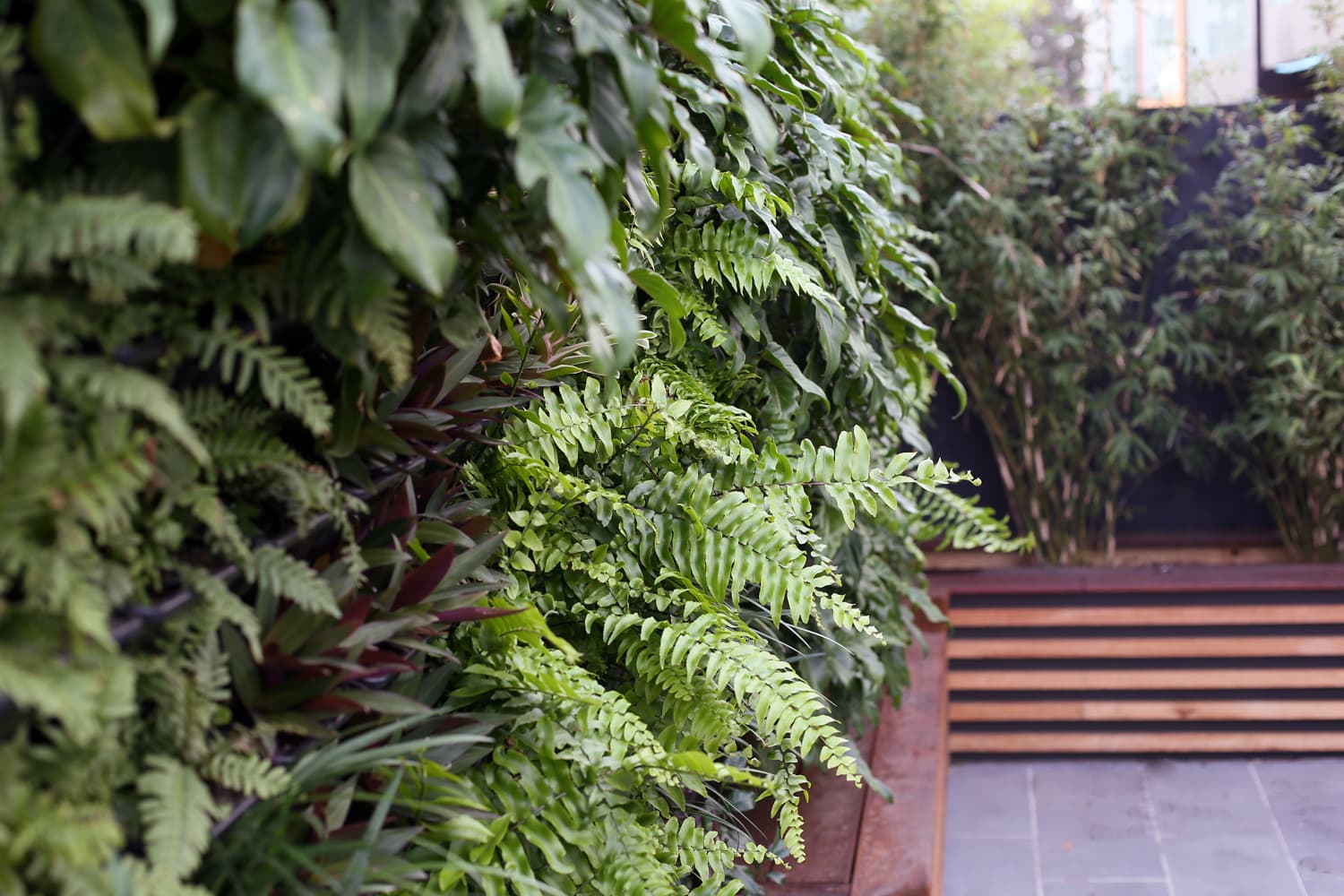
.webp)

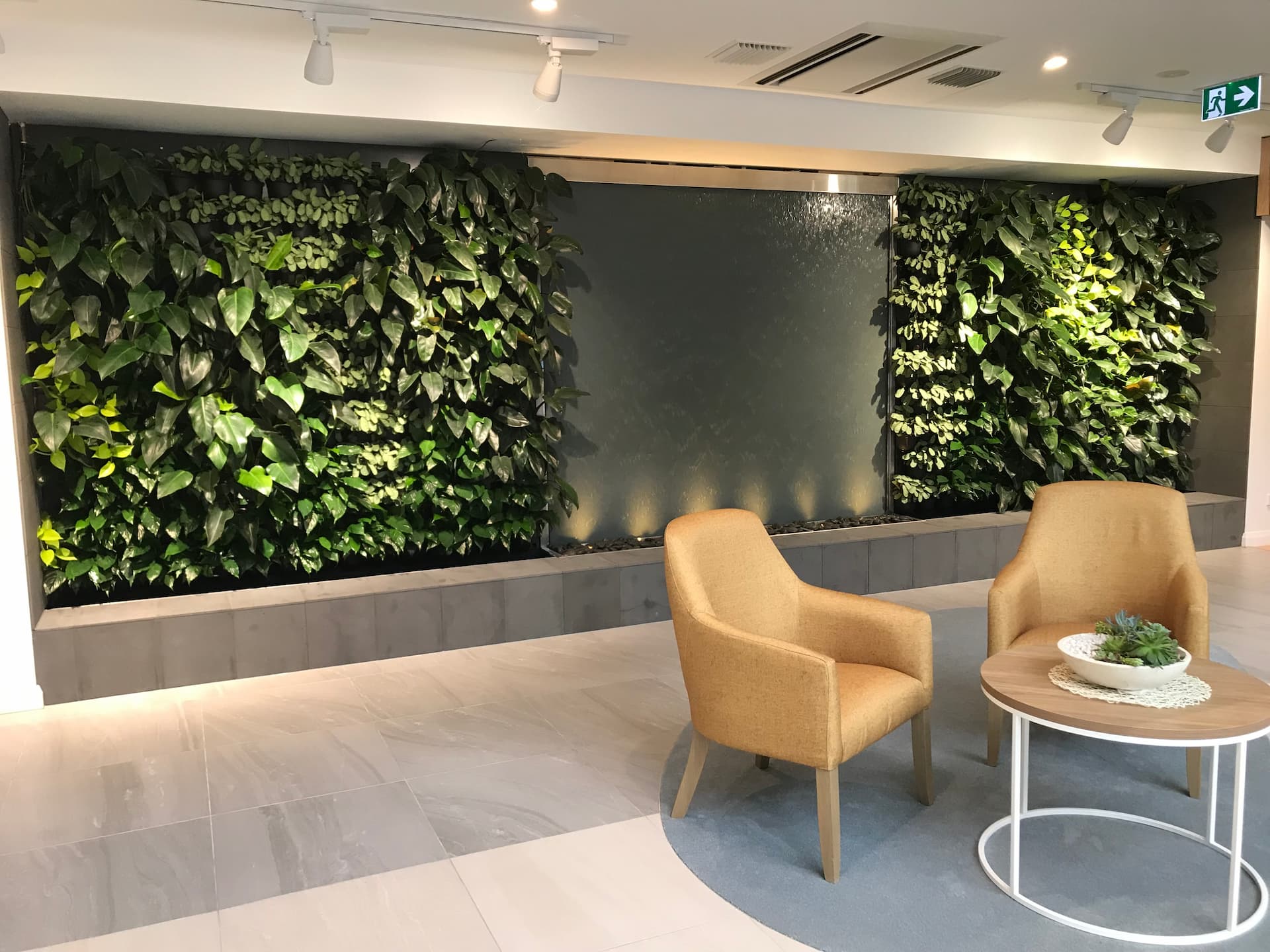
Living walls can't run on rainfall. There's very little growing media on a wall, and it dries out within days, so a built-in watering system is essential. For felt-based outdoor walls, budget roughly 2.5–9 litres per square metre per day. Use pressure-regulated drip, not sprinklers. Divide the wall into separate watering zones based on which way each section faces and what's planted there. Water two to three times a week during the establishment phase. Cut back through winter and use moisture sensors rather than a fixed timer. Maintenance carries as much weight as design: inspect monthly to weekly, flush out the pipes monthly, and test the system annually.
Vertical garden irrigation is the planned supply of water to living walls, green façades, and combined roof-and-wall systems. Every living wall needs a watering system. The growing media is shallow, it dries out quickly, and rain mostly runs off a wall rather than soaking in.
In Australian cities, summer heatwaves are intense, and rainfall is highly variable. A system that doesn't deliver enough water leaves plants stressed and the wall patchy, and repairs are costly. A well-designed wall keeps the planting dense enough to cool the building and support wildlife.
Living walls hold plants in a shallow layer on the wall itself, while green façades are climbers rooted in the ground or in planter boxes. That difference is why one needs watering year-round and the other barely at all.
Why irrigation is essential for vertical gardens
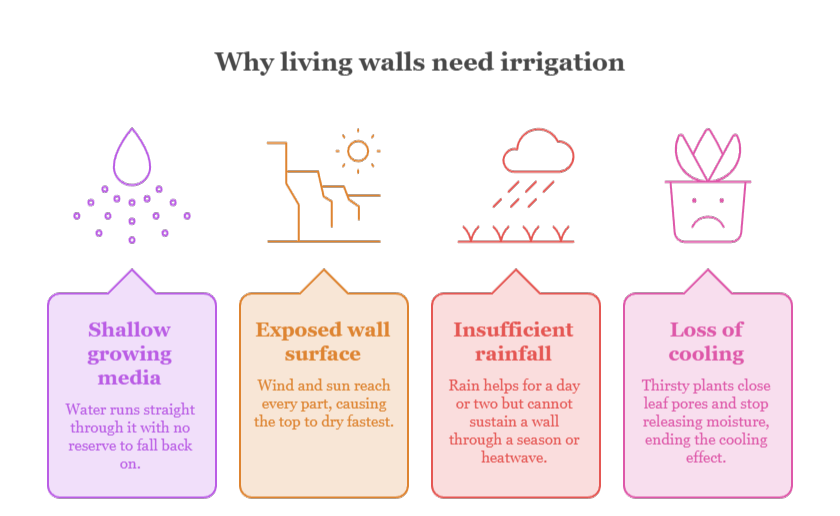
Irrigation is not optional for living walls. The growing media is shallow, and water runs straight through it. For outdoor walls, wind and sun can reach every part, and the upper sections always dry out the fastest.
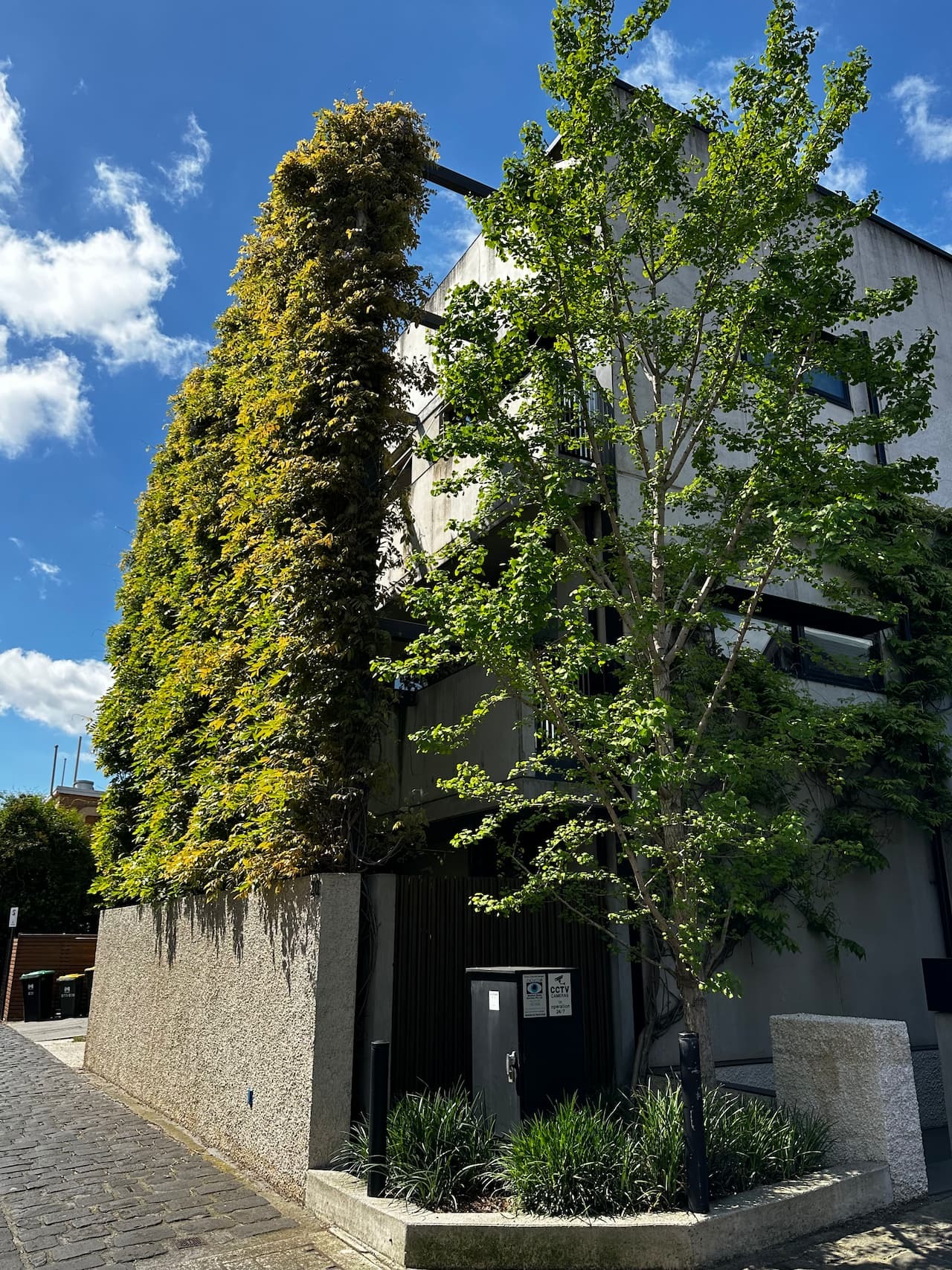
Rainfall provides temporary relief, but it won't keep the wall evenly watered through a season or a heatwave. Non-irrigated green wall plots show clear drought stress in a heatwave, even in mild climates that get plenty of rain.
Irrigation also determines whether the wall delivers its expected thermal benefit. According to Chung et al. (2021), a green façade only delivers its full cooling effect when it's watered enough to grow dense leaf cover.
Without a reliable water supply, plants close their stomata, and transpiration stops. In turn, the cooling benefit disappears.
How much water does a vertical garden system use?
A 2021 journal paper by Pérez-Urrestarazu reports average use of felt-based outdoor living walls at roughly 2.5–9 litres per square metre per day. A 2019 Madrid study by Segovia-Cardozo et al. of a single living wall measured substrate water retention at about 19.3 litres per square metre. That's a measure of how much water the growing media holds, not how much the wall uses in a day.
The seasonal swing is wide. A 2019 Australian study by Prodanovic et al. tested five green wall species. It found that daily needs ran from 4.3 litres per square metre in summer to 0.5 in winter.
Water demand varies by system type, plant selection, climate zone, and wall orientation. It also changes throughout the year, rising in warm weather and falling in cool weather. No published figure will match your wall exactly, so use them to sanity-check your own numbers rather than to set them.
What types of vertical garden irrigation systems are available?
Three irrigation approaches are used in living wall installations. Direct water line systems are generally preferred for outdoor and larger installations. However, they need backflow protection, though, and your plumber needs to be brought in early rather than at fit-out.
How to design a watering system for a vertical garden
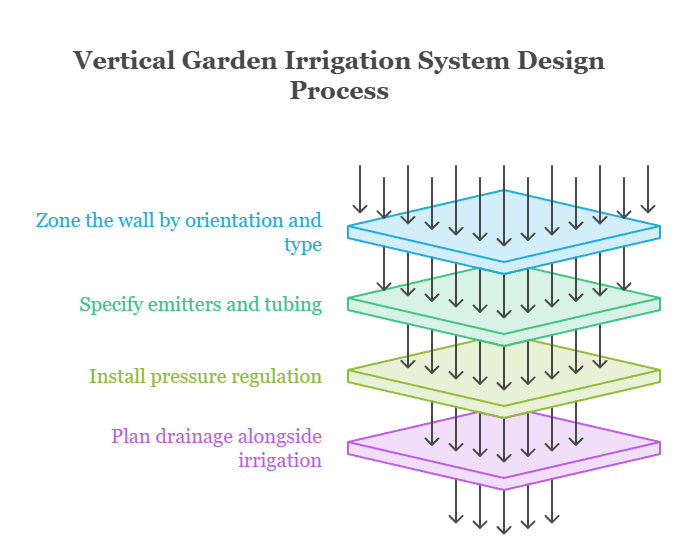
Design your vertical garden irrigation system by zoning the wall by orientation and plant type. Then, specify drip emitters rated to the system's available flow and pressure and set up pressure regulation. Connect to a non-potable water source where possible.
Zone by orientation and plant community
In Australia, north- and west-facing walls get the most sun. They also carry the highest irrigation demand, while south-facing walls generally need less.
It's important to group species with similar water needs into hydrozones. That way, you won't overwater drought-tolerant species or underwater moisture-demanding ones.
Specify emitters and tubing correctly
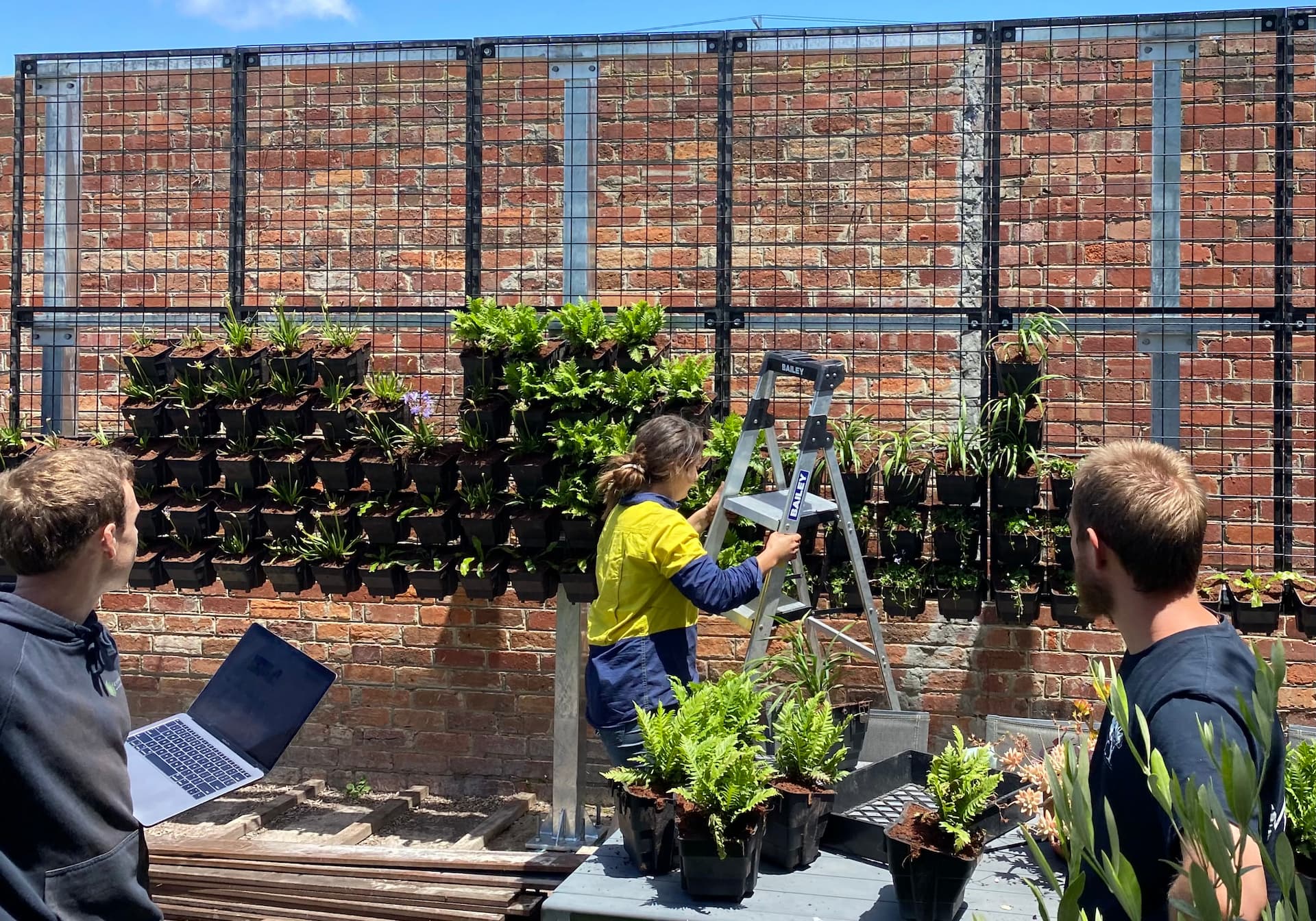
Florafelt's felt-based living wall installation guide recommends:
- 5/8 inch (16 mm) irrigation tubing
- 1/2 gallon-per-hour (about 1.9 L/h) button drip emitters, two per planting pocket
Low-flow emitters let the felt soak up the water rather than shedding it down the face of the wall. Using two per pocket spreads water more evenly and gives you a spare if one gets blocked.
Emitters range from 1/2 to 10 gallons per hour (about 1.9–38 L/h). Florafelt advises choosing enough that they total at least 40 gallons per hour (about 150 L/h). This is the minimum a pressure regulator needs to do its job.
Install pressure regulation
Drip systems on living walls need a pressure regulator to bring supply pressure down to 30 psi (about 200 kPa). Without one, the emitters and connectors might blow off the tubing.
Pressure regulators used in these systems have a minimum flow rating of 1/2 gallon per minute, or 30 gallons per hour (approximately 115 L/h). Australian mains water pressure regularly exceeds the upper threshold. Regulating pressure at the supply point is essential.
Hunter Industries publishes maximum run lengths for its HDL dripline by emitter rate, spacing, and pressure. The minimum operating pressure is 10 psi (about 70 kPa) for HDL-PC and HDL-R, and 15 psi for HDL-CV.
Always confirm that local operating conditions match the product's hydraulic assumptions.
Plan drainage alongside irrigation
Proper drainage prevents waterlogging and allows excess water to escape. Uncontrolled runoff can cause staining, slip hazards, and potential structural damage.
Collect drainage at the base and direct it to a drain point or storage tank. On building façades, check the drainage design against the waterproofing. It shouldn't compromise the membrane or open up a path for water to get into the building.
How to schedule irrigation for a vertical garden
Schedule irrigation using short, frequent cycles during establishment and summer. Reduce frequency in winter.
Plants take up significantly less water in cooler months. A schedule calibrated for January in Melbourne will overwater in July.
Establishment phase
The GIZ/UNEP Implementation Guidelines recommend watering green walls two to three times a week. This supports healthy plant establishment during the critical early period.
Establishment is not brief. The University of Melbourne's green roof guidelines put it at several months, sometimes up to two years. Throughout this period, irrigation is critical.
Plant roots are still developing during this phase, and moisture stress causes plant loss that is expensive and slow to recover from.
Long-term scheduling
Once plants have rooted in, watering settles into a steady pattern. Two things set it: how much water the system can hold, and how fast the wall loses it.
A wall with wick reservoirs behind each module can go a day or more between waterings. A felt wall holds almost nothing and needs several short cycles a day.
Duration matters as much as frequency. Run each cycle until the growing media at the base of the wall is damp but not streaming. Make sure to check that setting again as the seasons turn.
Adaptive and forecast-driven control
Rather than running to a fixed timer, tie watering to what the wall is actually holding. Moisture sensors in the growing media let the system water when the wall needs it and skip when it doesn't.
A fixed schedule drifts out of step as the seasons turn, which is the most common cause of both overwatering and dieback.
What water sources can supply a vertical garden watering system?
A vertical garden watering system can draw from:
- The mains potable supply
- Harvested rainwater
- Greywater
- Recycled water
Non-potable sources reduce operating costs and support Water Sensitive Urban Design (WSUD) compliance. WSUD requirements vary by Australian state and council. However, many jurisdictions mandate or incentivise it in development planning.
Feeding the wall from a rainwater tank or recycled supply is one of the more straightforward ways to meet WSUD requirements. Where rainwater is used, backflow prevention is mandatory under Australian plumbing standards.
Before connecting to the irrigation system when you use recycled water or treated greywater, make sure to confirm:
- Treatment levels
- Cross-connection controls
- Public health requirements
How to maintain a vertical garden irrigation system
Irrigation maintenance comes down to these routines:
- Inspecting operations monthly to weekly
- Flushing lines at least monthly during active irrigation periods
- Testing the overall system function annually
The University of Melbourne's green roof guidelines recommend inspecting the irrigation system regularly. Monthly is enough on low-maintenance roofs.
However, high-use roofs need weekly checks, especially through spring and summer. Living walls generally sit at the high-maintenance end or above it, given their smaller water reserve.
Annual testing should also be carried out after systems have been idle for a period. Substrate depth should be kept within about 2.5 cm of the designed depth. The reason for this is that shallow substrates hold less moisture and require more frequent irrigation.
How does irrigation interact with building performance?
Irrigation determines whether green wall and roof systems deliver their expected cooling benefits. It makes it a building performance decision as much as a horticultural one.
A 2022 GIZ guideline gathers figures for both roofs and façades. Green roofs cut summer heat flow through the roof by 80% and summertime energy use by 2.2–16.7% depending on roof type and coverage. In Hanoi, a green façade lowered indoor temperature by about 1°C and cut cooling costs by up to 35% over five hours of air-conditioning.
The evapotranspiration behind these savings depends on substrate moisture. When plants run short of water, they close the pores in their leaves and stop releasing moisture. The cooling stops with them, leaving only the shade the leaves cast and whatever heat the growing media soaks up.
Planning definitions often turn on plant cover, so losing plants can mean losing compliance. The City of Sydney counts a roof as green only if plants cover at least 30% of the usable rooftop. A bad heatwave can push a roof below that, and irrigation is one way to stop it.
What are the common mistakes with vertical garden irrigation systems?
Four mistakes cause most irrigation failures on commercial installations:
- Relying on rainfall
- Using sprinkler systems
- Applying a single irrigation zone across the whole wall
- Neglecting monitoring
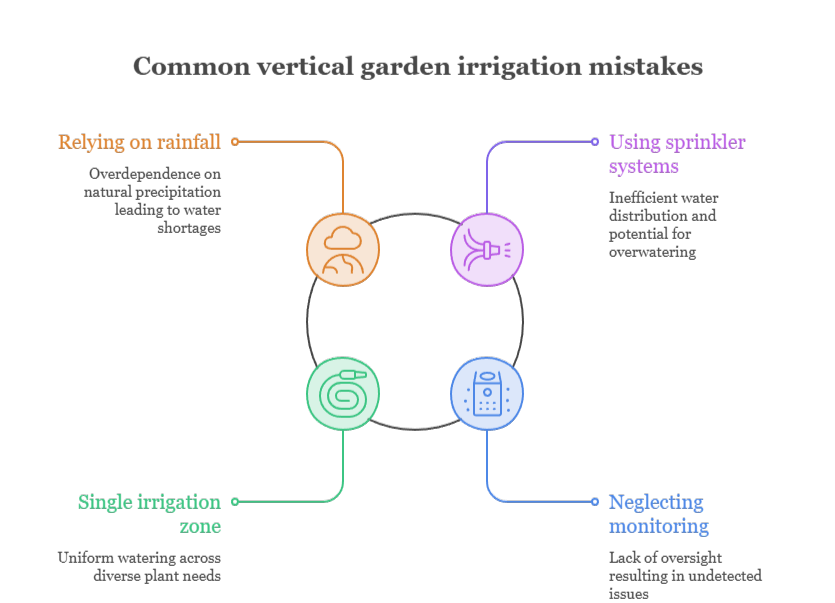
Relying on rainfall as the primary water source
Rain won't keep a living wall alive. A wall catches very little of what falls. The growing media behind it holds days of water at best, and less on the upper sections, where wind and sun are strongest.
Even in mild, wet climates, unwatered walls show clear drought stress in a heatwave. Since adding irrigation to a finished wall is far more disruptive than building it in, design it in from the start.
Using sprinkler systems
Sprinklers are built to water flat ground. Point one at a wall and gravity takes over: the top stays dry while the base floods.
Outdoors, wind carries the spray onto the façade itself, where it stains and works its way into the building. Wet foliage also invites fungal disease.
Use drip emitters instead. Pressure-compensating ones deliver the same measured amount to every module, regardless of how high up the wall it sits. This is the only way to water a tall wall evenly.
Applying a single irrigation zone to the entire wall
One schedule for the whole wall will overwater some sections and starve others. Group plants with similar needs together, splitting the wall by sun exposure, planting density, and height. Existing calculation methods were built for ground-level gardens, so expect to adjust them in the first season.
Neglecting ongoing monitoring and maintenance
Set a timer and walk away, and you'll get blocked emitters, leaks nobody spots, and a schedule that drifts from what the plants need. Recirculating systems need more attention, as salts build up and algae clog the drippers.
A living wall needs daily confirmation that it's running, plus regular pest checks and filter cleaning. A shallow green roof can go far longer between visits.
FAQ
Is artificial irrigation mandatory for all vertical gardens?
Not for all of them. It depends on where the plants are rooted. Living walls hold plants in shallow media on the wall face, which dries out within days, so designed irrigation is essential.
Ground-rooted green façades are the exception. Climbing plants draw on the growing media at the base of the wall and need little or no watering once established. That difference is the main reason green façades cost less to run over the long term.
How often should I water a vertical garden?
Frequency is set by the system more than by the plants. Felt and hydroponic walls hold almost no reserve and need several short cycles a day outdoors. Substrate-based systems with reservoirs run on much longer intervals, and interior walls need the least of all.
Water more often while plants are establishing and less through winter. Tie the schedule to moisture sensors rather than a fixed timer, which is the most common cause of both overwatering and dieback.
Can I connect my vertical garden irrigation to a rainwater tank?
Yes, and it is standard practice on projects following Water Sensitive Urban Design. Harvested rainwater cuts potable demand and can contribute to green building rating credits.
Rainwater pipes have to be kept completely separate from the drinking water supply. You'll also need backflow protection, signed off by your plumber and water authority. Rainwater carries grit that blocks drippers, so budget for filters and someone to clean them.
What goes wrong when vertical gardens are overwatered or underwatered?
Underwatering shows up first at the top of the wall, where exposure is greatest. If only one section is struggling, the problem is usually distribution rather than the schedule.
Overwatering is the more damaging of the two, because saturated media starves roots of oxygen and invites root disease. Persistent damp can also cause mould indoors or track into the building fabric behind the wall. Moisture sensors reduce both risks by matching delivery to what the wall actually needs.
Irrigation is the system, not an add-on
A living wall's irrigation isn't an accessory to the planting. It's what keeps the planting alive, and almost every decision above follows from that.
Design it in from the start, zone it properly, and put someone in charge of watching it. A wall left on a fixed timer will drift out of step with its plants long before anyone notices the bare patches.
At Evergreen Infrastructure, we design and build green roofs, green walls, and rooftop gardens. This includes everything from strategic consulting and design to long-term asset care.
We use smart irrigation, digital monitoring, and BIM workflows to keep systems performing and running costs down. We work alongside architects, engineers, and councils from concept through to delivery. Talk to us about your project.
{{cta}}
We create green oases in urban settings
We'd love to discuss how we can partner to bring innovative, sustainable solutions to your urban environment.