.webp)


Rain gardens are one of the most practical ways to manage stormwater on-site. They cut runoff volumes, slow peak flows, and strip out sediment, nutrients, and hydrocarbons. A well-designed garden drains within 24 to 48 hours, which is too short for mosquitoes to breed. Rain gardens scale from a single downpipe in a backyard up to streetscapes, campuses, and entire urban renewal precincts. They help developers meet WSUD planning requirements and Green Star ratings.
A rain garden is a shallow, planted depression. It captures stormwater runoff from hard surfaces such as rooftops, driveways, and paving.
Water ponds briefly on the surface and infiltrates down through engineered growing media. Plant roots and growing media microbes work alongside the media to remove pollutants. The treated water then soaks into the ground or drains slowly into the wider stormwater system.
Rain gardens reduce the volume, speed, and pollutant load of runoff leaving a site. This protects downstream waterways from sediment, nutrients, and hydrocarbons.
They are a core tool within Water Sensitive Urban Design (WSUD). WSUD shapes how urban water is managed under planning rules across Australia.
What does a rain garden do?
A rain garden reduces the volume, speed, and pollutant load of stormwater leaving a site.
Rain gardens go to work the moment rain hits hard urban surfaces. Runoff picks up oils, fertilisers, sediment, and other contaminants on its way to drains and waterways. A rain garden intercepts that flow before it gets there.
The system works in three stages:
- Stormwater enters the garden through a pipe from a downpipe or a surface channel from a driveway.
- The water ponds briefly in the depressed planting zone.
- The water moves down through a layered growing media profile and then leaves the system.
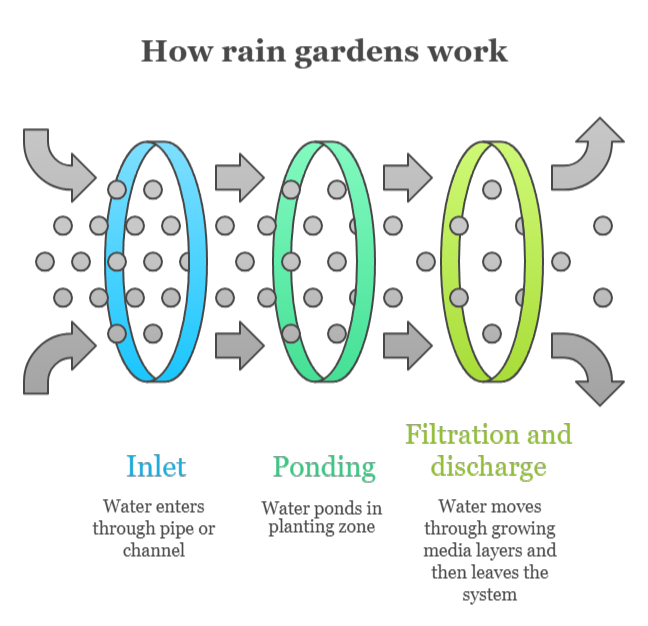
In the third stage, plant roots and growing media microorganisms remove pollutants as the water passes through the media. The treated water either soaks into the ground or drains through a perforated pipe into the wider drainage network.
A properly designed rain garden drains within 24 to 48 hours of a rainfall event. Water pooling longer than this signals a design or maintenance issue, not normal function.
How does a rain garden system work at a technical level?
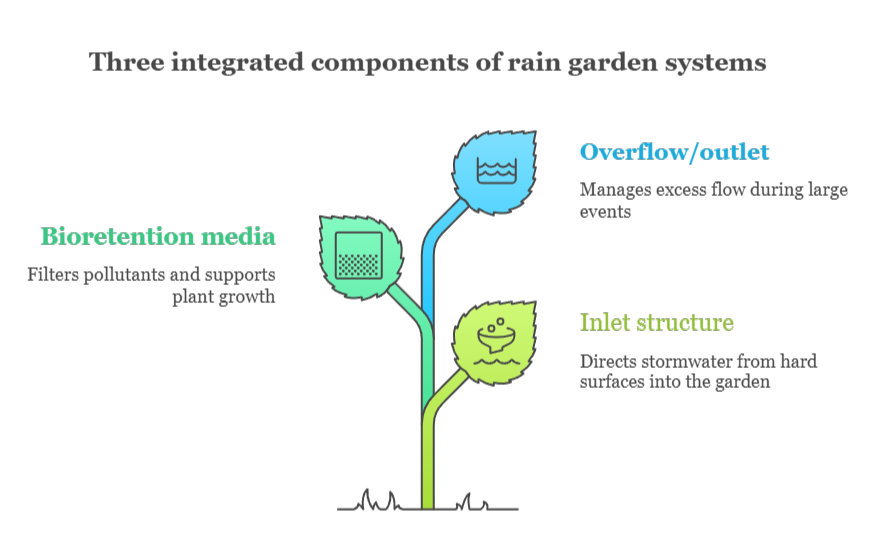
A rain garden system relies on three integrated components:
- The inlet structure
- The bioretention media profile
- The outlet or overflow arrangement
The bioretention media profile sits below the planting zone. It typically includes a loamy sand filter layer, a transition layer, and a gravel drainage layer at the base. This layered profile:
- Slows the water
- Lets pollutants bind to growing media particles
- Gives plant roots a stable growing environment
The growing media layer
The filter media in a rain garden is an engineered mix, not ordinary garden soil. It's commonly a loamy sand with a defined particle size distribution, organic content, and hydraulic conductivity. The mix must drain quickly between rain events but still hold enough moisture for plants.
The plant zone
Plants in a rain garden do more than provide visual interest. Their roots create preferential flow pathways that maintain growing media porosity over time. Root exudates feed growing media microbial communities that break down organic pollutants.
Above-ground biomass intercepts rainfall directly. This, in turn, reduces the volume and force of water entering the system.
The overflow structure
Every rain garden needs an overflow that handles large storms without damaging the surrounding area.
In engineered systems, this is usually a grated pit set at the maximum ponding depth, connected to the stormwater network. In simpler gardens, it can be a rock-lined notch or shallow spillway that directs overflow safely away.
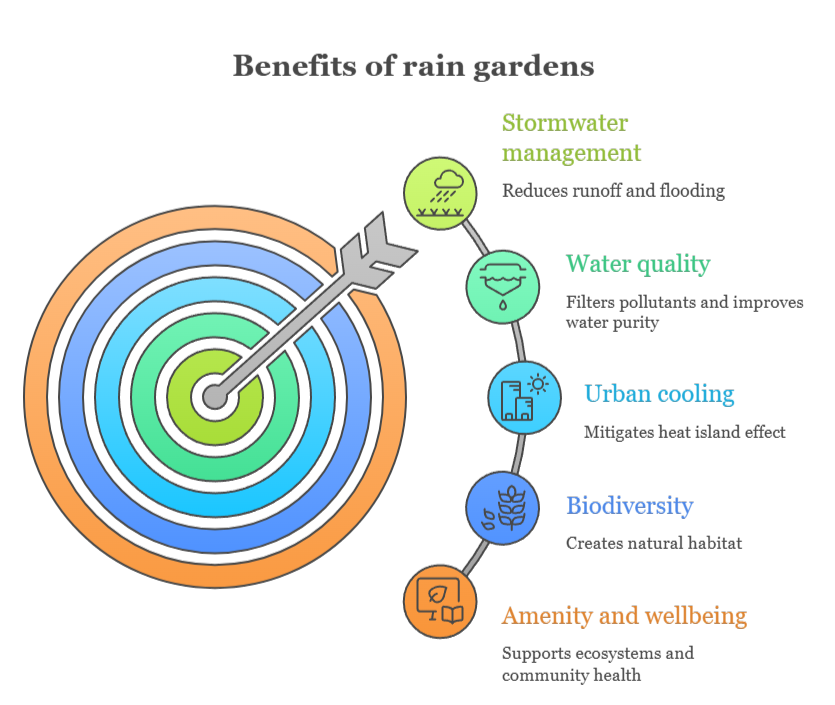
What are the benefits of a rain garden?
Rain gardens deliver:
- Stormwater management
- Water quality
- Urban cooling
- Biodiversity
- Amenity and wellbeing
The table below summarises the primary benefits:
Stormwater management
Rain gardens reduce peak stormwater flows by holding water on-site and releasing it slowly. In dense urban areas, large areas of impervious surface generate rapid runoff. When rain gardens are spread across many properties, they add up to real reductions in downstream flood risk.
Water quality improvement
Urban stormwater is heavily polluted. Rain gardens trap sediment in the filter media. They take up nitrogen and phosphorus through plants and microbes.
Hydrocarbons then bind to organic matter in the soil. The result is cleaner water reaching local waterways and drains.
Urban cooling
Plants and damp growing media release water vapour through evapotranspiration, which absorbs heat from the air. Cities are hotter than the countryside because of the urban heat island effect. Rain gardens help cool things down alongside other green infrastructure.
Biodiversity
Rain gardens add habitat to urban areas where most surfaces are sealed and lifeless. Locally native plants attract insects, which in turn support birds and small reptiles.
The mix of wet and dry zones creates microhabitats that a standard garden bed can't offer. When rain gardens are spread across a neighbourhood, they form stepping stones that let wildlife move through the city.
Wellbeing and therapeutic benefits
Rain gardens are lively, biodiverse spaces that support mental health. This happens through contact with nature, sensory variety, and seasonal change.
In therapeutic landscape design, water, plant diversity, and wildlife are used with intention. Rain gardens bring all three together, which is part of why they support wellbeing.
What plants work best in an Australian rain garden?
The best plants for an Australian rain garden handle both wet spells and long dry periods between storms. In most Australian cities, local native species chosen for the local climate and growing media type perform best over the long term.
Plant selection should cover three functional layers:
- Emergent aquatics or rushes (lowest, wettest zone)
- Moisture‑tolerant groundcovers and grasses (mid‑zone)
- Shrubs and small trees (planted at the garden edge, above the maximum ponding level)
Emergent aquatics or rushes use tall sedges and knobby club-rush–type plants. They go in the wettest zone, where they handle regular flooding and anchor the inlet.
Moisture-tolerant groundcovers and grasses use mat-rushes and suitable flax-lily–type plants. They can cope well with wet–dry cycles.
Shrubs and small trees benefit from extra growing media moisture without sitting in water.
At least 50% of plants should perform nitrogen uptake functions to ensure effective water quality outcomes.
Species selection must always account for:
- Local climate
- Growing media type
- The specific microclimate of the installation site
How do rain gardens fit within WSUD requirements in Australia?
Water Sensitive Urban Design (WSUD) is an approach to planning that manages the urban water cycle as a whole. It covers stormwater, drinking water, and wastewater. The goal is to protect waterways and make cities better places to live.
Rain gardens are one of the most common lot-scale WSUD tools in Australian developments.
In some Australian jurisdictions, larger new developments must meet stormwater quality targets. This includes Victoria, Queensland, Tasmania, and the ACT.
In some cases, there are also flow or volume objectives. Other states rely more on council‑level planning rules to set stormwater requirements.
One example in Victoria is the Clearwater program. The program is hosted by Melbourne Water and supported by government, industry, and research partners. Clearwater provides design guidance for bioretention systems, including rain gardens.
Council permits for medium and large developments often include WSUD conditions, which rain gardens can help meet.
Rain gardens are relevant to multiple planning compliance contexts:
- New residential subdivisions where councils require on-site stormwater treatment before discharge
- Commercial and mixed-use developments seeking Green Star or WELL Building Standard ratings
- Public realm upgrades, including streetscapes, parks, and urban renewal precincts
- Institutional campuses (universities, hospitals, schools) with sustainability targets
What is a residential rain garden?
A residential rain garden is scaled to capture runoff from a single property. It typically serves the roof area from one or more downpipes, plus adjacent hard surfaces such as driveways and paths. It's the most common form of individual rain garden installation.
A residential rain garden is commonly sized at a minimum of about 10% of the contributing hard surface area. Although, the actual size depends on growing media drainage rates and may be higher on poorly draining sites.
For a 150 m² roof area draining to a single downpipe, a 15 m² planted zone provides a reasonable starting point. The precise size depends on local rainfall intensity and growing media infiltration rates.
Worked example: sizing a residential rain garden
A house has a rear roof section of 120 m² draining to one downpipe. The goal is to size a rain garden for that catchment.
- Contributing area: 120 m²
- Target rain garden area (10% rule of thumb): 120 × 0.10 = 12 m²
- Ponding depth: 150 mm (0.15 m)
- Temporary storage volume: 12 × 0.15 = 1.8 m³ (1,800 litres)
This garden briefly holds 1,800 litres of stormwater from a moderate rainfall event, filtering it before disposal. The filtered water soaks into the ground or drains slowly into the stormwater system.
For sites with slow-draining growing media, increase the surface area. You can also add a subsoil drainage layer to ensure the system empties within 24–48 hours.
Where should a rain garden be located?
Place the rain garden at or near the lowest point of the area draining into it, below the hard surfaces it serves. The inlet must sit higher than the garden floor so water flows in by gravity.
Key siting rules are:
- Keep the garden at least 3 metres from buildings — further on slopes — to protect the foundations.
- Don't build over underground services. Check with your council before digging.
- Avoid spots where seasonal groundwater sits within 1 metre of the garden's base.
- On heavy clay soils, add an underdrainage layer so the system empties between storms.
How do you maintain a rain garden?
A rain garden needs routine inspection, plant establishment care, and periodic media maintenance.
During the first two growing seasons, establishment watering and weed removal are the priority tasks. Once plants are established, maintenance needs reduce significantly.
Ongoing maintenance tasks include:
- Clearing inlet structures of debris before and after major storm events to maintain hydraulic function.
- Removing invasive weeds before they establish and outcompete planted species.
- Replacing failed plants during the establishment period, particularly in the wettest zones.
- Checking overflow outlets are clear and functioning after large rainfall events.
- Checking the growing media every three to five years, and replacing the top filter layer if drainage has slowed.
Operational and Maintenance (O&M) manuals are essential for rain garden projects. They set out inspection schedules, plant replacement specs, and performance reporting requirements.
Can rain gardens be used in large-scale projects?
Rain gardens work at any scale, from a single backyard installation to large precincts and institutional sites.
On big projects, multiple bioretention cells are spread across the site to capture runoff from different areas. The cells are then linked through a site-wide stormwater network.
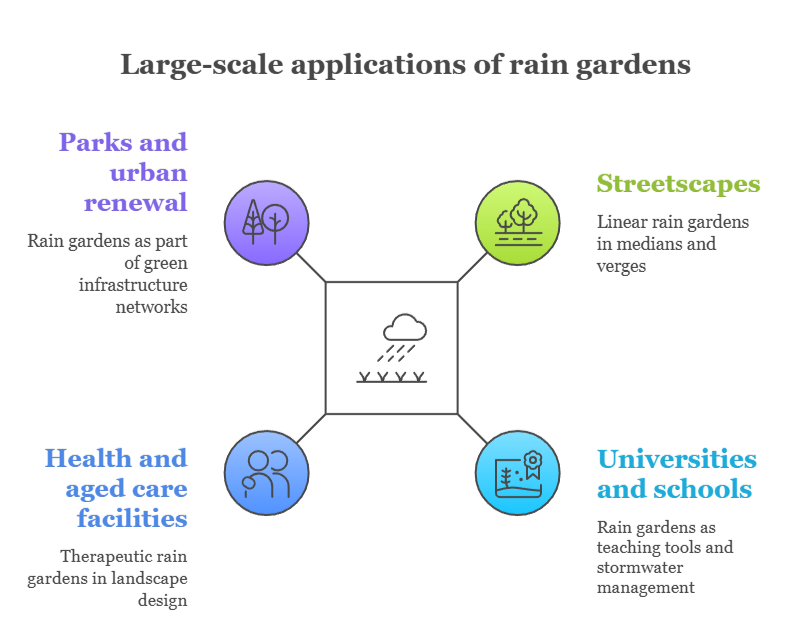
Large-scale applications include:
- Streetscapes, where linear rain gardens treat road runoff in medians and verges
- Universities and schools, where rain gardens manage stormwater and double as teaching tools
- Health and aged care facilities, where rain gardens are built into therapeutic landscape design
- Parks and urban renewal precincts, where rain gardens form part of a wider green infrastructure network
On large projects, Building Information Modelling (BIM) supports design and coordination. Smart sensors track rain garden performance in real time. This allows for proactive maintenance and evidence-based reporting for sustainability certifications.
FAQ
How long does a rain garden take to drain?
A well-designed rain garden drains within 24–48 hours of a rainfall event. Water remaining in the garden longer than 48 hours indicates insufficient drainage. This results from growing media clogging, a high water table, or undersized underdrainage, and should be investigated.
Do rain gardens attract mosquitoes?
A working rain garden drains within 24–48 hours, which isn't long enough for mosquitoes to complete their life cycle. Eggs can hatch in that time, but larvae need several more days in water to mature into adults. Standing water after 48 hours points to a maintenance or design issue, like clogged growing media or a high water table, and should be investigated.
Can a rain garden work on a sloped site?
Yes, with the right design. The garden is usually cut into the slope and bermed on the downhill side to create a level ponding zone. The inlet and overflow need careful design, and the inlet needs erosion protection.
Are rain gardens required by planning regulations in Australia?
Rain gardens aren't named in Australian planning regulations as a strict requirement. But they help meet the WSUD outcomes that planning schemes require for medium and large developments.
Council permits often set stormwater quality and quantity targets that rain gardens can satisfy. A landscape architect or WSUD consultant can assess which rules apply to your site.
What is the difference between a rain garden and a swale?
A rain garden is a depressed planted zone designed for temporary ponding and infiltration. A swale is a broad, shallow channel designed to move stormwater slowly across a site while allowing some infiltration. Swales move water from one point to another; rain gardens hold water in one place and treat it.
Both are WSUD tools and are often used together — a swale directing runoff into a rain garden is a common design combination.
About Evergreen Infrastructure
Evergreen Infrastructure delivers rain garden and WSUD projects end-to-end. That covers consulting, design, project management, asset management, and compliance reporting.
Our team includes green infrastructure specialists qualified in urban horticulture and therapeutic landscape design. Notable projects include the Victorian State Treasury Building green roof and the Federation Square biodiversity green roof in Melbourne.
We use BIM, smart irrigation, and digital monitoring to track performance and cut long-term maintenance costs.
Get in touch to discuss your project's WSUD requirements and how a rain garden can help you meet planning, Green Star, or ESG goals.
{{cta}}
We create green oases in urban settings
We'd love to discuss how we can partner to bring innovative, sustainable solutions to your urban environment.