.webp)


Green stormwater infrastructure (GSI) manages urban runoff using vegetated systems. These include bioretention cells, green roofs, wetlands, permeable pavements, swales, and green walls. In Australia, these systems help developments meet WSUD pollutant reduction targets. They typically cost less than conventional drainage. GSI offers extra benefits that grey infrastructure can't provide. GSI can be retrofitted into existing areas and fit most project types.
Green stormwater infrastructure (GSI) captures, filters, and releases urban stormwater runoff. It uses growing media, vegetation, and natural processes to slowly release water back into the environment. It mimics the natural water cycle instead of sending water into pipes and drainage channels.
Green stormwater infrastructure is used widely across Australian cities. It sits within the broader Water Sensitive Urban Design (WSUD) framework.
WSUD aims to capture, treat, and reuse stormwater before it can pollute creeks and rivers. Most state planning schemes now require WSUD compliance as a condition of development approval.
What is green stormwater infrastructure?
Green stormwater infrastructure (GSI) is a set of nature-based systems that capture stormwater at the source. These systems allow some stormwater to infiltrate into the ground and remove the rest. The removal happens through a process called evapotranspiration.
Green stormwater infrastructure systems sometimes also release water back into the drainage network. The release is slow and controlled, which helps reduce peak flows downstream.
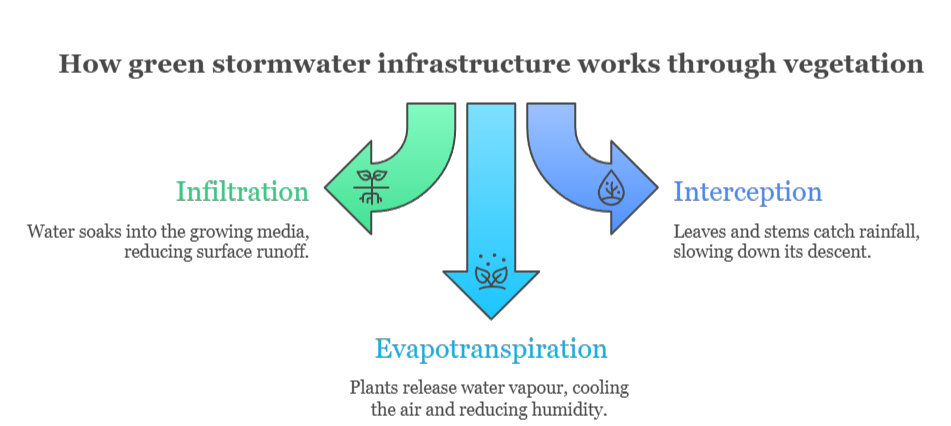
Vegetation is central to how green stormwater infrastructure works. A 2021 Sydney Water report explains how plants drive three key processes. These include:
- Infiltration — water soaks into the growing media instead of running off the surface
- Interception — leaves and stems catch rainfall before it reaches the ground
- Evapotranspiration — plants release water vapour into the air through their leaves
The contrast between green stormwater and conventional grey infrastructure is direct. Grey systems (pipes, kerbs, gutters, and detention basins) are built to move water away from the built environment as quickly as possible.
Green stormwater infrastructure treats water where it falls. It delivers co-benefits that grey infrastructure can't. This includes urban cooling, biodiversity support, and improved community amenity.
What types of green stormwater infrastructure are used in Australia?
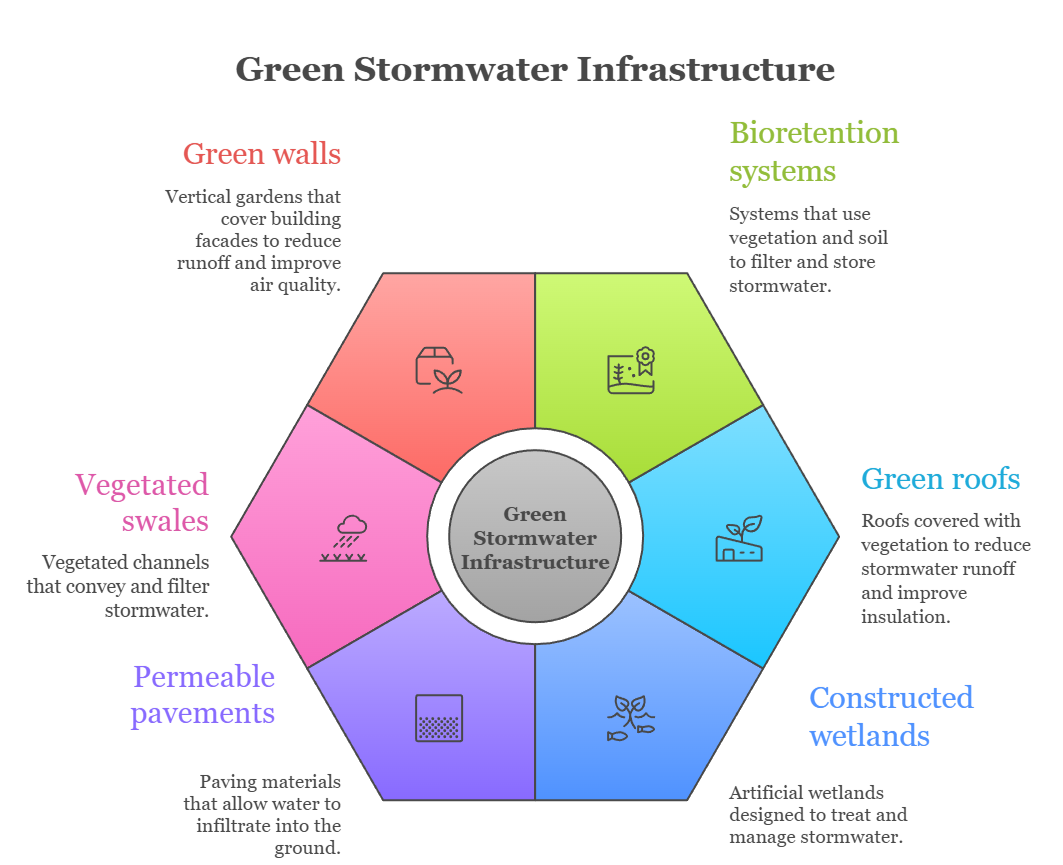
Australia uses six main types of green stormwater infrastructure (GSI). You'll find these GSI systems across residential, commercial, and public-realm projects. They include:
- Bioretention systems
- Green roofs
- Constructed wetlands
- Permeable pavements
- Vegetated swales
- Green walls
Bioretention systems
Bioretention systems are planted cells that filter stormwater through an engineered growing media layer. They're also commonly called rain gardens.

The WSUD 01 guideline by Water Sensitive SA (January 2020) sets out sizing requirements for rain gardens in South Australia. According to this guide, a rain garden should cover 0.5–2.0% of its contributing catchment area.
Water Sensitive SA also published the Bioretention Systems summary sheet in December 2010. It recommends that filter media have a saturated hydraulic conductivity of 100–300 mm/hr, with a preferred range of 150–350 mm/hr.
In a bioretention system, a transition layer of coarse sand or fine gravel sits between the filter media and the drainage layer. This layer prevents fine particles from migrating downward and clogging the under-drain.
According to FAWB/Monash University (2009), bioretention filter media is typically designed to a depth of 400–600 mm. It also has a hydraulic conductivity of 100–300 mm/hr and a specified organic matter content. These properties together determine the system's water holding and storage capacity.
Green roofs
A green roof is a vegetated roof assembly that retains rainfall in its substrate and drainage layers. Excess runoff is then released slowly into the drainage system.
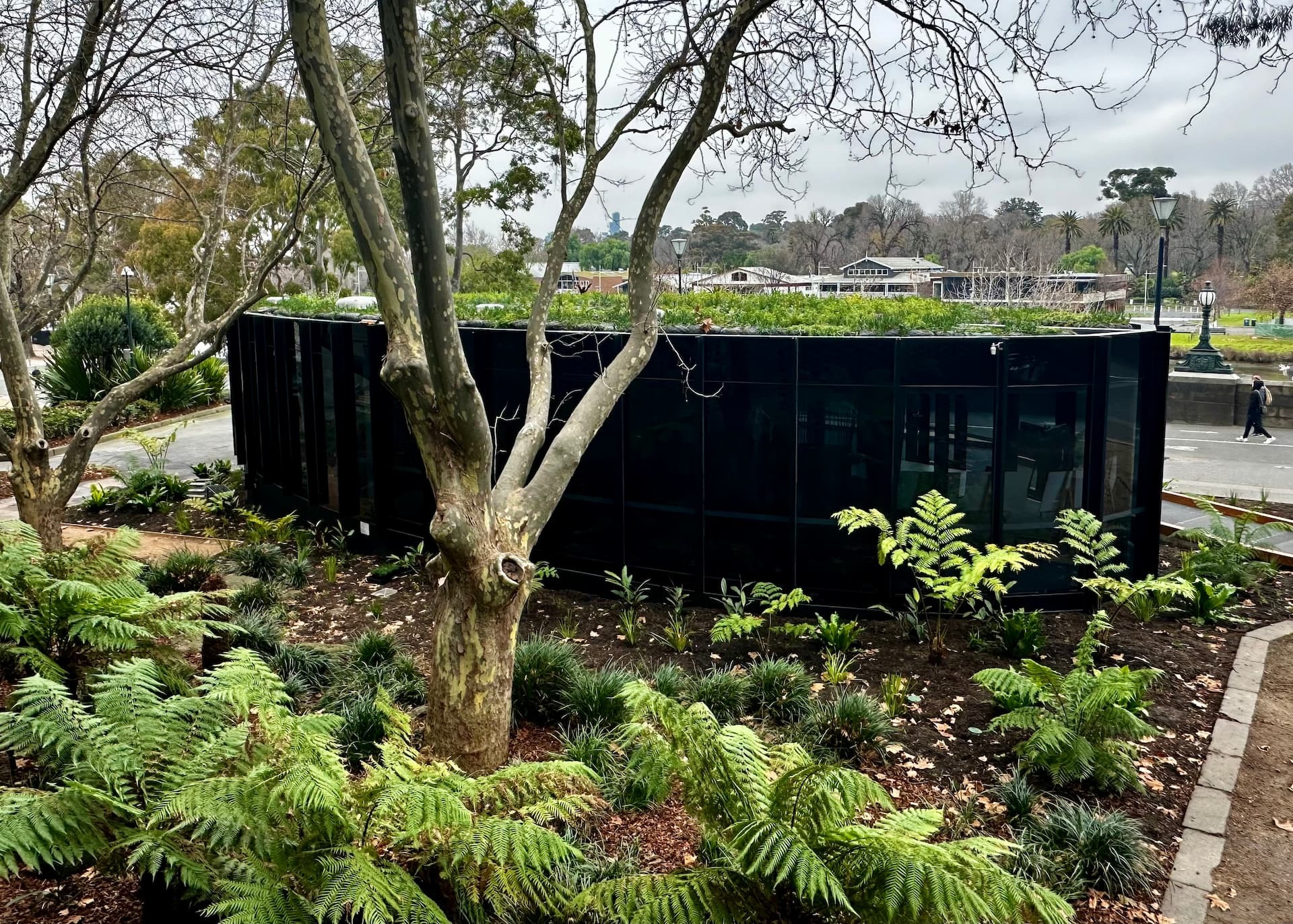
A three-year study by Van Seters et al. (2009) monitored a green roof at York University in Toronto. The roof discharged 63% less runoff than a neighbouring conventional roof.
A green roof's stormwater retention depends mainly on its water storage capacity, which is set by substrate depth. A 2021 Sydney Water review of 55 green roof assets found that retention varied widely. The median was 56%, with results ranging from 11% to 77% depending on design and climate.
In Greater Adelaide, the WSUD 01 guideline by Water Sensitive SA (January 2020) recommends a deeper substrate of 150–600 mm. This depth suits local climate conditions.
{{cta}}
Constructed wetlands
Constructed wetlands are engineered shallow water systems planted with aquatic vegetation. They are designed to slow, filter, and treat urban stormwater runoff. This removes nutrients and sediment before they reach local creeks and waterways.
Constructed wetlands are widely used across Australian cities. They are used as standard WSUD infrastructure to detain, retain, and treat urban runoff. They're among the most common technologies in stormwater harvesting schemes.
Permeable pavements
Permeable pavements allow rainfall to move through the surface and into the sub-base. From there, water flows into the underlying growing media or a controlled drainage layer.
A 2009 paper by Ball and Rankin found that permeable pavements can dramatically reduce stormwater runoff. Their field study showed near-complete elimination of surface runoff for most storm events. However, they note that effectiveness depends on design and site conditions.
Vegetated swales
Swales are shallow, planted channels that slow, convey, and treat runoff before it enters the piped network.
A MUSICX modelling study simulated the performance of a vegetated swale network in Aldinga, South Australia. The results showed over 99% removal of total suspended solids, nitrogen, phosphorus, and gross pollutants. The swale network also achieved a 99.09% reduction in runoff volume.
Green walls
Green walls capture rainfall on vertical surfaces. Plants then absorb the water and release it through evapotranspiration.
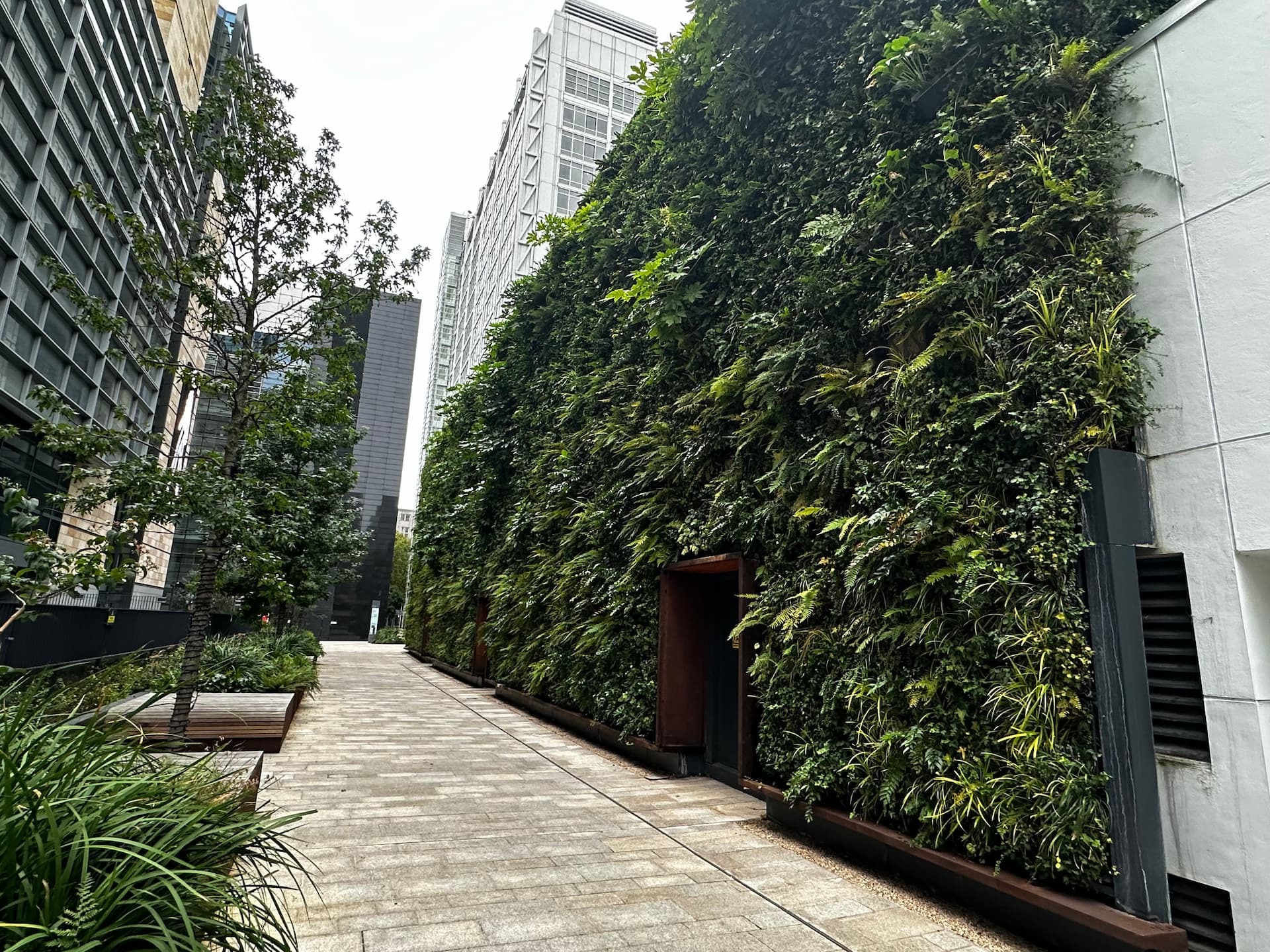
A 2019 Water Research study by Prodanovic et al. examined green walls in a temperate-oceanic climate, common in parts of Australia. The study found that plant uptake and transpiration dominate in summer. This resulted in three to four times higher water needs than during winter, when evaporation is a major factor.
Designers must account for this seasonal variation when specifying irrigation and drainage.
What pollutant removal targets must green stormwater infrastructure meet in Australia?
In South Australia, Water Sensitive SA's WSUD guideline sets stormwater quality targets. These targets require developments to reduce annual pollutant loads by:
- 80% for total suspended solids
- 60% for total phosphorus
- 45% for total nitrogen
- 90% for gross pollutants
These reductions are measured compared with untreated runoff.
Greater Adelaide councils use these targets to assess stormwater quality in development applications. They are typically met through appropriately designed WSUD measures. These include bioretention systems, swales, and wetlands.
Is green stormwater infrastructure cost-effective compared to conventional systems?
Green stormwater infrastructure is cost-effective.
A U.S. EPA review compared green and conventional stormwater designs across 12 projects. Eleven of the projects achieved cost savings, with average capital cost reductions of about 35%.
Green infrastructure also produces multiple co-benefits that grey infrastructure cannot. As outlined in a 2025 review of green and blue-green infrastructure benefits and trade-offs, these systems support:
- Flood mitigation
- Water quality improvement
- Air quality improvement
- Urban heat island reduction
- Biodiversity
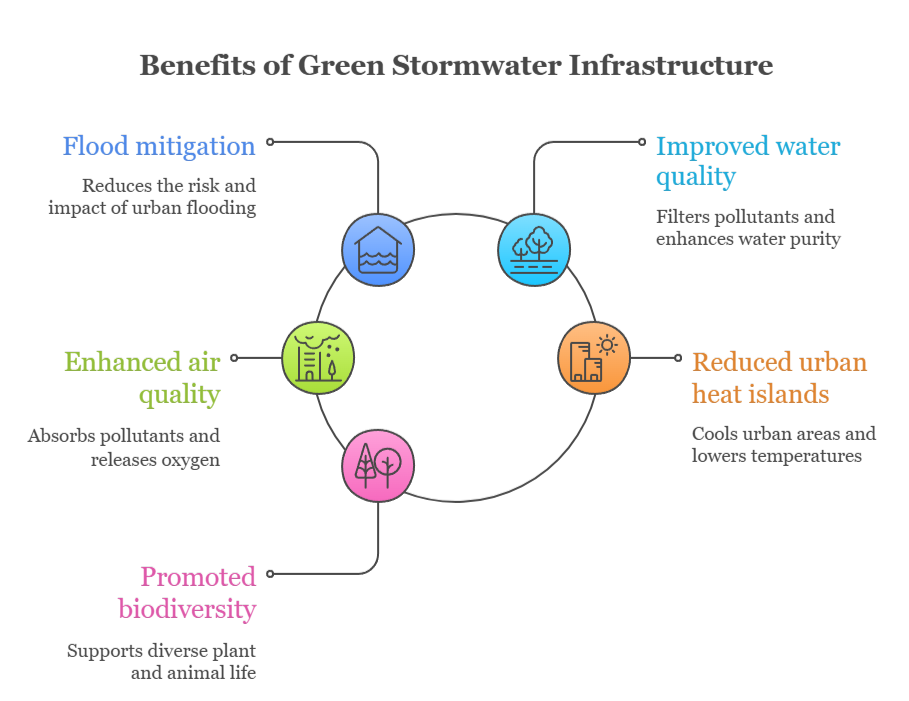
These co-benefits strengthen the financial case because they cut costs elsewhere. This includes cooling energy, health services, and downstream water treatment.
A 2023 NSW Government report found that green infrastructure cuts costs. This happens through reduced stormwater servicing and water filtration needs. It also improves water quality by lowering stormwater volumes entering waterways.
What are the ongoing maintenance requirements and costs?
Green stormwater infrastructure needs regular inspection and vegetation management. Sediment removal and irrigation system checks are also necessary.
Green infrastructure maintenance costs vary by system type. Wave Consulting (2022) reports that green wall maintenance in Australia costs approximately $30/m² per year. Specialised asset management can deliver significant budget savings.
In practice, the costs of green stormwater infrastructure vary significantly between system types. It depends on factors such as design complexity, project scale, and local site conditions.
Well-designed systems keep the maintenance burden low. Smart irrigation and digital monitoring can cut labour. They also alert managers to system faults before they affect performance.
Maintenance obligations should be set out in an operations and maintenance (O&M) manual. Many councils require this manual as a condition of development approval.
What regulations and guidelines govern green stormwater infrastructure in Victoria?
Victoria's Department of Environment, Land, Water and Planning has published Planning a Green-Blue City. This is a how‑to guide for planning urban greening and enhanced stormwater management in Victoria.
The guide sets out a framework for green infrastructure and stormwater management. It can be applied across different urban contexts, including:
- Waterways
- Green corridors
- Residential streets
- Parks
- Retail centres
Australian Rainfall and Runoff (ARR) is the national guideline for design flood estimation in Australia. It was first published by Engineers Australia in 1958 and is now maintained by Geoscience Australia.
Recent editions (ARR 2016–2019) reflect contemporary urban stormwater practice. This includes risk‑based design and approaches consistent with water sensitive urban design.
Community acceptance is also a documented consideration.
The Goyder Institute for Water Research conducted a study using six South Australian case studies. The goal was to investigate community acceptance of WSUD. The study identified what helps or hinders WSUD uptake.
Can green stormwater infrastructure be retrofitted into existing urban areas?
Green stormwater infrastructure can be retrofitted into existing urban environments. Established Australian cities have added GSI through road renewal projects. They added rain gardens, street trees, and permeable pavements without redeveloping surrounding lots.
Water Sensitive SA recommends sizing rain gardens at 0.5–2.0% of the contributing catchment area. This rule means that effective systems can be compact.
Green roofs and green walls are vertical or rooftop interventions. They add green stormwater infrastructure capacity without using ground-level space.
The key constraint in retrofitting is site assessment. Growing media type, water table depth, and existing drainage infrastructure all affect which GSI types are viable. A thorough site investigation must come before any retrofit design.
FAQ
What is the difference between green stormwater infrastructure and WSUD?
Water Sensitive Urban Design (WSUD) is a planning and design framework. Green stormwater infrastructure is the set of physical systems used to deliver WSUD outcomes. WSUD sets the policy objectives, such as reducing pollutant loads by 45–90%, and GSI systems are the tools used to meet those objectives.
Do green roofs count as stormwater infrastructure in Australian planning schemes?
Green roofs count as stormwater infrastructure in most Australian planning contexts. They retain rainfall in their substrate layers and slow peak runoff rates. They also support evapotranspiration.
How do you choose between a rain garden, swale, and constructed wetland for a site?
The choice depends on catchment size, available land, slope, and the required level of treatment. Rain gardens suit small to medium catchments and tight urban lots. Swales suit linear sites such as streetscapes and road corridors where water can be conveyed along the surface.
Constructed wetlands suit larger catchments where flow volume can sustain a permanent water body. They work best where nutrient removal is the main goal.
Is green stormwater infrastructure suitable for commercial and institutional sites?
Green stormwater infrastructure suits commercial, institutional, educational, and health sector sites. These projects often have large impervious roof areas that produce significant runoff volumes. This makes green roofs, bioretention, and permeable pavements directly applicable. GSI on these sites also supports Green Star ratings, ESG reporting, and SDG alignment requirements.
Making the shift to green stormwater infrastructure
Green stormwater infrastructure gives Australian cities a practical way to manage urban runoff. It also delivers benefits that conventional drainage cannot.
Different green stormwater infrastructure systems suit various sites and treatment goals. All of them work with natural processes rather than against them.
The question is no longer whether to use green stormwater infrastructure. It's which combination of systems best fits the site, the catchment, and the regulations.
Evergreen Infrastructure can help you find the answer. Our team designs, delivers, and maintains green stormwater infrastructure across Australia. We work with developers, councils, and asset owners from early site assessment through to long-term O&M.
Get in touch to discuss your project.
{{cta}}
We create green oases in urban settings
We'd love to discuss how we can partner to bring innovative, sustainable solutions to your urban environment.