.webp)

Urban heat islands form when dark, built surfaces absorb solar energy and release it slowly. They push city temperatures 1–3°C above surrounding rural areas with deadly consequences. Different solutions can reverse this: green roofs, green walls, urban trees and forests, Water Sensitive Urban Design, and cool reflective roofs. Each uses cooling through mechanisms like evapotranspiration, shading, and high albedo. They work best in combination.
Urban heat islands form where hard, dark surfaces trap solar energy. That energy is slowly released overnight. The urban heat island (UHI) effect pushes city temperatures well above those of surrounding rural areas.
There are many heat island effect solutions that can help reverse this process. These include green roofs and green walls. Urban trees, reflective cool roofs, and water-sensitive design are also effective options.
This article explores how these design interventions work. It covers how serious the problem has become in Australia and what is necessary to combat it.
What causes the urban heat island effect?
The urban heat island effect occurs when built surfaces absorb and retain far more heat than the vegetated land they replace. Roads, rooftops, and concrete walls have high thermal mass and low albedo. In other words, they heat quickly under direct sunlight and cool slowly overnight.
This effect keeps city air temperatures typically 1–3°C warmer than surrounding rural areas. Surface temperatures on dark pavements and rooftops are often far higher.
Three physical processes drive the heat island effect:
- Heat-absorbing surfaces
- Loss of evapotranspiration
- Urban canyon geometry

Dark, low-reflectance materials absorb solar radiation and re-radiate it as heat. Urban surfaces sometimes run well above surrounding air temperatures.
Vegetation cools the air by drawing moisture from the soil and releasing it through leaves. Sealed surfaces eliminate this natural cooling process.
Urban canyon geometry refers to the channelling effect of streets lined by tall buildings. They trap warm air and restrict airflow. This reduces convective cooling and prevents nighttime heat loss.
The 2009 Victorian heatwave showed what happens when these forces combine. Maximum temperatures reached 12–15°C above normal for five consecutive days. An estimated 374 excess deaths occurred, and climate change caused by humans raised that death toll by 20%.
What are the most widely used heat island solutions?
The most widely used heat island solutions are green roofs, green walls, and urban trees and forests. Water Sensitive Urban Design and cool roofs with reflective materials are also effective.
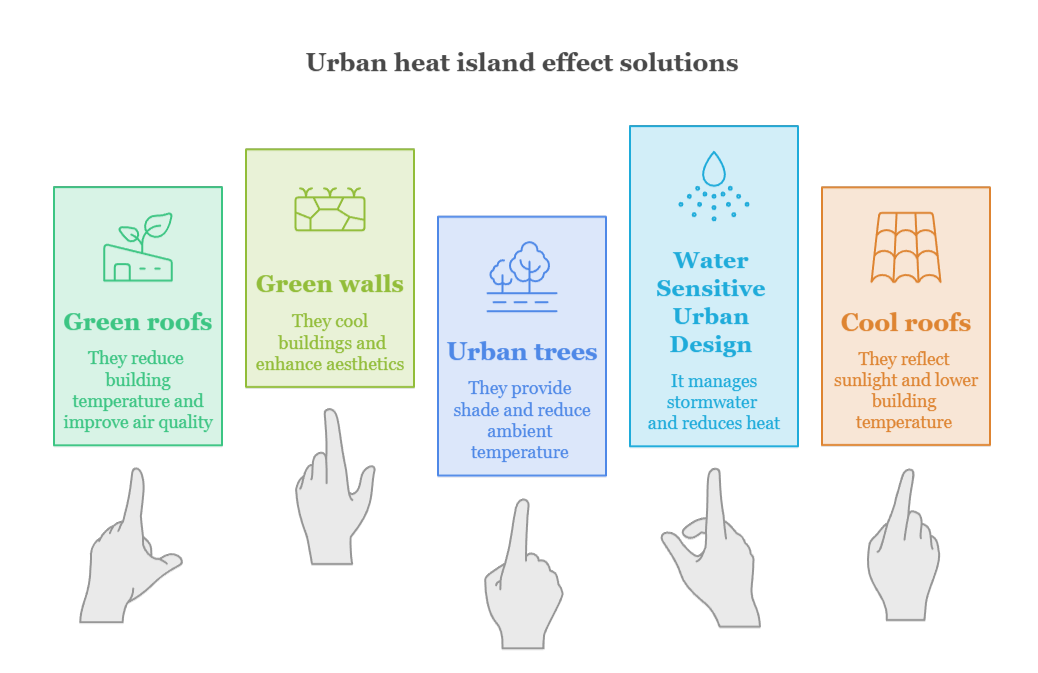
Each works through a different mechanism. Combining them produces greater cooling than any single measure alone.
Green roofs
Green roofs reduce the heat island effect by replacing regular roofs with living vegetation.
Research in Melbourne found that a green roof reduced roof-level daytime air temperature by 1.5°C on a hot day. The same study found it improved rooftop thermal comfort by 2.38°C.
A typical green roof assembly can include up to seven distinct layers:
- Waterproofing membrane
- Root barrier
- Drainage layer
- Water-retention layer
- Filter fabric
- Growing media
- Vegetation
Many extensive green roof substrates use mixes of about 20% organic and 80% mineral material.
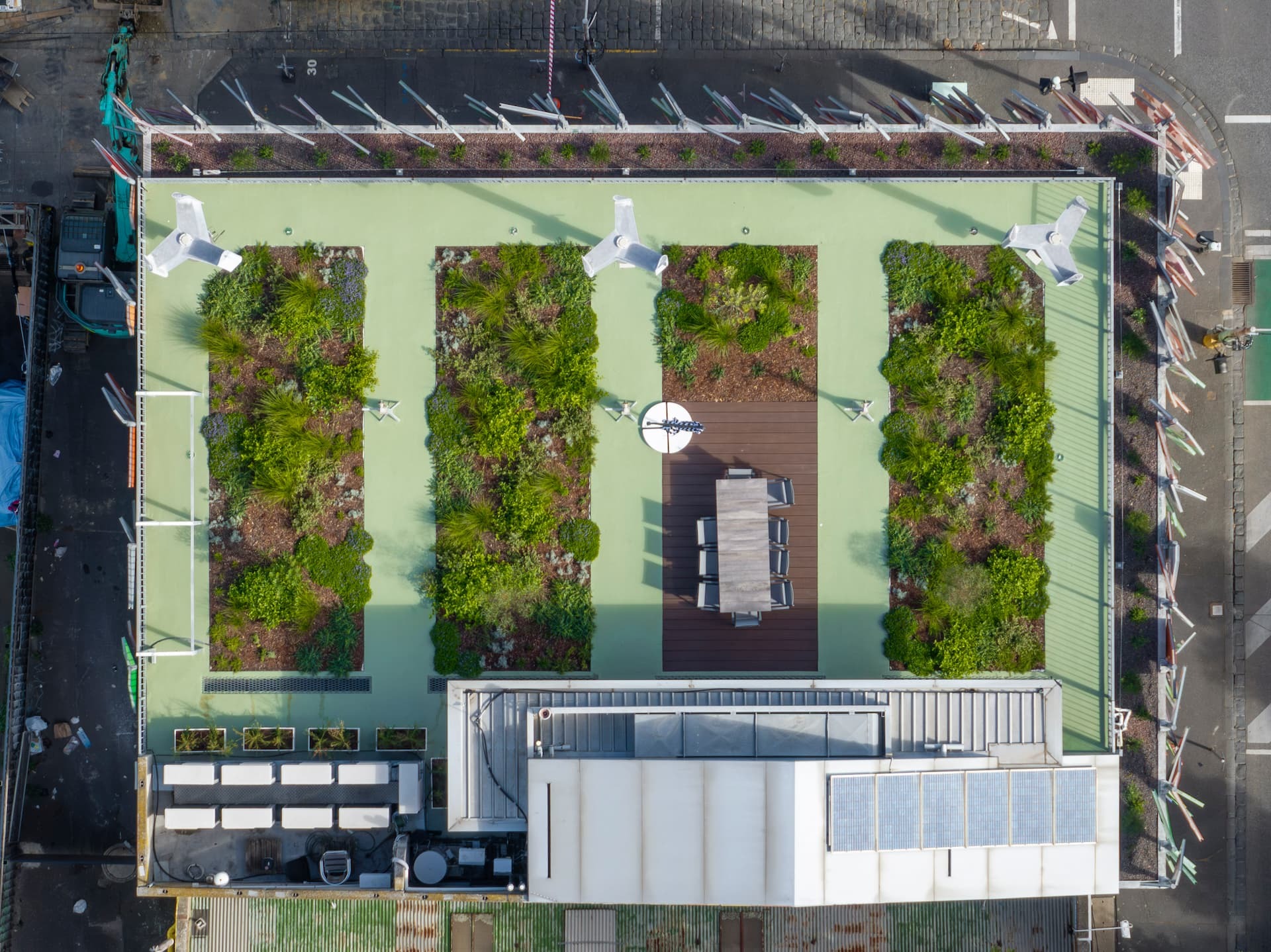
Green roofs also reduce stormwater runoff. According to the US Environmental Protection Agency, extensive green roofs can reduce roof runoff by around 60%. Intensive systems can reduce it by up to 100%, depending on rainfall patterns and design.
In Adelaide, green roofs showed significant cooling effects in summer. They also acted as an insulation layer to keep buildings warmer in winter, according to Urban Forestry & Urban Greening.
Green walls
Green walls reduce heat gain through north-facing façades, which receive the highest solar load in Australian cities. They also help with west-facing façades, which experience the most intense late-afternoon sun.
Research done in 2021 by Daemei et al. looked at façade greening. It showed that summer heat gains through façades with green walls can decrease by about 97%. On the other hand, heat loss is reduced by around 30%.
Green walls fall into three main types:
- Green façades with direct climbers
- Green façades with indirect climbers on a support structure
- Modular living walls with planter modules
Green façades with direct climbers use plants rooted at ground level, attached directly to the building surface. This approach has the lowest cost and maintenance.
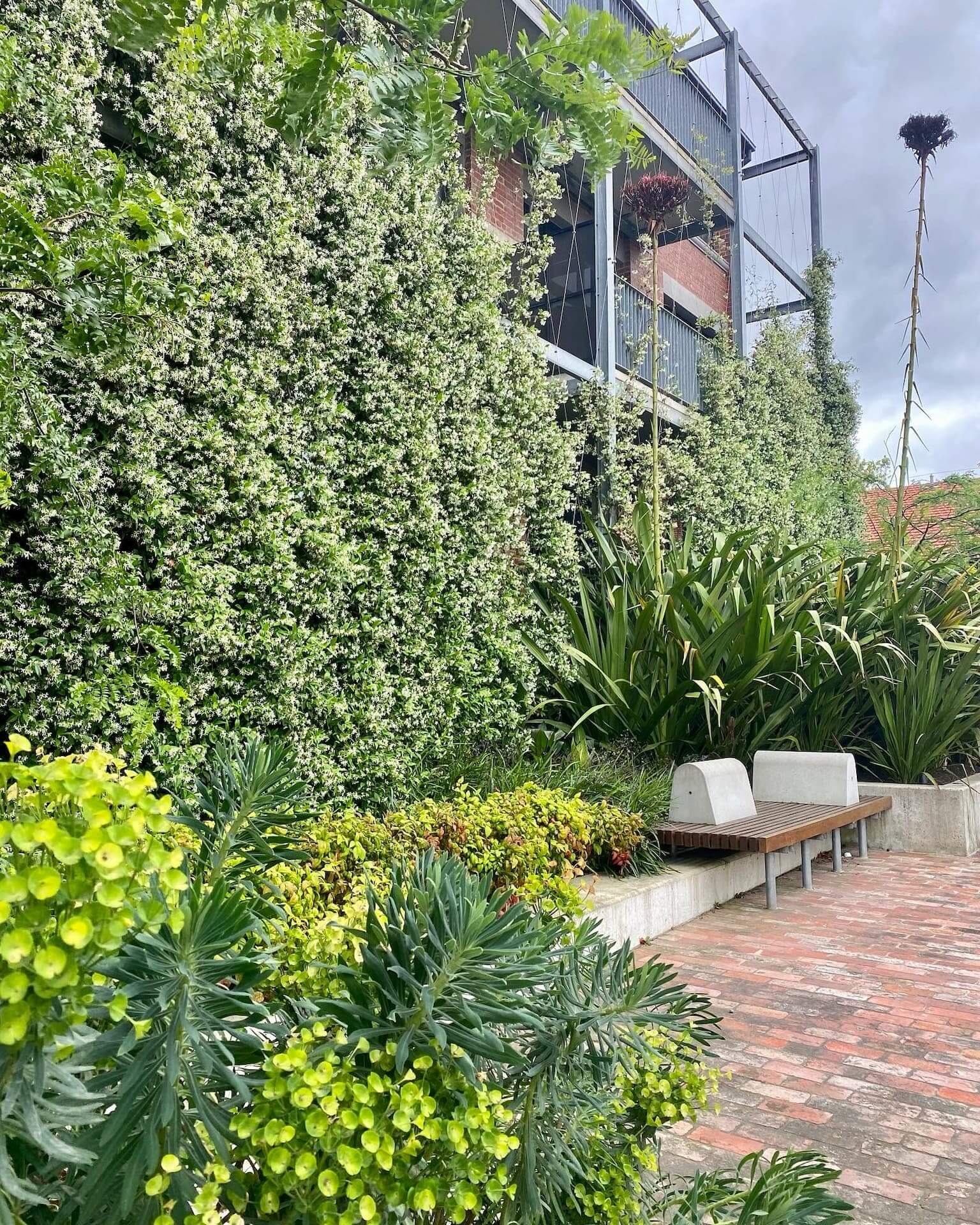
Green façades with indirect climbers use plants rooted at ground level that grow up trellis systems attached to the building. This has a lower cost and maintenance than living walls.
Modular living walls use panels filled with growing medium and plants. They're mounted directly to the façade with integrated irrigation. They deliver higher planting density and greater thermal performance than green façades.
Urban trees and forests
Urban trees and forests are among the most effective nature‑based solutions for reducing urban heat. They offer substantial cooling benefits and could be expanded across many neighbourhoods.
Current global urban tree cover mitigates 41–49% of the maximum potential air-temperature UHI effect. This is the effect that would occur in the absence of trees.
Areas with a healthy urban forest can have surface ground temperatures up to 6°C lower than cleared areas.
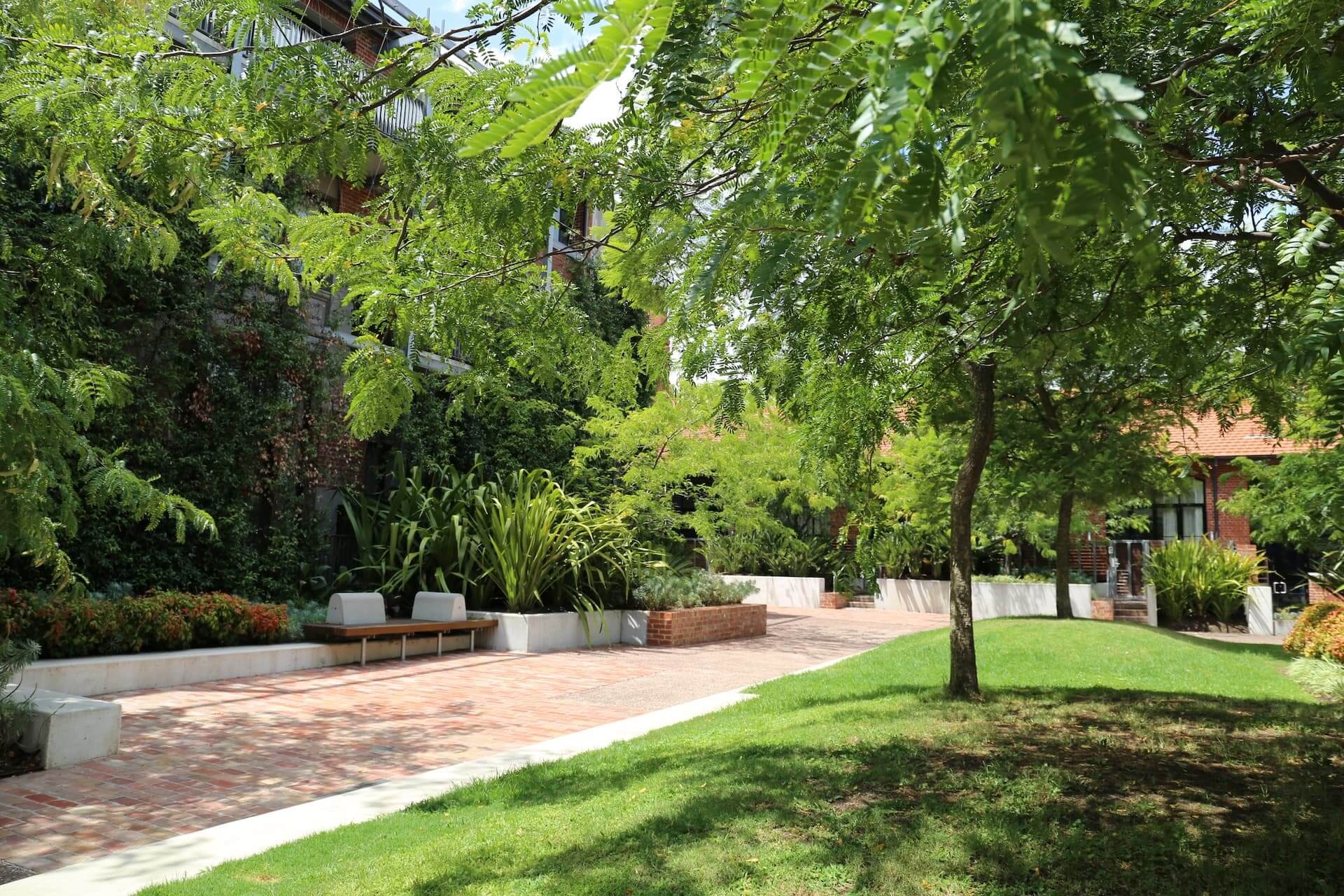
A 2023 study by Zhao et al. examined tree canopy across 806 cities worldwide. It found that increases in tree canopy are associated with midday reductions in land surface temperature of around 1.5°C on average.
Australian cities have set measurable canopy targets in response:
- Melbourne: targeting an increase in tree canopy from 22% in 2014 to 40% by 2040 (City of Melbourne, 2014).
- Sydney: targeting 40% green cover, including a minimum of 27% tree canopy by 2050 (Bloomberg New Economy, 2023).
- City of South Perth: maintaining existing canopy cover (City of South Perth, 2018).
Water Sensitive Urban Design
Water Sensitive Urban Design (WSUD) is a planning approach that manages water to cool cities. It combines stormwater management with urban cooling by keeping water in the landscape. WSUD features include:
- Rain gardens
- Bioswales
- Constructed wetlands
- Permeable surfaces

The Cooperative Research Centre for Water Sensitive Cities (2016) found that sites near water bodies were up to 1.8°C cooler during the day. With irrigation in place, modelling showed daily average temperatures dropped by up to 2.8°C during heatwaves.
WSUD is a widely adopted planning approach in Australian development. Combining it with green roofs and urban forests creates blue–green networks that cool more than any element alone.
Cool roofs and reflective surfaces
Cool roofs are light-coloured or specially coated roofs. Rather than absorbing solar radiation, cool roofs reflect it.
UNSW Sydney research showed that cool roofs can reduce peak ambient temperature significantly. The reductions were 2.4°C in Sydney and 2.1°C in Melbourne. The reduction reaches 2.5°C in Brisbane.
A comparative 2018 study by Imran et al. found that cool roofs are more efficient than green roofs in reducing the UHI effect. This finding was made at city scale. Maximum temperature differences reached up to 1.4°C during a Melbourne heatwave.
How do therapeutic landscapes contribute to heat island reduction?
Therapeutic landscapes create cool refuges that can help combat the heat island effect. They combine tree shade, water features, and diverse planting. They can be used in healthcare, aged care, and educational settings.
Hospital gardens are increasingly included in developments because they can reduce stress. According to this 2023 research by Nieberler-Walker et al., they can also support patient recovery.
During heatwaves, outdoor green spaces on hospital campuses serve as shaded retreats. Adding other cooling elements to these gardens improves their function. For instance, high-albedo paving, shade trees, and water features.
WRI's Cool Cities Lab found that urban trees can improve thermal comfort by 2–8°C. In therapeutic settings, they can reduce the risk of heat stress for older adults and people with chronic illnesses. They also benefit those who are most vulnerable to extreme heat.
Using Water Sensitive Urban Design in therapeutic gardens combines cooling with green space. Captured water feeds irrigation. Bioretention basins serve as landscape features within this approach.
What does Australian policy require for urban heat island mitigation?
Australian policy on the urban heat island effect is becoming clearer and more structured. Local governments are:
- Setting canopy and green cover targets
- Embedding WSUD and greening requirements into planning controls
- Publishing formal action plans that commit to specific green infrastructure measures
Moreland City Council's Urban Heat Island Effect Action Plan treats green infrastructure as a primary response. It focuses on vegetation, trees and Water Sensitive Urban Design (WSUD). It also identifies cool roofs and other cool materials as key opportunities for further mitigation.
Research by Bush et al. (2023) proposed four priority pathways for mainstreaming nature-based solutions in Australian cities. These include:
- Addressing changing climate conditions and climate extremes, including heat and drought
- Embedding an ecology and biodiversity focus (including threatened species and the risk of "ecological traps")
- Localising approaches that bring together local knowledge, research, and practice
- Foregrounding Indigenous knowledges and custodianship as decolonising approaches
Brisbane's Clean, Green, Sustainable strategy commits to providing shade for 100% of public playgrounds. This is a direct response to the urban heat island effect.
For property developers and building owners, this policy momentum has practical consequences. Several requirements are now common features of development approvals:
- Planning permit conditions
- WSUD compliance requirements
- New canopy protection and replacement controls (in Victoria)
What happens if Australian cities fail to act on urban heat?
Without more green cover, conditions could become increasingly unlivable. By 2060–2080, Sydney's hottest days could regularly top 50°C, made worse by urban heat island effects in areas with low tree canopy. Climate change is a key driver of these projections.
Even with global warming limited to 2°C, heatwaves in major Australian cities could approach 50°C by the 2040s.
A 2023 modelling study by Iungman et al. looked at 93 European cities. It found that hotter urban temperatures from the heat island effect caused about 6,700 premature summer deaths in 2015. Raising urban tree cover to 30% could have prevented around a third of these, roughly 2,600 deaths.
Heat risk is also a spatial equity issue. Low-income neighbourhoods consistently have less tree canopy and fewer parks. As a result, they have more heat-absorbing surfaces than wealthier suburbs.
Designing and funding heat island solutions must prioritise the hottest, least-vegetated communities.
FAQ
How much can a green roof reduce ambient temperature?
Green roofs can help lower ambient air and surface temperatures by providing shade and cooling. They can also improve thermal comfort in surrounding areas and reduce the amount of heat absorbed and released by buildings.
The extent of cooling depends on factors such as climate, vegetation type, and roof design. It also depends on how widely green infrastructure is used and how well it is combined with other urban greening measures.
Are cool roofs better than green roofs for reducing urban heat?
Cool roofs reduce peak ambient temperatures more efficiently than green roofs at city scale. Green roofs, however, provide extra benefits that cool roofs do not. This includes stormwater retention, biodiversity, insulation in winter, and amenities for building occupants.
Combining both approaches delivers stronger overall outcomes than either measure alone.
What is WSUD, and why does it matter for urban heat?
WSUD stands for Water Sensitive Urban Design. It is a planning framework that keeps water in the landscape. It's done through rain gardens, bioswales, wetlands, etc.
With irrigation, modelling showed that the daily average temperature could be reduced by up to 2.8°C during heatwave conditions.
In many Australian jurisdictions, WSUD is now embedded in planning schemes. WSUD responses are a standard requirement for many types of development rather than an optional add‑on.
How much tree canopy does a city need to reduce urban heat?
Increasing tree canopy cover can help reduce urban heat by providing shade and cooling. Many cities have established urban greening targets to increase tree canopy and other forms of vegetation.
However, the effectiveness of tree canopy in reducing urban heat depends on different factors. For example, canopy extent, tree species, urban density, and long-term maintenance.
Do green walls actually cool buildings?
Green walls can meaningfully cool buildings by shading facades from direct sunlight. They also reduce surface and nearby air temperatures through evapotranspiration.
Their effectiveness depends on design factors. For example, plant density, irrigation, and the distance between the planting layer and the wall.
Living green walls with real plants provide much greater cooling benefits than artificial green walls. Artificial ones offer shade but do not provide evaporative or biological cooling.
Combating the urban heat island effect
The urban heat island effect is no longer a distant concern. It's a present-day threat to the liveability of Australian cities. Rising temperatures drive heat stress, premature deaths, and inequity between neighbourhoods.
The good news is that proven solutions already exist. These are green roofs, green walls, urban trees, Water Sensitive Urban Design, and cool reflective surfaces. Combining them creates blue–green networks far more effective than any single measure.
Ready to cool your development and future-proof it against rising temperatures? Evergreen Infrastructure designs and delivers tailored heat island solutions.
This includes living green roofs, green walls, and Water Sensitive Urban Design. Our projects meet planning requirements while creating healthier, more comfortable spaces.
Get in touch with the Evergreen Infrastructure team today to find out how we can help your project beat the heat.
{{cta}}
We create green oases in urban settings
We'd love to discuss how we can partner to bring innovative, sustainable solutions to your urban environment.